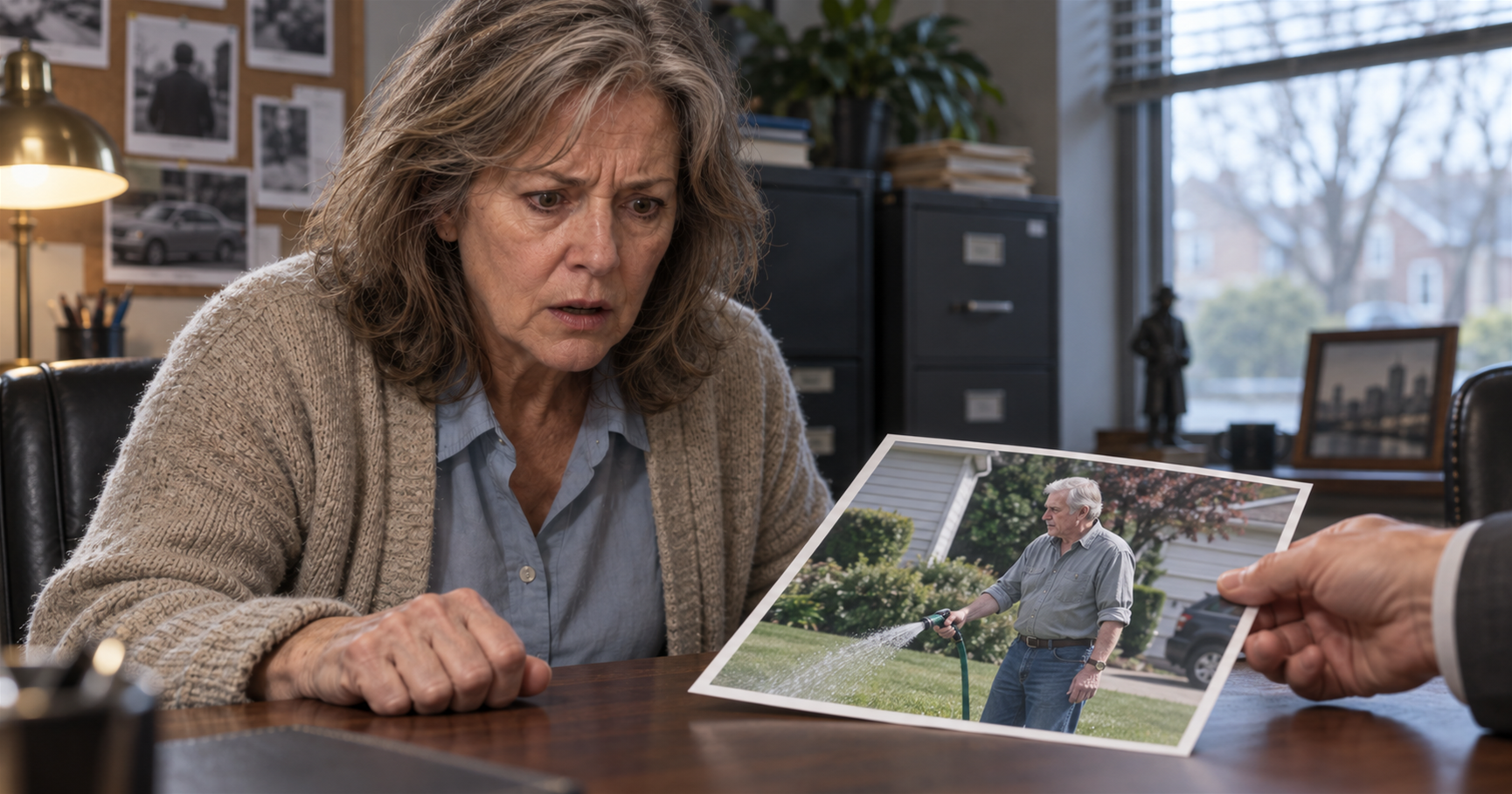
"My husband disappeared in 2005. On my birthday, I received a card that said "LOOK IN THE BASEMENT."" Chapter 1
Chapter 1
The Card Under the Door
The card arrived on the morning I turned sixty-four.
There was no stamp, no postmark, and no return address. Someone had pushed the plain white envelope beneath my front door, where it lay among a grocery circular and the electric bill.
Only my name appeared on the front.
Eleanor.
The handwriting made me forget the kettle screaming in the kitchen.
The capital E leaned too far to the right. The final r ended in a small upward hook, as if the writer had changed his mind about stopping. I had watched that hand fill out birthday cards, permission slips, grocery lists, and twenty-three years' worth of notes tucked into my lunch bag.
Don't forget your umbrella.
Grace called. She passed chemistry.
I already miss you.
Thomas Carter had written those notes.
Thomas Carter had also been missing since June 21, 2005.
I turned off the stove before the kettle boiled dry. Then I stood over the envelope with one hand pressed to the counter and told myself that memory was an unreliable thing.
Twenty years could turn any slanted handwriting into his.
Twenty years could make a widow see ghosts.
Except I was not legally a widow. No body had ever been recovered, and I had never asked a court to declare Thomas dead. On forms, I still checked married when there was no box for abandoned by a man the river refused to return.
I picked up the envelope.
The paper was cool. The flap had been sealed with a narrow strip of clear tape, exactly the way Thomas used to close envelopes after complaining that glue never worked properly.
My thumb shook as I opened it.
Inside was a cheap birthday card covered in watercolor daisies. The printed message wished me peace and joy. I almost laughed.
Then I opened it.
Happy birthday, Eleanor.
I never really left.
LOOK IN THE BASEMENT.
The card slipped from my fingers.
For several seconds, the room made no sound except the clock above the stove. I stared at those four words in capital letters until they seemed to lift from the paper.
The police had found Thomas's Buick on a dirt turnout above the Monongahela River. His wallet, phone, keys, and wedding ring were arranged on the passenger seat. There were no signs of a struggle. Heavy rain had swollen the river that week, and the search teams said the current could carry a body for miles.
They called it a probable suicide.
Grace and I held a memorial in front of an empty coffin.
She was twenty-two, newly graduated from Penn State, and she gripped my hand so hard that her fingernails left half-moons in my skin. People told us Thomas was at peace. They brought casseroles, sympathy cards, and stories about the teacher who made American history sound like gossip.
I listened to every word while wondering whether my husband had stepped into the river because living with me had become unbearable.
ADVERTISEMENT
For years, that question slept beside me.
Now his handwriting lay on my kitchen floor.
I locked the front door, then checked the back one. Through the living-room window, Millbrook looked offensively ordinary. A delivery van rolled past. Mrs. Hanley walked her terrier on the opposite sidewalk. No one waited beneath the maples to see whether I had opened the card.
I called Grace's number and stopped before pressing the final digit.
If this was a cruel joke, I would not drag her into it.
If it was real, I needed to know what I was asking her to survive a second time.
I put the phone down and took the flashlight from the utility drawer.
The basement door stood at the end of the hall.
I had gone down there only when necessity forced me—once for a blown fuse, twice for burst pipes, and every few years to throw away something mold had already claimed. Thomas had spent hours below the house during his final months. He said he was sorting old boxes, but I rarely heard anything move.
Sometimes I stood at the top of the stairs and called his name.
Sometimes he did not answer.
I opened the door.
The switch at the top of the stairs produced one weak flicker and darkness. The bulb had burned out again. I aimed the flashlight downward.
"This is my house," I said aloud.
My voice sounded steadier than I felt.
The wooden steps complained beneath my weight. At the bottom, the air smelled of concrete, dust, and the metallic breath of the old furnace. My flashlight swept over Christmas boxes, Grace's college trunk, two dining chairs with split cane seats, and the workbench Thomas had built but almost never used.
Nothing moved.
Nothing whispered.
There was no ghost waiting for me.
I walked past the furnace and noticed that the paneling behind it was the wrong color.
Most of the basement walls had darkened with age. One narrow section looked smoother, almost clean. I moved closer and ran my fingers over it.
A fine seam pressed against my fingertip.
I set the flashlight on a shelf, braced both hands against the panel, and pushed. It did not move. I tried again, harder.
Something clicked.
The panel opened two inches.
Behind it was a shallow cavity framed between the studs. A gray metal document box sat inside, coated in twenty years of undisturbed dust.
My first instinct was to back away and call the police. Instead, I photographed the closed panel, the cavity, and the box with my phone. Then I pulled an old gardening glove over my right hand and lifted the box out.
It was heavier than paper should have been.
I carried it to the workbench. There was no lock. When I raised the lid, the hinge gave a soft, almost polite squeal.
Folders stood inside beside a ring of keys, several envelopes, and a brown leather wallet that did not belong to the man I had buried.
I opened the wallet first.
The driver's license had expired in 2009. The face was Thomas's—thinner, dark-haired, unsmiling.
The name was not.
Daniel Mercer.
An address in Ohio appeared beneath it.
I sat down before my knees could make the decision for me.
Beneath the wallet was a stack of photographs held together with a rubber band. In the first, Thomas stood outside a redbrick apartment building beside a blond woman I had never seen. In the second, the same woman leaned against him while two children played at their feet.
The third photograph stopped my breath.
Thomas was holding a boy of perhaps eight on his shoulders. Both of them were laughing. The boy had Thomas's narrow chin and the same deep crease beside his left cheek.
I turned the picture over.
On the back, in the handwriting from the birthday card, were five words and a date.
Daniel and Owen. April 3, 2005.
Thomas disappeared eleven weeks later.
ADVERTISEMENT
You May Also Like
-
CompletedChapter 11

The Little Girl Who Put a Purple Crayon Beside My Loaded Pistol
Anthony Moretti has spent decades making dangerous men obey him. Then a three-year-old girl walks into his secret meeting, places a purple crayon beside his loaded pistol, and asks to borrow him for one day. Sophia needs someone for Family Day. Her father is dead, her mother needs to work, and Anthony looks like a man who can clear his own schedule. He says yes. But his most trusted lieutenant seems strangely interested in whether he’ll keep that promise. And when an ordinary afternoon ends with a photograph of the woman Anthony believed he buried thirty-four years ago, he starts asking questions someone close to him has spent a lifetime preventing. Sophia only wanted a day at school, the swings, and strawberry ice cream. Anthony may have to dismantle the life he built to give her anything more.Maid/Nanny|Human Nature12.3k words5 0 -
CompletedChapter 11
They Forgot Me for Thirteen Christmases. Then I Inherited the House.
For thirteen Christmases, Claire Whitmore watched her family celebrate without her. Every year brought another excuse—and another photograph with no place for her at the table. Then her grandmother leaves her the family’s favorite seaside house. Two days before Christmas, twenty-three relatives arrive with luggage, assigned bedrooms, and a locksmith. They haven’t asked permission. They expect Claire to open the gate, make their beds, and swallow her resentment. This time, she refuses. But her grandmother left more than a house: three binders, an old iPad, and a letter warning Claire whom not to believe. As her family demands to be let inside, Claire begins discovering why they kept her outside for thirteen years—and what they’re afraid she’ll uncover next.Human Nature11.9k words5 5 -
CompletedChapter 11
They Married Me to a Dying Mafia Boss
Two nights before her wedding, Nora Bennett was sleeping in her car. Now she’s standing beside a hospital bed in a private chapel, marrying a feared Chicago mafia boss who cannot say yes—or refuse. The arrangement is simple: stay beside Adrian Voss until he dies, and his family will pay for her mother’s care. But Nora used to be an intensive care nurse. And the doctor overseeing her new husband’s treatment is the same man whose testimony destroyed her career. Something about Adrian’s care doesn’t add up. While his cousin waits to inherit control and his doctor warns her to stop asking questions, Nora begins keeping a record. She speaks to Adrian when nobody else bothers. She treats him like a man instead of a fortune waiting to change hands. Then his finger moves after she asks him a question. Now Nora must discover who she can trust—and whether the husband everyone considers helpless has been listening all along.Human Nature12.3k words5 4 -
CompletedChapter 11
They Strapped My Daughter to a Gurney. I Made Them Answer.
At 1:07 a.m., Colonel Evelyn Hayes finds her daughter strapped to a hospital gurney, her face bruised, her husband insisting she can’t be trusted. His wealthy family has arranged a transfer to a private psychiatric facility. Claire says she never agreed. Nobody seems interested in listening. Then her mother-in-law tears a silver locket from her neck—and Claire risks another injury trying to reach it. Evelyn bought that necklace when Claire was ten. Now her daughter is protecting something inside it that her husband’s family desperately wants back. Getting Claire off the gurney is only the beginning. To keep her safe, Evelyn must uncover how a marriage, a medical record, and a powerful family became weapons against the woman who asked the wrong questions.Human Nature12.1k words5 0 -
CompletedChapter 11
The Groom Was the Only Thing I Changed
A week before her wedding, Audrey Bennett discovers that her fiancé and her best friend have secretly changed the destination—and bet on how long it would take her to notice. Then he takes the engagement ring off Audrey’s hand and gives it to her friend as the prize. After ten years of explaining away humiliation, Audrey stops asking to be chosen. She ends the engagement, accepts the career opportunity she nearly gave up, and keeps the wedding reservation she paid for in Ireland. There, an old friend offers her something unfamiliar: help without conditions, affection without pressure, and the freedom to say no. Preston expects an angry bride to arrive in Iceland. Audrey has plans of her own. A romance about betrayal, an unforgettable wedding reversal, and learning that love should never require you to surrender your dignity.Billionaire|Human Nature|Love After Marriage|Fake Relationship|OE11.8k words5 8 -
CompletedChapter 11
The Proposal He Refused Was Hiding a Truth Neither of Them Expected
June Mercer had one terrible day, one private rant, and five seconds of spectacularly bad judgment. She kissed the portrait of her impossible boss—then heard the real Adrian Vale speak behind her. June expects to lose her job. Instead, Adrian reveals why he rejected the waterfront proposal she spent six weeks building: the warehouse at its center belonged to his mother, and its abandoned plans contain a photograph of June’s late father. As June investigates why their parents’ project failed, she finds a disputed signature, missing tenant applications, and a trail of property deals threatening the businesses still standing on Riverton Avenue. Adrian has the power to help her, but his family helped create the mess—and his own name appears on one of the old documents. June must decide how much she can trust the man who finally sees her work, while fighting for a future that belongs to the neighborhood rather than another Vale.Billionaire|Human Nature11.8k words5 20 -
CompletedChapter 11
The Night My Mother Burned My Restaurant
Daniel Mercer had finally made his restaurant a success. Then a fire destroyed it, leaving twenty-six employees without work and Daniel facing a mountain of debt. His mother admits she set the fire because his adopted brother, Evan, could not bear watching Daniel succeed. Worse, Daniel’s fiancée knew they were discussing how to force him to close. Daniel pays his staff, reports what he knows, and starts looking for proof. As investigators recover footage from the restaurant, he discovers that his mother has also tried to sell the house his father left him. The buyer’s deposit has already gone into Evan’s new coffee shop. Everyone expects Daniel to protect his family. This time, he intends to find out exactly what each of them did.Human Nature12.3k words5 15 -
CompletedChapter 11
The Keys He Dropped on the Floor
Blake Whitmore threw his sports car keys at the feet of a man with an old bicycle. “Pick them up.” Evan Mercer refused. Minutes later, Bellwether University’s president welcomed him as the new chair of its board. Blake’s public humiliation should have ended there. Instead, Evan realized Blake knew about a confidential plan to redevelop East Hall—a residence filled with scholarship students and a community teaching center. The figures presented to the board were out of date, a crucial appendix had disappeared, and the developer seeking the property was Blake’s father. As an edited video turns the campus against him, Evan has to find out who shaped the deal and stop students from losing their rooms. But Bellwether is running out of money. Exposing the proposal may save East Hall while leaving the university without the funds it needs to keep its promises. Evan came to campus expecting a board meeting. Now he must decide what his family’s influence is worth if he cannot use it to protect the people everyone else left out of the plan.Human Nature12.1k words5 12 -
CompletedChapter 11
The Girl They Taught to Be Unwanted
"Nobody picks the difficult ones," nine-year-old Maisie Reed whispers to her worn-out stuffed rabbit. Grant Whitaker hears her at a family center, then sees the name on her bracelet. Maisie's late mother was his sister. For six years, Grant never knew he had a niece. The records say he was contacted and refused to take her in. Grant knows he never signed that refusal. His search brings him back to the sister whose letters he returned unopened, a little girl who has learned to offer pancakes and good behavior in exchange for a home, and a former guardian determined to define Maisie as too difficult to keep. Each disputed record raises a harder question: who benefited from making Maisie believe her family did not want her? Grant can challenge the paperwork. Earning Maisie's trust will take something else: showing up when she is angry, frightened, or inconvenient, and telling her the truth about the years he lost.Human Nature|Dark Secrets11.6k words5 15 -
CompletedChapter 11
The Woman Who Sat in Sofia’s Place
On her first day at Grayhaven Correctional Facility, Elena Moretti sits on the one bench everyone has warned her to avoid. Vera Sokolov, the woman who rules Block C, takes Elena’s lunch in front of a guard. Elena asks for it back. Before long, her bunk is changed, her food goes missing, and an officer begins watching her every move. Elena has a reason to stay. Her sister Sofia died at Grayhaven after writing letters about women who were threatened, deprived of food, and too frightened to complain. One of those letters never left the prison. Elena means to find out who stopped it—and what happened to Sofia after she refused to be silent. With help from Mina, who knew her sister, and Tess, who is still paying the price of Vera’s rules, Elena follows the trail through stolen meals, missing records, and a night when the laundry corridor went dark. But each woman who speaks could become Vera’s next target. To expose the truth, Elena must give them a choice Sofia never had time to secure.Human Nature11.7k words5 13