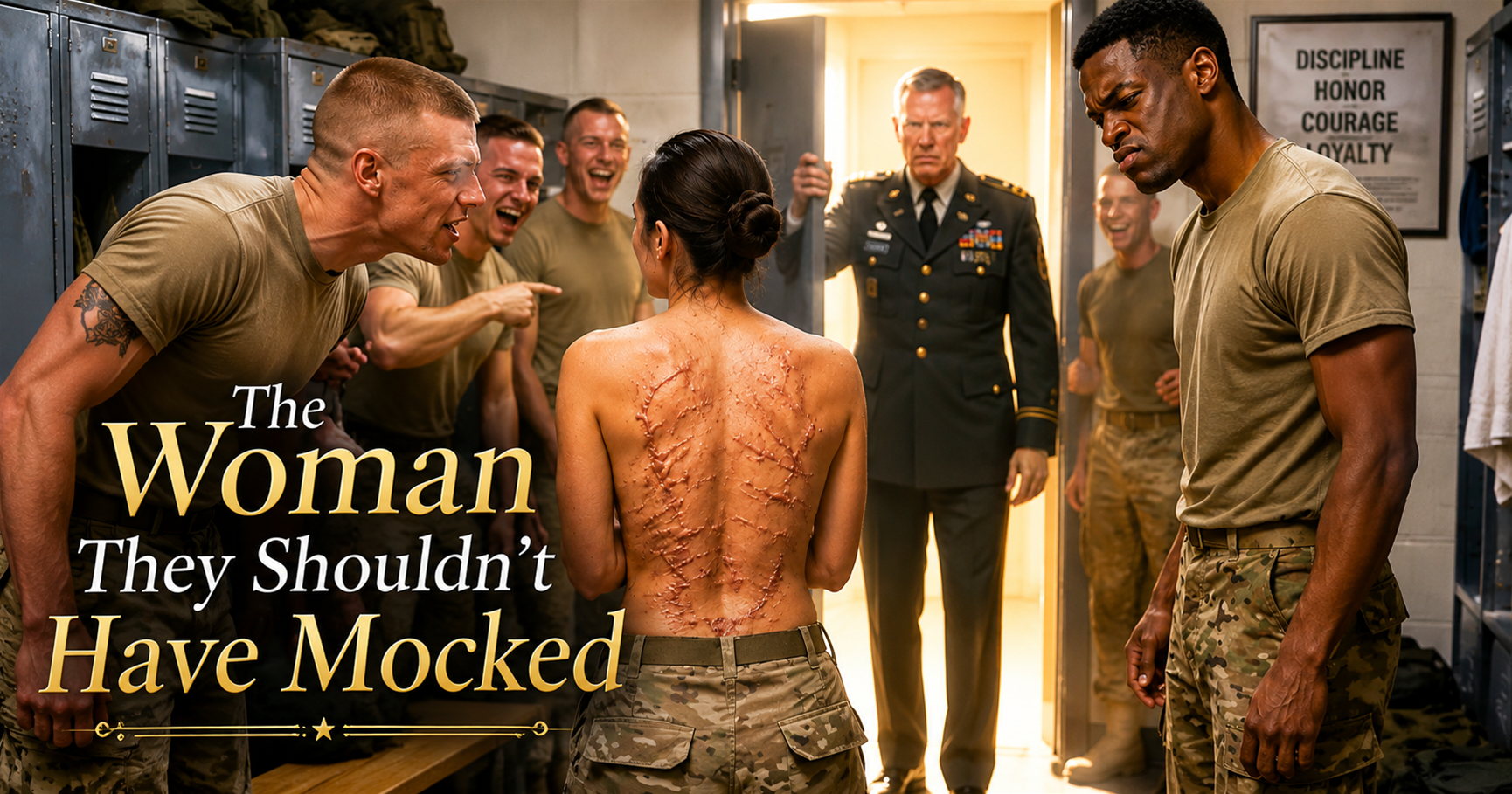
"The Woman They Shouldn’t Have Mocked" Chapter 13
Chapter 13
The worst part was that nobody laughed anymore.
Emily realized it halfway through breakfast on Monday morning while sitting alone near the far corner of the mess hall with untouched coffee cooling beside her tray. The room remained loud in the ordinary military sense—boots scraping across concrete floors, trays clattering, exhausted soldiers arguing over sports highlights playing silently on the mounted television screens overhead—but every time someone looked toward her, the noise shifted slightly.
Not silence.
Avoidance.
People lowered their voices without meaning to.
They stopped joking when she passed.
Even Ryan Brooks, who usually filled rooms with obnoxious commentary simply to hear himself exist, barely looked at her directly now.
It felt unbearable.
Emily stared down into the black surface of her coffee while movement blurred softly around her peripheral vision.
Three days ago these same men mocked her scars openly.
Now they watched her like survivors watched memorial walls.
The transformation made her skin crawl.
Across the room, Jake Miller sat with several other soldiers near the windows. He looked exhausted lately, dark circles bruising the skin beneath his eyes badly enough that even Ryan had stopped making comments about it.
Jake glanced toward her once.
Then immediately looked away.
Guilt radiated from him now in visible waves.
Emily hated that too.
Because pity was easier for people than accountability. Once someone transformed you into tragedy inside their head, they no longer had to confront the uglier truth—that they had chosen cruelty freely before discovering your pain carried historical value.
Marcus Reed entered the mess hall a few minutes later still damp from early drills, sleeves rolled halfway up his forearms. Conversation near the doorway shifted subtly around him as several soldiers made room without thinking.
Authority came naturally to men like Marcus.
Not because they were kind.
Because people learned early that resisting them cost energy.
He spotted Emily immediately.
Not difficult now.
Everyone noticed where she sat these days.
Marcus grabbed black coffee from the service counter before crossing halfway through the hall. Several soldiers looked up expectantly as he approached her table.
Emily saw him coming and already felt tired.
“Seat taken?” he asked.
She didn’t look up from the coffee. “Depends.”
“On what?”
“Whether you’re here because you feel guilty.”
Marcus pulled out the chair opposite her anyway.
“That obvious?”
Emily finally lifted her eyes.
For one brief second neither spoke.
Marcus looked rough this morning, exhaustion hardening the lines around his mouth while something unresolved lingered beneath his expression. He no longer carried the same easy confidence from Emily’s first days at Blackridge. Awareness had unsettled him. She could see it happening in real time.
Good.
It should.
Marcus leaned back slightly. “People are talking.”
Emily gave a faint humorless smile. “People always talk.”
“Not like this.”
No.
Not like this.
Now conversations stopped when she entered rooms.
Now soldiers glanced at her scars accidentally and then looked ashamed afterward.
ADVERTISEMENT
Now instructors softened their voices around her without realizing it.
Emily preferred the mockery.
At least hatred felt honest.
She pushed the untouched coffee aside. “If you came over here to apologize again, don’t.”
Marcus frowned faintly. “Again?”
“You’ve been apologizing without words for two days.”
The observation landed because it was true.
Marcus stared at her a second longer than necessary before exhaling quietly through his nose.
“You make it difficult to talk to you.”
Emily almost laughed at that.
Instead she looked toward the windows where snow drifted softly beyond the mess hall glass.
“No,” she said quietly. “I think people just don’t like talking to someone once they realize they were wrong about them.”
The words settled between them heavily.
Marcus wrapped both hands loosely around his coffee cup.
“I didn’t know.”
Emily’s jaw tightened immediately.
There it was.
The sentence everyone reached for first.
I didn’t know.
As though ignorance erased damage somehow.
“You knew enough,” she said softly.
Marcus flinched almost invisibly.
Because he had.
He knew she was isolated.
Knew the others targeted her deliberately.
Knew something about her behavior suggested old trauma long before Hayes revealed Convoy Seven.
And still he joined in because cruelty at Blackridge functioned like social gravity. Easier to move with it than against it.
Marcus stared down into the steam rising from his coffee.
“My sister enlisted last year,” he said unexpectedly.
Emily looked back at him.
“She ships out this spring.” His mouth tightened faintly. “I keep thinking about somebody treating her the way we treated you.”
Emily felt something cold settle beneath her ribs.
Not sympathy.
Recognition.
Because shame always became personal before it became moral.
Marcus rubbed one hand slowly across his jaw. “That’s not an excuse.”
“No,” Emily agreed. “It isn’t.”
Another silence followed.
Not hostile.
Just uncomfortable in the honest way conversations became once nobody hid behind performance anymore.
Across the mess hall, Ryan glanced toward their table before quickly pretending not to.
Marcus noticed.
Then looked back at Emily carefully.
“You hate this, don’t you?”
The question surprised her enough to still her hand around the coffee cup.
“What?”
“The attention.” Marcus nodded subtly toward the room around them. “People looking at you differently.”
Emily stared at him for several seconds before answering.
“Yes.”
Marcus looked genuinely confused. “Why?”
Because mockery was easier to survive than pity.
Because once people pitied you, they stopped seeing you as human and started seeing you as evidence of suffering.
Because everyone suddenly became gentle in ways that felt like distance.
Because she did not survive Kandahar just to spend the rest of her life treated like a wound with a pulse.
But Emily only said:
“Because now they’re afraid to be honest.”
Marcus leaned back slowly in his chair.
Understanding flickered behind his eyes then—not complete, but enough.
The silence between them stretched quietly afterward while snow continued falling outside.
ADVERTISEMENT
At the far end of the mess hall, two younger recruits walked past Emily’s table carrying breakfast trays. One of them glanced toward her scars visible faintly beneath the collar of her training shirt before immediately lowering his eyes.
Not disgust.
Sympathy.
Emily looked away first.
Her appetite vanished completely.
Later that afternoon, during weapons maintenance, the atmosphere felt even worse.
Nobody teased her anymore.
Nobody challenged her either.
When she reached for a cleaning kit near the supply bench, another soldier stepped aside too quickly like he feared touching her accidentally might somehow disrespect the dead.
Emily almost snapped at him for it.
Instead she kept cleaning her rifle while the room filled with awkward careful silence.
General Hayes watched part of the interaction from the elevated observation office overlooking the maintenance floor below.
He recognized the pattern immediately.
Soldiers often shifted from cruelty into reverence after learning painful truths about someone. The emotional transition looked compassionate from a distance.
In reality, it frequently isolated people worse.
Emily moved through the room now like a ghost everyone suddenly felt guilty haunting.
Hayes rested one hand against the office window.
Below him, she sat alone beneath fluorescent light methodically dismantling her rifle with precise controlled movements while conversations drifted carefully around her instead of toward her.
Too controlled.
Always too controlled.
He remembered reading trauma evaluations after the convoy.
Patient demonstrates severe emotional compartmentalization.
At the time, the phrase sounded clinical.
Now he understood what it really meant.
Emily Carter survived unbearable things by making herself smaller around them.
The realization sat heavily inside him.
Down on the maintenance floor, Emily finished cleaning the rifle and reassembled it in silence.
Then she looked up instinctively.
Straight toward the observation window.
Toward Hayes.
Even through reinforced glass and distance, she held his gaze steadily enough that something uncomfortable moved beneath his ribs again.
Not fear.
Recognition.
Because every time she looked at him now, Hayes felt increasingly certain Emily already suspected the truth he still hadn’t admitted aloud:
He could have fought harder for her three years ago.
And somewhere beneath all her restraint—
She knew it.
ADVERTISEMENT
You May Also Like
-
CompletedChapter 11

My Husband Swore He Never Touched Me. Then Who Got Me Pregnant?
Evelyn Hart tells her husband she’s carrying his child. Nathaniel Cross tells her he has never touched her. She remembers the night he came for her. He insists it never happened. After twenty years of loving him, Evelyn discovers that their marriage was built around a revenge she never understood. When his supposed lover dies, Evelyn becomes the woman everyone blames—and escaping him costs more than she could have imagined. Months later, blind and grieving, she meets Luke, a gentle stranger who asks before touching her and stays when she’s afraid. For the first time, Evelyn wants a future without her husband. But Luke’s hands feel familiar. His voice sometimes changes. And whenever she mentions Nathaniel, the man who makes her feel safe goes strangely silent.Billionaire|Dark Secrets|Substitute Lover|Fake Relationship14.8k words5 7 -
CompletedChapter 11
My Celebrity Boss Was Supposed to Be an Omega
Cole Bennett knows how to throw a punch, spot a threat, and keep his clients safe. Figuring out why his gorgeous new boss keeps finding reasons to touch him? That’s outside his training. When rising star Adrian Vale hires him as a bodyguard, Cole assumes he’s protecting an Omega. It would explain the pretty face, the unwanted attention, and why Adrian apparently can’t spend a night alone. It does not explain the strength in Adrian’s hands—or the way sharing a bed starts feeling dangerously natural.Healing Romance|Mutual Pining|HE14.3k words5 0 -
CompletedChapter 11
My arch-nemesis is dead, but I see him every night.
Julian Reed is dead. I know because I read the headline—and broke my couch celebrating. Before you judge me, try spending eight years with a man who criticizes your groceries, meddles in your life, and once paid your roommates to soak your bedding so you’d have to share his bed. I thought I’d finally have some peace. Then my apartment started going dark at eleven every night. My mattress dipped beside me. And a voice I knew far too well asked whether I was really that happy he was gone. Apparently, even death can’t make Julian leave me alone. But somewhere between hiding under the covers and arguing with empty rooms, I start wondering what I actually want: for him to stop coming back—or for him to stay.Healing Romance|Mutual Pining|HE14.8k words5 4 -
CompletedChapter 11
The Mafia Boss’s Seventh Nurse
Mara Bennett only accepts the live-in nursing job because she desperately needs money for her younger brother’s cancer treatment. Her patient is Vincent DeLuca, one of Chicago’s most feared mafia bosses—a ruthless man left badly injured after an ambush and determined to drive away anyone who tries to help him. Six nurses have already quit. Mara becomes the seventh, but she refuses to be intimidated. As Vincent slowly begins to recover, Mara discovers that someone inside his own estate has been secretly keeping him weak. Worse, the danger soon reaches her brother. Trapped between betrayal, buried family secrets, and a growing attraction neither of them is willing to admit, Mara must decide how far she is willing to go to save a man who trusts no one. And Vincent must decide whether the woman who broke every rule he gave her might be the only person he can trust with his life—and his heart.Billionaire|Mafia|Healing Romance|Dark Secrets|Plot Twist|Redemption Arc|HE11.0k words5 3 -
CompletedChapter 11
The Mafia Boss’s Secret Son
Elena Bennett loved Dante Moretti for eight years, but every time she asked about marriage, Chicago’s most powerful mafia boss gave her the same answer: he couldn’t marry her. Then an invitation arrived. Dante was marrying Victoria—Elena’s older sister. Heartbroken, Elena disappeared to Switzerland. Three weeks later, she discovered she was pregnant. For nearly three years, she raised their son, Leo, without ever telling Dante he was a father. But when her father’s death forces Elena back to Chicago, one accidental encounter at O’Hare changes everything. Leo takes one look at Dante and innocently says, “Mommy… that man looks like me.” Dante immediately realizes the truth. Now the man Elena spent years trying to forget wants answers—and a place in his son’s life. But buried inside her father’s estate is an old contract that reveals something even more devastating: Dante’s marriage to Victoria was never what Elena believed. And the real reason he refused to marry Elena may change everything she thought she knew about the man who broke her heart.Billionaire|Mafia|Mutual Pining|Dark Secrets|Plot Twist|Reunion Romance|Redemption Arc|Marriage of Convenience|Second Chance11.7k words5 10