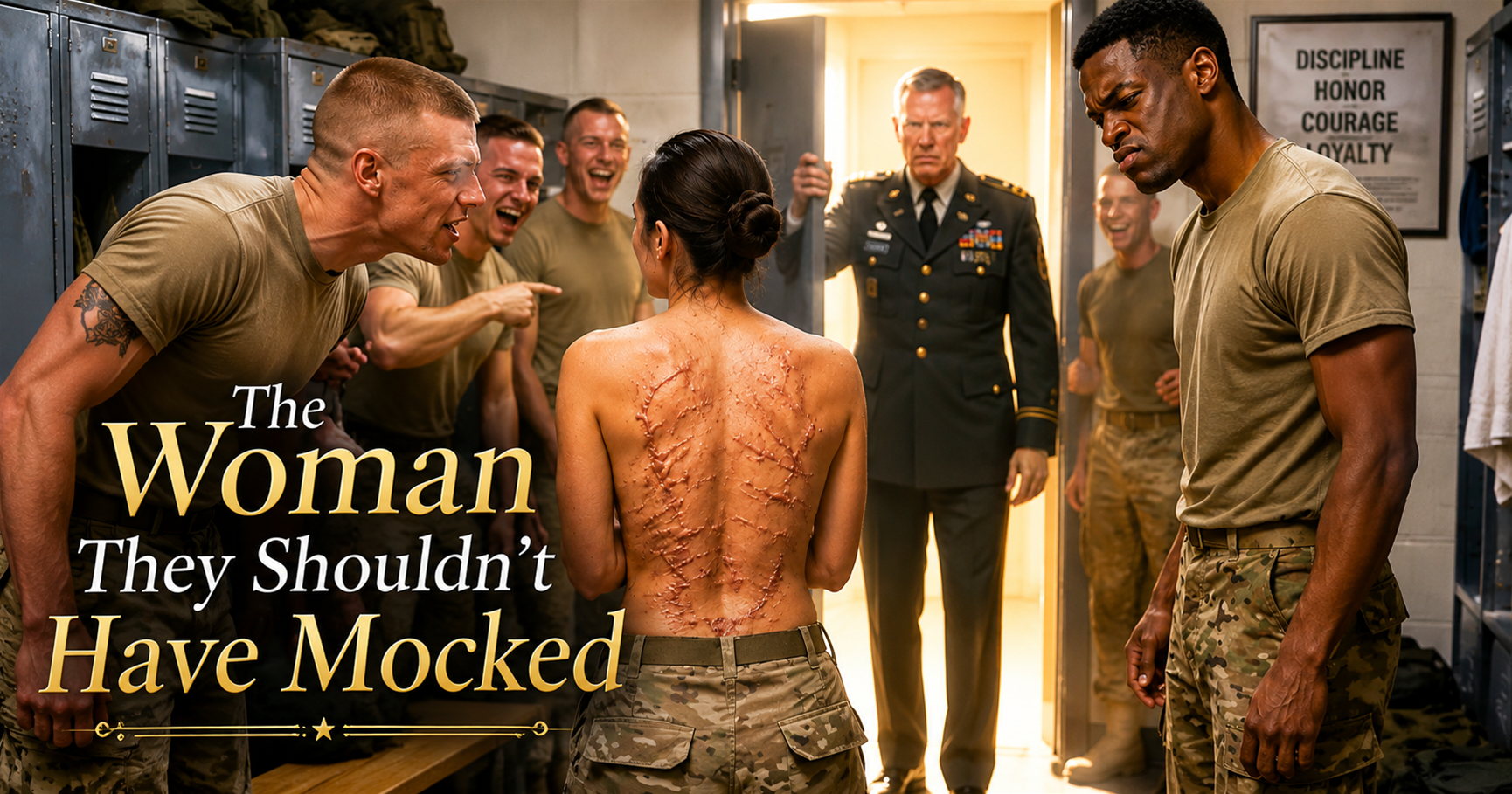
"The Woman They Shouldn’t Have Mocked" Chapter 25
Chapter 25
Captain Howard Vane should have known Emily Carter would eventually find him.
The only question was whether she would arrive angry—
Or devastated.
By the look in her eyes when she stepped into his office just after dusk, Vane realized with quiet unease that the answer was both.
Rain lashed hard against the administration windows behind him while stormlight flickered faintly through the blinds. The operations wing had mostly emptied for the evening shift change, leaving the corridor outside unnaturally quiet except for distant footsteps echoing through concrete halls.
Emily closed the office door behind her carefully.
Too carefully.
Vane immediately noticed the tension in the movement.
Not fear.
Control barely holding together.
He remained seated behind the desk, though his posture stiffened visibly the second he saw her expression.
“Private Carter.”
Emily didn’t answer right away.
The office smelled faintly of paper, rain, and stale coffee. On the wall behind Vane hung military commendations framed beneath polished glass—campaign ribbons, command citations, photographs beside decorated officers smiling beneath flags and ceremony lights.
Emily stared at them a long moment.
Then finally:
“How many lies are hanging on your walls?”
Vane’s jaw tightened instantly.
“I assume Hayes spoke to you.”
Emily stepped farther into the office.
“No,” she said quietly. “Survivors did.”
That changed something behind his eyes.
Not surprise.
Calculation.
He leaned back slowly in his chair. “You shouldn’t be chasing this anymore.”
The calmness of his voice nearly made her laugh.
Nearly.
Instead Emily pulled the burned convoy photograph from her jacket pocket and dropped it onto his desk between them.
Vane looked down.
The image showed smoke swallowing half the transport line while a barely recognizable figure dragged an unconscious officer through flames.
Mercer.
Her.
History reduced to evidence.
“You erased witness reports,” Emily said.
Vane remained silent.
“You buried testimony.”
Still nothing.
“You knew Mercer ran.”
At that, Vane finally looked up.
And the absence of denial hit harder than anger would have.
Emily felt rage rise fast enough to make her hands tremble.
For years she told herself the convoy was chaos. Confusion. Institutional failure caused by panic and bureaucracy and distance.
But sitting here now across from the man who helped erase her—
The betrayal suddenly felt personal.
Vane folded his hands carefully together atop the desk.
“You need to understand the pressure command was under.”
Emily laughed once.
Sharp.
Disbelieving.
“There it is,” she whispered. “That sentence.”
“Private—”
“Don’t call me that.”
The interruption cracked through the office hard enough to silence even the storm outside for a second.
Emily stepped closer to the desk now.
“You know what I kept thinking after Kandahar?” she asked quietly. “That maybe I remembered wrong.”
Vane watched her carefully.
“Trauma distorts memory,” he said.
“No.” Emily’s eyes locked onto his. “People do.”
The words landed hard enough that something flickered briefly beneath his composure.
Guilt maybe.
ADVERTISEMENT
Or annoyance at being forced to confront the consequences directly instead of through paperwork.
Emily looked toward the commendations behind him again.
“You let them turn cowardice into heroism.”
Vane stood slowly from his chair.
“You think war works on morality?” he asked quietly. “It works on narrative.”
Emily stared at him.
Vane stepped around the desk now, voice lowering into something colder.
“Countries need heroes after disasters. They need symbols people can rally around.” His jaw tightened faintly. “Mercer fit the image command required.”
Emily felt nausea twist sharply beneath her ribs.
“And I didn’t.”
Vane held her gaze.
“No.”
The honesty nearly broke something inside her.
Not because it surprised her.
Because he said it so easily.
Rain hammered violently against the windows while fluorescent lights buzzed overhead.
Emily looked suddenly nineteen again in her own mind—burned alive beneath hospital blankets while televisions praised Elias Mercer across every news network in the country.
Heroes returning home.
Leadership under fire.
Valor.
Meanwhile her own name vanished quietly beneath administrative revisions signed by men standing in offices like this one.
Vane continued calmly.
“You were unstable after the convoy. Traumatized. Injured. Barely coherent during portions of the investigation.”
Emily moved before fully realizing she’d done it.
One second she stood frozen beside the desk.
The next she slammed both hands against his chest hard enough to drive him backward into the filing cabinet behind him.
Metal crashed violently through the office.
Vane swore sharply.
Emily grabbed the front of his uniform with shaking fists while years of buried rage finally surfaced raw enough to breathe.
“I carried your heroes out of that fire!”
The scream tore out of her before she could stop it.
Vane stared at her in genuine shock now.
Emily’s entire body trembled violently—not weakness this time, not panic.
Rage.
The kind she spent three years swallowing because survival required silence.
“You sat in offices while we burned alive,” she hissed. “And then you rewrote us.”
Vane grabbed her wrists hard enough to stop her from shoving him again.
“Control yourself.”
“Or what?”
Her eyes looked terrifying suddenly.
Bright with fury and grief and exhaustion all tangled together.
Vane’s own expression hardened instantly.
“Or I will have you discharged under psychiatric instability before sunrise.”
The threat hit like ice water.
Emily went completely still.
Not calm.
Frozen.
Vane released her wrists slowly and straightened his uniform with controlled irritation.
“There are still evaluations in your file,” he said quietly. “Panic episodes. Trauma responses. Behavioral concerns.” His voice lowered further. “Do you really think the military will choose your word over institutional command?”
The office fell silent except for the storm.
Emily stood breathing unevenly a few feet away while humiliation and fury crashed violently together beneath her ribs.
Because part of her knew he was right.
Systems protected themselves first.
Always.
Vane adjusted the cuffs of his sleeves carefully.
“You want the ugly truth, Carter?” he asked. “Heroes are chosen politically long before they’re chosen morally.”
The sentence hollowed the room.
Emily looked at him a long moment.
Then slowly, quietly:
“That’s the first honest thing you’ve said.”
Vane’s expression shifted faintly.
Not remorse.
Recognition.
Because for the first time since she arrived at Blackridge, Emily Carter no longer looked like a traumatized soldier chasing buried answers.
She looked dangerous.
And somewhere deep beneath his controlled exterior—
Captain Howard Vane finally understood why powerful men spent three years trying to keep her silent.
ADVERTISEMENT
You May Also Like
-
CompletedChapter 11

My Husband Swore He Never Touched Me. Then Who Got Me Pregnant?
Evelyn Hart tells her husband she’s carrying his child. Nathaniel Cross tells her he has never touched her. She remembers the night he came for her. He insists it never happened. After twenty years of loving him, Evelyn discovers that their marriage was built around a revenge she never understood. When his supposed lover dies, Evelyn becomes the woman everyone blames—and escaping him costs more than she could have imagined. Months later, blind and grieving, she meets Luke, a gentle stranger who asks before touching her and stays when she’s afraid. For the first time, Evelyn wants a future without her husband. But Luke’s hands feel familiar. His voice sometimes changes. And whenever she mentions Nathaniel, the man who makes her feel safe goes strangely silent.Billionaire|Dark Secrets|Substitute Lover|Fake Relationship14.8k words5 7 -
CompletedChapter 11
My Celebrity Boss Was Supposed to Be an Omega
Cole Bennett knows how to throw a punch, spot a threat, and keep his clients safe. Figuring out why his gorgeous new boss keeps finding reasons to touch him? That’s outside his training. When rising star Adrian Vale hires him as a bodyguard, Cole assumes he’s protecting an Omega. It would explain the pretty face, the unwanted attention, and why Adrian apparently can’t spend a night alone. It does not explain the strength in Adrian’s hands—or the way sharing a bed starts feeling dangerously natural.Healing Romance|Mutual Pining|HE14.3k words5 0 -
CompletedChapter 11
My arch-nemesis is dead, but I see him every night.
Julian Reed is dead. I know because I read the headline—and broke my couch celebrating. Before you judge me, try spending eight years with a man who criticizes your groceries, meddles in your life, and once paid your roommates to soak your bedding so you’d have to share his bed. I thought I’d finally have some peace. Then my apartment started going dark at eleven every night. My mattress dipped beside me. And a voice I knew far too well asked whether I was really that happy he was gone. Apparently, even death can’t make Julian leave me alone. But somewhere between hiding under the covers and arguing with empty rooms, I start wondering what I actually want: for him to stop coming back—or for him to stay.Healing Romance|Mutual Pining|HE14.8k words5 4 -
CompletedChapter 11
The Mafia Boss’s Seventh Nurse
Mara Bennett only accepts the live-in nursing job because she desperately needs money for her younger brother’s cancer treatment. Her patient is Vincent DeLuca, one of Chicago’s most feared mafia bosses—a ruthless man left badly injured after an ambush and determined to drive away anyone who tries to help him. Six nurses have already quit. Mara becomes the seventh, but she refuses to be intimidated. As Vincent slowly begins to recover, Mara discovers that someone inside his own estate has been secretly keeping him weak. Worse, the danger soon reaches her brother. Trapped between betrayal, buried family secrets, and a growing attraction neither of them is willing to admit, Mara must decide how far she is willing to go to save a man who trusts no one. And Vincent must decide whether the woman who broke every rule he gave her might be the only person he can trust with his life—and his heart.Billionaire|Mafia|Healing Romance|Dark Secrets|Plot Twist|Redemption Arc|HE11.0k words5 3 -
CompletedChapter 11
The Mafia Boss’s Secret Son
Elena Bennett loved Dante Moretti for eight years, but every time she asked about marriage, Chicago’s most powerful mafia boss gave her the same answer: he couldn’t marry her. Then an invitation arrived. Dante was marrying Victoria—Elena’s older sister. Heartbroken, Elena disappeared to Switzerland. Three weeks later, she discovered she was pregnant. For nearly three years, she raised their son, Leo, without ever telling Dante he was a father. But when her father’s death forces Elena back to Chicago, one accidental encounter at O’Hare changes everything. Leo takes one look at Dante and innocently says, “Mommy… that man looks like me.” Dante immediately realizes the truth. Now the man Elena spent years trying to forget wants answers—and a place in his son’s life. But buried inside her father’s estate is an old contract that reveals something even more devastating: Dante’s marriage to Victoria was never what Elena believed. And the real reason he refused to marry Elena may change everything she thought she knew about the man who broke her heart.Billionaire|Mafia|Mutual Pining|Dark Secrets|Plot Twist|Reunion Romance|Redemption Arc|Marriage of Convenience|Second Chance11.7k words5 10