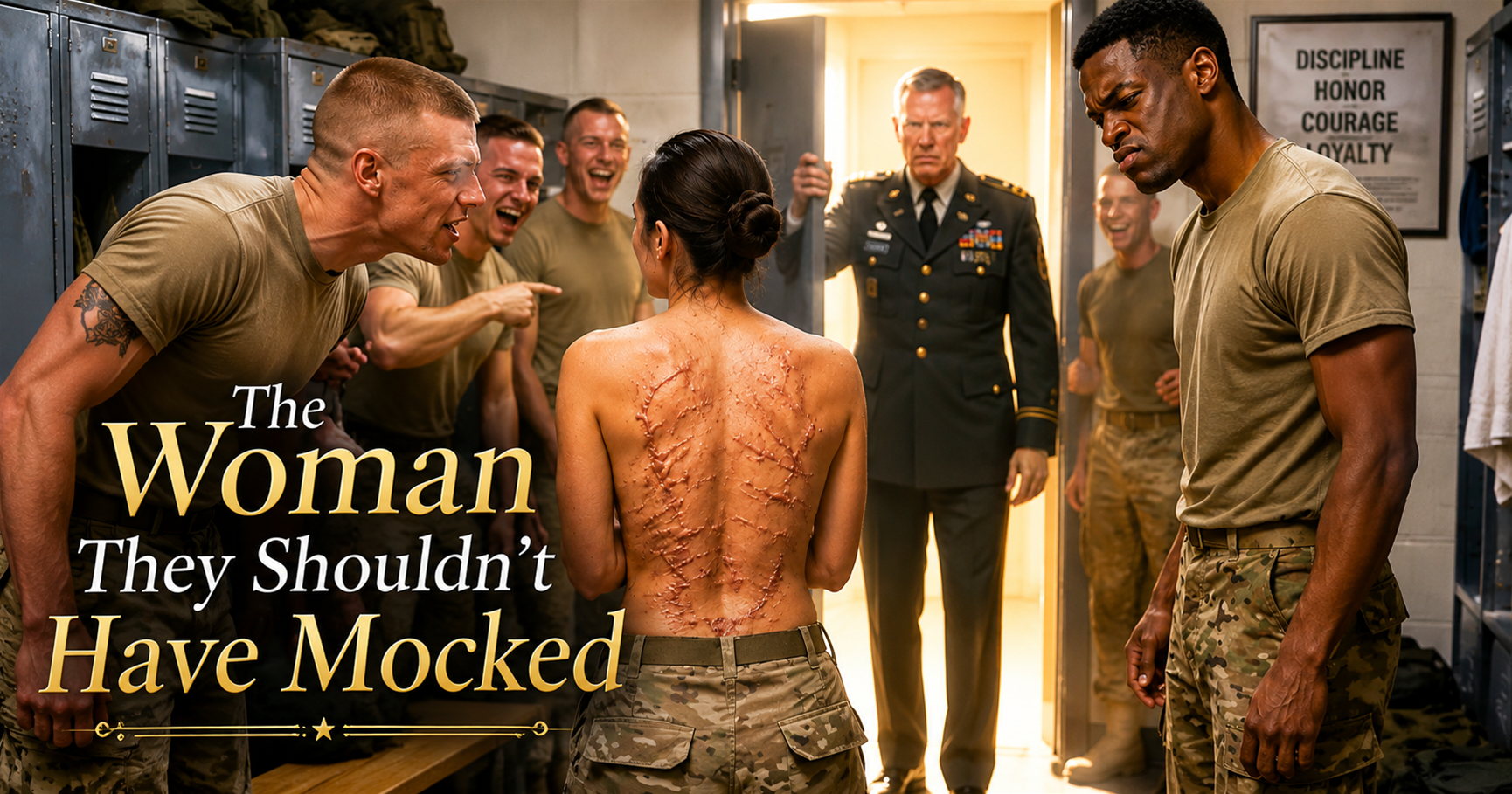
"The Woman They Shouldn’t Have Mocked" Chapter 32
Chapter 32
The country fell in love with Emily Carter overnight.
That was the first thing that terrified her.
By the end of the week, her face appeared everywhere.
News broadcasts.
Military debate panels.
Online articles.
Comment sections filled with strangers calling her brave, tragic, inspiring, resilient—as though years of trauma had transformed neatly into something consumable the second the truth became public enough to trend.
Blackridge no longer belonged to soldiers.
It belonged to cameras.
Temporary media tents crowded the outer perimeter while military legal teams rotated through the administration wing carrying binders thick enough to break arms. Every hour brought another public statement, another leaked document, another retired official suddenly claiming they “always suspected inconsistencies.”
Cowards always found morality once survival became socially profitable.
Emily watched almost none of it voluntarily.
Didn’t matter.
The world forced itself into her life anyway.
She stepped into the mess hall one morning and heard her own name from three separate televisions before she even reached the coffee machine.
“…award restoration proceedings expected to begin this month…”
“…growing public pressure on the Department of Defense…”
“…surviving convoy personnel now calling Carter the true hero of Kandahar…”
Emily turned around and left before breakfast.
The applause felt worse than the silence ever had.
At least silence was honest.
By afternoon, official hearing preparations had consumed nearly every senior office inside Blackridge. Investigators interviewed surviving convoy personnel one by one while military attorneys rebuilt timelines from recovered testimony and destroyed records.
Emily sat through three hours of questioning that morning alone.
Where were you positioned after the second blast?
Did Lieutenant Mercer issue evacuation commands?
Can you confirm Captain Vane authorized revised testimony processing?
Every answer scraped old wounds open again.
By evening she felt hollowed out from speaking.
And underneath all of it lurked a question she could not stop asking herself:
If the country suddenly loved her now—
What exactly had they loved before?
Certainly not her.
Not the panic attacks.
Not the years spent isolated and unstable and furious at herself for surviving badly.
No.
They loved the narrative.
The burn survivor.
The forgotten hero.
The woman wronged by the system.
Emily understood storytelling well enough now to recognize when she became one.
That realization exhausted her more than the hearings.
She disappeared just after sunset.
Nobody noticed immediately because Blackridge had become chaos—reporters at the gates, legal teams moving through command offices, soldiers arguing quietly in corridors every time another convoy detail surfaced publicly.
Emily slipped away toward the old eastern locker rooms near the decommissioned training wing where nobody went anymore.
The building smelled faintly of rust and cold concrete.
Half the overhead lights no longer worked.
Good.
She sat alone on the wooden bench beneath flickering fluorescent shadows with her back against dented metal lockers and both hands wrapped tightly around untouched coffee gone cold an hour earlier.
ADVERTISEMENT
Quiet at last.
No cameras.
No questions.
No sympathetic eyes.
The silence settled heavily around her.
Emily stared at the floor for a long time.
Then finally whispered into the empty room:
“What if they only love heroes?”
The sentence sounded pathetic out loud.
Still true.
She rested her elbows against her knees and pressed one hand hard against her forehead.
Because suddenly everyone wanted pieces of her strength publicly while nobody understood how ugly survival actually looked behind closed doors.
They didn’t see her sleeping with combat knives beneath pillows.
Didn’t see her shaking after loud noises.
Didn’t see the nights she still woke gasping because fire returned in fragments sharp enough to smell.
Heroes were easier to admire when trauma became cinematic instead of inconvenient.
The locker room door opened quietly behind her.
Emily didn’t look up.
“Go away.”
Marcus ignored her immediately.
He crossed the room slowly before sitting beside her on the bench without speaking.
For several seconds only the buzzing fluorescent lights filled the silence between them.
Then Marcus glanced toward the untouched coffee in her hands.
“You planning to drink that or emotionally support it?”
Emily almost smiled.
Almost.
“Did Hayes send you?”
“No.”
“Good.”
Marcus leaned back against the lockers beside her, long legs stretched loosely across the concrete floor.
“You vanished during legal briefing.”
“I know.”
“They thought reporters got you.”
Emily laughed softly under her breath.
“Maybe they did.”
Marcus looked sideways at her then.
Too pale again.
Too tired.
He had started recognizing the warning signs almost automatically now.
“You okay?”
Emily stared at the opposite lockers.
“No.”
The honesty surprised both of them.
Marcus stayed quiet carefully.
Emily rubbed one trembling thumb along the side of the coffee cup.
“Everywhere I go now, people look at me like I survived beautifully for them.”
Marcus frowned faintly.
“What does that mean?”
Emily exhaled slowly through her nose.
“It means they only understand pain once it turns inspirational.”
The words settled heavily into the old locker room.
Marcus looked down at his hands briefly before answering.
“My mom used to volunteer at a rehab center for veterans.”
Emily stayed silent.
“She said civilians always preferred wounded soldiers who healed cleanly.” His jaw tightened slightly. “The messy ones made people uncomfortable.”
Emily looked at him then.
Not because the statement shocked her.
Because it matched something she already knew too well.
Marcus continued quietly.
“You scare people because you survived honestly.”
That landed somewhere dangerously deep inside her chest.
Emily looked away immediately.
The fluorescent light above them flickered weakly.
After a long silence, she whispered:
“I don’t know who I’m supposed to be after this.”
Marcus understood immediately.
Not the investigation.
Not the hearings.
After survival itself stopped being her only identity.
He leaned forward slightly with his forearms resting on his knees.
“Maybe nobody’s supposed to survive something like Kandahar perfectly.”
Emily laughed once under her breath.
“You’d make a terrible motivational speaker.”
“Good. Those guys are usually frauds.”
That finally pulled a real smile from her.
Small.
Brief.
Gone almost instantly.
Still enough to tighten something warm and dangerous beneath Marcus’s ribs.
Emily stared at the floor again afterward.
“Sometimes I think everyone only cares because the story ended dramatically enough.”
Marcus looked at her steadily.
“No.”
Emily’s voice dropped softer.
“You sure?”
“Yes.”
She frowned faintly. “Why?”
Marcus considered the question carefully before answering.
“Because I watched this place before people knew the truth.” His jaw tightened slightly. “And the second you walked into Blackridge, everyone reacted to you.”
Emily looked confused by that.
Marcus continued.
“Not because of the convoy. Nobody knew about that yet.” He glanced sideways toward her. “You carried something people recognized immediately even if they didn’t understand it.”
“What.”
Marcus held her gaze a second too long.
“Pain that survived.”
The silence afterward felt different somehow.
Not lighter.
Just less lonely.
Outside, rain tapped softly against the old locker room windows while somewhere across Blackridge reporters and investigators and politicians continued fighting over narratives and responsibility and military history.
But here, beneath flickering fluorescent lights and rusted lockers and the quiet aftermath of too many ruined years—
Emily Carter sat beside someone who looked at her like a person first.
Not a symbol.
Not a scandal.
Not a hero.
And for the first time in a very long while, that frightened her almost as much as it comforted her.
ADVERTISEMENT
You May Also Like
-
CompletedChapter 11

My Husband Swore He Never Touched Me. Then Who Got Me Pregnant?
Evelyn Hart tells her husband she’s carrying his child. Nathaniel Cross tells her he has never touched her. She remembers the night he came for her. He insists it never happened. After twenty years of loving him, Evelyn discovers that their marriage was built around a revenge she never understood. When his supposed lover dies, Evelyn becomes the woman everyone blames—and escaping him costs more than she could have imagined. Months later, blind and grieving, she meets Luke, a gentle stranger who asks before touching her and stays when she’s afraid. For the first time, Evelyn wants a future without her husband. But Luke’s hands feel familiar. His voice sometimes changes. And whenever she mentions Nathaniel, the man who makes her feel safe goes strangely silent.Billionaire|Dark Secrets|Substitute Lover|Fake Relationship14.8k words5 7 -
CompletedChapter 11
My Celebrity Boss Was Supposed to Be an Omega
Cole Bennett knows how to throw a punch, spot a threat, and keep his clients safe. Figuring out why his gorgeous new boss keeps finding reasons to touch him? That’s outside his training. When rising star Adrian Vale hires him as a bodyguard, Cole assumes he’s protecting an Omega. It would explain the pretty face, the unwanted attention, and why Adrian apparently can’t spend a night alone. It does not explain the strength in Adrian’s hands—or the way sharing a bed starts feeling dangerously natural.Healing Romance|Mutual Pining|HE14.3k words5 0 -
CompletedChapter 11
My arch-nemesis is dead, but I see him every night.
Julian Reed is dead. I know because I read the headline—and broke my couch celebrating. Before you judge me, try spending eight years with a man who criticizes your groceries, meddles in your life, and once paid your roommates to soak your bedding so you’d have to share his bed. I thought I’d finally have some peace. Then my apartment started going dark at eleven every night. My mattress dipped beside me. And a voice I knew far too well asked whether I was really that happy he was gone. Apparently, even death can’t make Julian leave me alone. But somewhere between hiding under the covers and arguing with empty rooms, I start wondering what I actually want: for him to stop coming back—or for him to stay.Healing Romance|Mutual Pining|HE14.8k words5 4 -
CompletedChapter 11
The Mafia Boss’s Seventh Nurse
Mara Bennett only accepts the live-in nursing job because she desperately needs money for her younger brother’s cancer treatment. Her patient is Vincent DeLuca, one of Chicago’s most feared mafia bosses—a ruthless man left badly injured after an ambush and determined to drive away anyone who tries to help him. Six nurses have already quit. Mara becomes the seventh, but she refuses to be intimidated. As Vincent slowly begins to recover, Mara discovers that someone inside his own estate has been secretly keeping him weak. Worse, the danger soon reaches her brother. Trapped between betrayal, buried family secrets, and a growing attraction neither of them is willing to admit, Mara must decide how far she is willing to go to save a man who trusts no one. And Vincent must decide whether the woman who broke every rule he gave her might be the only person he can trust with his life—and his heart.Billionaire|Mafia|Healing Romance|Dark Secrets|Plot Twist|Redemption Arc|HE11.0k words5 3 -
CompletedChapter 11
The Mafia Boss’s Secret Son
Elena Bennett loved Dante Moretti for eight years, but every time she asked about marriage, Chicago’s most powerful mafia boss gave her the same answer: he couldn’t marry her. Then an invitation arrived. Dante was marrying Victoria—Elena’s older sister. Heartbroken, Elena disappeared to Switzerland. Three weeks later, she discovered she was pregnant. For nearly three years, she raised their son, Leo, without ever telling Dante he was a father. But when her father’s death forces Elena back to Chicago, one accidental encounter at O’Hare changes everything. Leo takes one look at Dante and innocently says, “Mommy… that man looks like me.” Dante immediately realizes the truth. Now the man Elena spent years trying to forget wants answers—and a place in his son’s life. But buried inside her father’s estate is an old contract that reveals something even more devastating: Dante’s marriage to Victoria was never what Elena believed. And the real reason he refused to marry Elena may change everything she thought she knew about the man who broke her heart.Billionaire|Mafia|Mutual Pining|Dark Secrets|Plot Twist|Reunion Romance|Redemption Arc|Marriage of Convenience|Second Chance11.7k words5 10