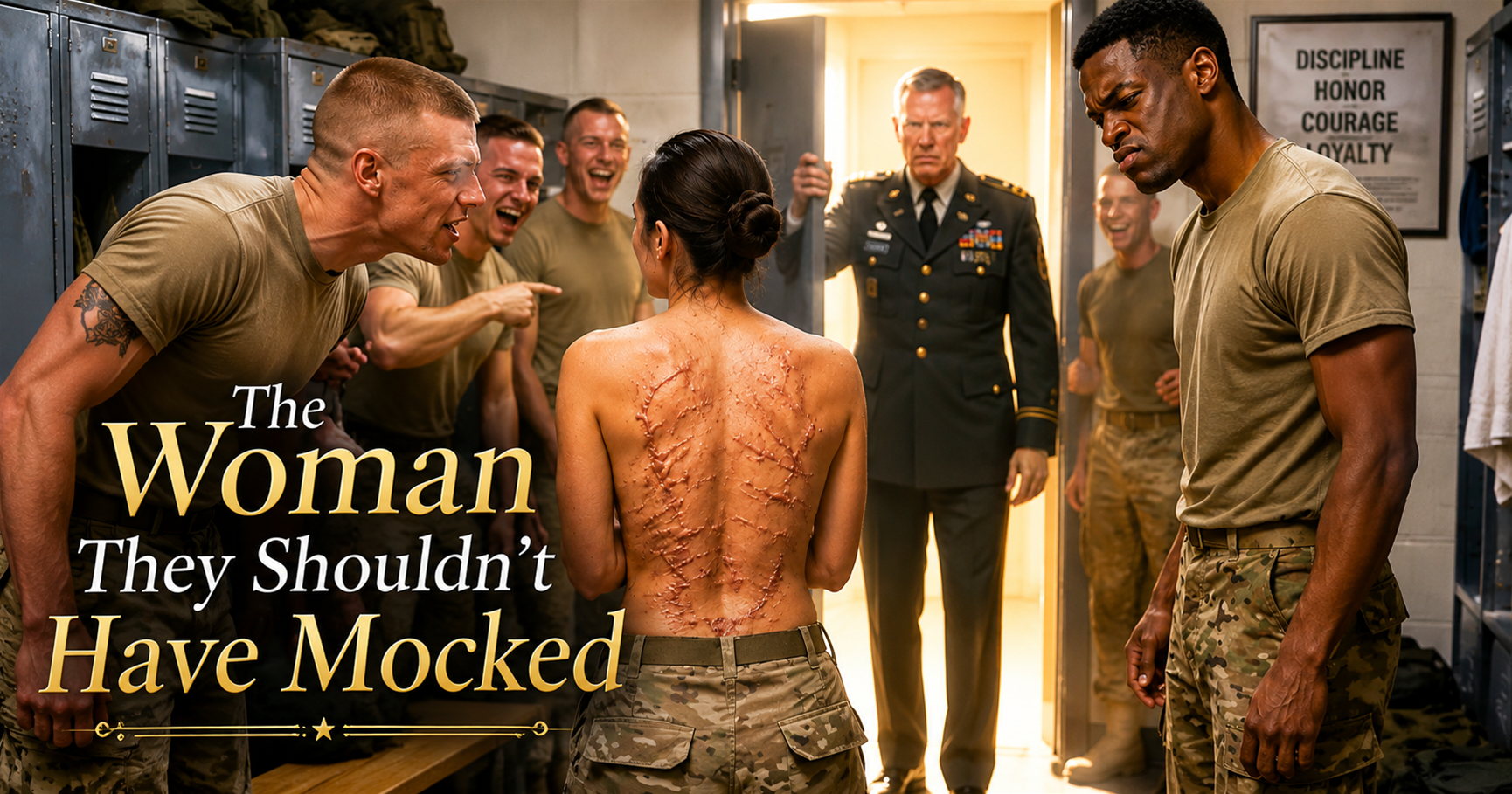
"The Woman They Shouldn’t Have Mocked" Chapter 34
Chapter 34
The hearing room held two hundred people.
By nine o’clock, there were nearly twice that many.
Military officials crowded the back walls shoulder-to-shoulder beside reporters balancing cameras and notebooks while federal observers filled the elevated side gallery beneath bright white ceiling lights. Outside the secured building, news vans lined the streets surrounding the Defense Review Center in Washington, D.C., broadcasting live updates to half the country.
Inside, the air felt painfully still.
Emily stood alone outside the double hearing doors with her hands clasped tightly behind her back because otherwise they would have visibly trembled.
Her formal dress uniform felt too heavy.
The restored insignia on the chest looked unfamiliar there.
For several seconds she stared at the polished brass nameplate mounted beside the entrance:
FORMAL REVIEW PANEL — CONVOY SEVEN
Three years of silence reduced to engraved metal.
Marcus stood nearby in civilian clothes, leaning quietly against the wall while reporters shouted questions farther down the secured corridor behind military barricades.
Neither had spoken much during the drive over.
Some emotions became too large for conversation.
Hayes emerged from the hearing chamber moments later carrying several folders beneath one arm. The exhaustion in his face looked permanent now.
When he reached Emily, he stopped.
“You ready?”
Emily almost laughed.
No one was ready for this.
Instead she looked through the narrow glass panel built into the hearing room doors.
Rows of officials.
Military investigators.
Witnesses.
And cameras waiting patiently to record every reaction for the public afterward.
Her stomach twisted sharply.
“They’re televising portions of it.”
Hayes followed her gaze quietly.
“Yes.”
Emily closed her eyes briefly.
Of course they were.
America loved redemption stories almost as much as it loved public destruction.
Hayes lowered his voice carefully.
“You can still request partial privacy protections.”
“No.”
The answer came instantly.
Hayes studied her face.
Emily stared toward the hearing room again.
“They made me invisible once already.” Her jaw tightened faintly. “I’m not disappearing again.”
Something moved across Hayes’s expression then.
Not pride.
Something sadder than that.
Before he could answer, the chamber doors opened fully from inside.
“Private Carter,” an official announced softly. “The panel is ready.”
The room beyond fell silent the second Emily entered.
Every conversation stopped.
Every camera turned.
The sound of her shoes against polished floor echoed too loudly through the massive chamber while rows of military personnel and reporters watched openly from both sides.
Emily felt suddenly detached from her own body.
Not panic.
Overwhelm.
At the center of the room sat the review panel beneath military insignia and national flags, stacks of reconstructed convoy documents spread across long polished tables beneath harsh white lighting.
And seated behind the witness section—
Elias Mercer.
Captain Vane.
Nolan Price.
Jake Miller.
Survivors.
Participants.
People who spent years carrying different versions of the same disaster.
Mercer looked exhausted.
Vane looked cornered.
Jake looked like he had not slept in weeks.
ADVERTISEMENT
Emily kept walking.
The room remained completely silent until she reached the witness table.
Then the panel chairwoman spoke formally into the microphone.
“This hearing concerns the suppression and alteration of official military testimony connected to Convoy Seven, Kandahar Province, May 14th, 2023.”
Her voice echoed softly through the chamber.
“We will begin with survivor testimony.”
Emily sat slowly beneath the lights.
For one terrifying second, all she could hear was her own pulse.
Then the chairwoman looked directly at her.
“Private Emily Carter,” she said gently, “do you confirm that the testimony you are about to provide reflects your truthful recollection of events?”
Emily swallowed once.
“Yes.”
The microphone caught every tiny fracture in her voice.
The hearing began.
For nearly three hours, survivors testified one by one.
Nolan Price described the convoy collapse and Mercer’s attempted withdrawal during the second attack.
Jake Miller admitted publicly to processing revised reports under command pressure.
Archived communications surfaced.
Destroyed testimony orders were reconstructed.
Captain Howard Vane sat beneath questioning that slowly stripped every remaining layer of institutional language from the cover-up until only cowardice remained underneath it.
And through all of it—
Emily listened.
Sometimes answering questions.
Sometimes staring at the polished wood grain of the witness table because looking directly at the cameras became impossible.
At one point a senator asked quietly:
“Private Carter, when did you first realize your commendations had been removed?”
The room went still.
Emily looked down at her hands before answering.
“In the hospital.”
No dramatic speech.
No performance.
Just truth.
She described hearing nurses whisper outside the room.
Described the television broadcasts.
Described wondering for years whether trauma had damaged her memory badly enough to make her doubt herself.
By the time she finished speaking, nobody in the chamber could comfortably look away anymore.
Not because she sounded heroic.
Because she sounded human.
That was worse.
Near the end of the hearing, the panel chairwoman unfolded the final official document and adjusted her glasses carefully.
The chamber quieted immediately.
“After formal review of recovered testimony, military archive reconstruction, and verified survivor statements...” Her voice steadied slightly. “This panel recognizes Private Emily Carter as the primary rescue operative responsible for the extraction of multiple surviving personnel during the Convoy Seven attack.”
Emily stopped breathing.
Somewhere behind her, cameras clicked rapidly.
The chairwoman continued:
“All commendations previously withheld or reassigned are hereby formally restored.”
Silence crashed softly through the room.
Not empty silence.
Emotional silence.
The kind that settled when too many people suddenly realized history had shifted in front of them.
Emily stared forward without moving.
The words should have felt victorious.
Instead they felt strangely heavy.
Like grief arriving dressed as justice.
Then the chairwoman added quietly:
“The Department of Defense further acknowledges that systemic failures and deliberate testimony suppression caused profound personal and psychological harm to Private Carter over the course of three years.”
That did it.
Not the medals.
Not the restored records.
That.
The acknowledgment.
Someone finally saying aloud that what happened to her mattered.
Emily lowered her head sharply before emotion fully surfaced publicly.
Too late.
Tears slipped silently down her face anyway.
She wiped at them immediately, furious with herself for crying in front of cameras after surviving everything else without breaking publicly once.
But the tears kept coming.
Quiet.
Exhausted.
The kind pulled from years too heavy to carry cleanly anymore.
Marcus watched from the rear gallery with his chest tightening painfully.
Hayes looked away entirely.
Even Mercer lowered his eyes.
And then—
Movement near the side entrance.
A little girl slipped quietly past one of the military attendants carrying a folded paper drawing clutched tightly against her chest.
Maybe eight years old.
Dark curls.
Nervous eyes.
The room shifted in confusion as she approached the witness area carefully beneath the massive chamber lights.
An official moved to stop her.
The chairwoman raised one hand gently instead.
The little girl reached Emily’s table and held out the drawing with both hands.
“My dad said you saved him,” she whispered.
Emily looked down slowly.
Crayon drawing.
Stick figures.
Military trucks beneath orange flames.
One figure carrying another from the fire.
At the bottom, written in uneven child handwriting:
THANK YOU FOR BRINGING MY DADDY HOME
Emily’s vision blurred completely.
The little girl shifted nervously. “I’m Grace.”
Emily stared at her.
Grace Nolan.
Nolan Price’s daughter.
Somewhere behind them, Nolan quietly broke down entirely.
Emily took the drawing with visibly shaking hands.
And for the first time since Kandahar—
Not the hospital.
Not Blackridge.
Not the investigation—
She finally cried without trying to stop herself.
ADVERTISEMENT
You May Also Like
-
CompletedChapter 11

My Husband Swore He Never Touched Me. Then Who Got Me Pregnant?
Evelyn Hart tells her husband she’s carrying his child. Nathaniel Cross tells her he has never touched her. She remembers the night he came for her. He insists it never happened. After twenty years of loving him, Evelyn discovers that their marriage was built around a revenge she never understood. When his supposed lover dies, Evelyn becomes the woman everyone blames—and escaping him costs more than she could have imagined. Months later, blind and grieving, she meets Luke, a gentle stranger who asks before touching her and stays when she’s afraid. For the first time, Evelyn wants a future without her husband. But Luke’s hands feel familiar. His voice sometimes changes. And whenever she mentions Nathaniel, the man who makes her feel safe goes strangely silent.Billionaire|Dark Secrets|Substitute Lover|Fake Relationship14.8k words5 7 -
CompletedChapter 11
My Celebrity Boss Was Supposed to Be an Omega
Cole Bennett knows how to throw a punch, spot a threat, and keep his clients safe. Figuring out why his gorgeous new boss keeps finding reasons to touch him? That’s outside his training. When rising star Adrian Vale hires him as a bodyguard, Cole assumes he’s protecting an Omega. It would explain the pretty face, the unwanted attention, and why Adrian apparently can’t spend a night alone. It does not explain the strength in Adrian’s hands—or the way sharing a bed starts feeling dangerously natural.Healing Romance|Mutual Pining|HE14.3k words5 0 -
CompletedChapter 11
My arch-nemesis is dead, but I see him every night.
Julian Reed is dead. I know because I read the headline—and broke my couch celebrating. Before you judge me, try spending eight years with a man who criticizes your groceries, meddles in your life, and once paid your roommates to soak your bedding so you’d have to share his bed. I thought I’d finally have some peace. Then my apartment started going dark at eleven every night. My mattress dipped beside me. And a voice I knew far too well asked whether I was really that happy he was gone. Apparently, even death can’t make Julian leave me alone. But somewhere between hiding under the covers and arguing with empty rooms, I start wondering what I actually want: for him to stop coming back—or for him to stay.Healing Romance|Mutual Pining|HE14.8k words5 4 -
CompletedChapter 11
The Mafia Boss’s Seventh Nurse
Mara Bennett only accepts the live-in nursing job because she desperately needs money for her younger brother’s cancer treatment. Her patient is Vincent DeLuca, one of Chicago’s most feared mafia bosses—a ruthless man left badly injured after an ambush and determined to drive away anyone who tries to help him. Six nurses have already quit. Mara becomes the seventh, but she refuses to be intimidated. As Vincent slowly begins to recover, Mara discovers that someone inside his own estate has been secretly keeping him weak. Worse, the danger soon reaches her brother. Trapped between betrayal, buried family secrets, and a growing attraction neither of them is willing to admit, Mara must decide how far she is willing to go to save a man who trusts no one. And Vincent must decide whether the woman who broke every rule he gave her might be the only person he can trust with his life—and his heart.Billionaire|Mafia|Healing Romance|Dark Secrets|Plot Twist|Redemption Arc|HE11.0k words5 3 -
CompletedChapter 11
The Mafia Boss’s Secret Son
Elena Bennett loved Dante Moretti for eight years, but every time she asked about marriage, Chicago’s most powerful mafia boss gave her the same answer: he couldn’t marry her. Then an invitation arrived. Dante was marrying Victoria—Elena’s older sister. Heartbroken, Elena disappeared to Switzerland. Three weeks later, she discovered she was pregnant. For nearly three years, she raised their son, Leo, without ever telling Dante he was a father. But when her father’s death forces Elena back to Chicago, one accidental encounter at O’Hare changes everything. Leo takes one look at Dante and innocently says, “Mommy… that man looks like me.” Dante immediately realizes the truth. Now the man Elena spent years trying to forget wants answers—and a place in his son’s life. But buried inside her father’s estate is an old contract that reveals something even more devastating: Dante’s marriage to Victoria was never what Elena believed. And the real reason he refused to marry Elena may change everything she thought she knew about the man who broke her heart.Billionaire|Mafia|Mutual Pining|Dark Secrets|Plot Twist|Reunion Romance|Redemption Arc|Marriage of Convenience|Second Chance11.7k words5 10