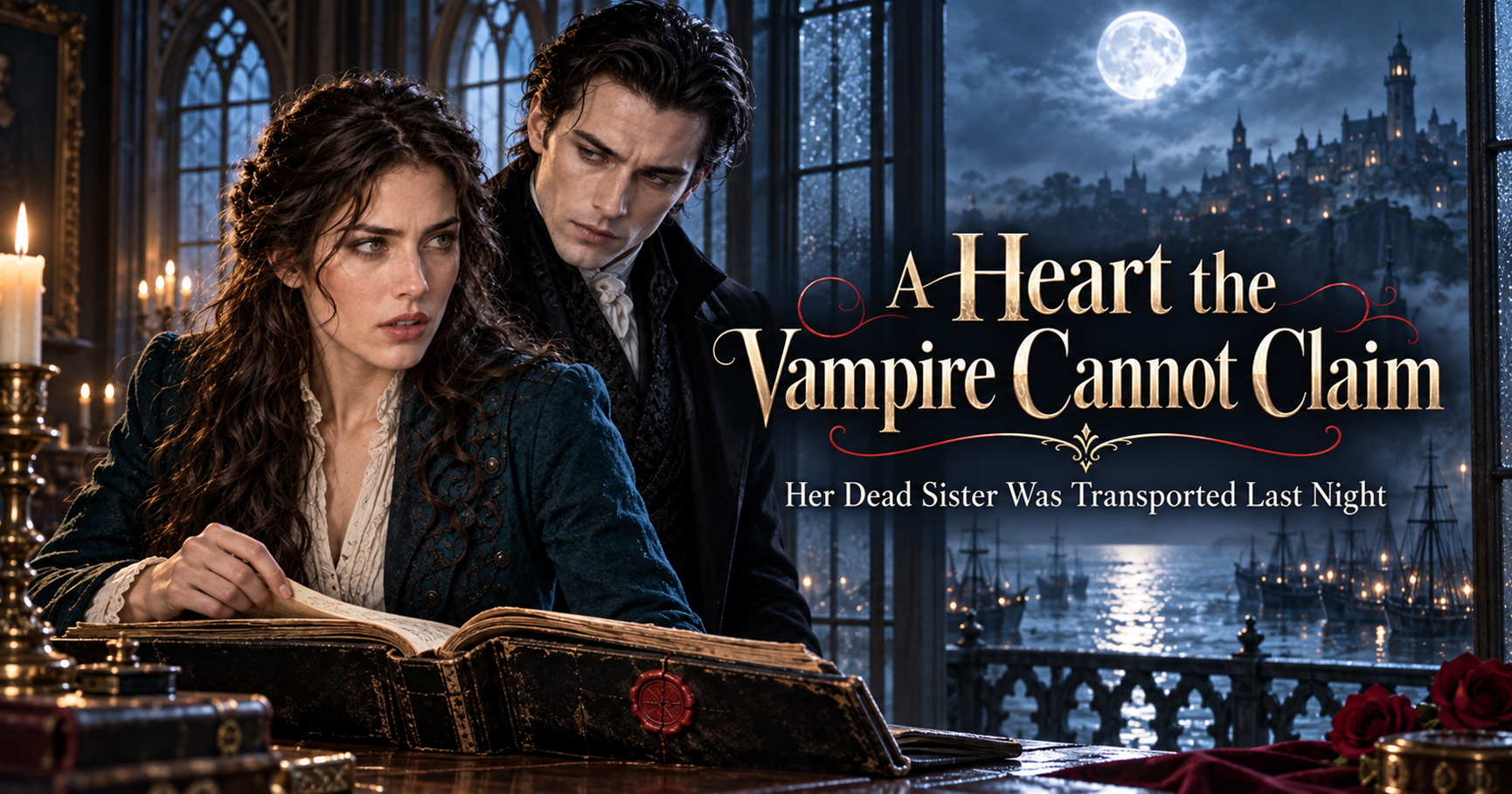
"A Heart the Vampire Cannot Claim" Chapter 10 — What We Refused to Bury
You May Also Like
-
SerialChapter 30

The Reluctant Bride of Vampire
Every century, the human world pays a debt. One bride is sent to the vampire kingdom. Ruby Kingsley volunteered—not out of bravery, but to save her best friend. She expected political schemes, a terrifying court, maybe even death. What she didn’t expect was the vampire prince who refused to leave her alone. Dion Lancaster is centuries-old, powerful, and deadly. He was supposed to view her as a mere bride, a political pawn. But from the moment she arrived, something changed. He starts showing up where she is, watching her, guarding her, and—despite his insistence that humans are “annoying”—acting jealous whenever anyone else comes close. Ruby, the girl who just wanted naps and quiet, now finds herself navigating: a palace full of secrets and intrigue a prince who is impossibly beautiful, terrifyingly possessive, and strangely… human in his obsession daily challenges of surviving the vampire court without losing her mind—or her life He says he isn’t interested. He says humans are weak. He says she’s nothing special. Then why does he: 🩸 track her movements 🩸 insist on being near her every day 🩸 whisper warnings that only she understands 🩸 look at her like she’s the only person left in the worldHealing Romance|Plot Twist|Vampires|Yandere|Possessive Love|Sweet Romance|Arranged Marriage|HE32.2k words5 246 -
SerialChapter 16
The Blood He Waited For
Twelve centuries ago, Lady Aurelia Ravenshire died in the arms of the most feared vampire in history. Count Evander Valmont never recovered. For 1,247 years, he searched for the soul he buried with his own hands, watching kingdoms rise and fall, empires crumble, and centuries disappear into dust. Then he finds her again. Not as a noblewoman. Not as the girl he loved. But as Vivienne Whitmore—a sleep-deprived medical student drowning in exams, student debt, and hospital night shifts. She doesn't remember him. She doesn't remember the castle. She doesn't remember the life they shared. And she certainly doesn't remember dying. But her blood does. The moment a single drop touches the floor, the vampire world descends into chaos. Ancient predators begin hunting her. Old enemies emerge from the shadows. And the immortal man who once lost everything is forced to confront the one truth he fears most: Vivienne may carry Aurelia's soul... But she is not Aurelia. As memories awaken and obsession collides with destiny, Vivienne must decide whether the impossible connection pulling her toward Evander is the promise of a second chance— Or the beginning of another tragedy. Because some loves survive death. The dangerous ones survive eternity.Healing Romance|Age Gap|Dark Secrets|Plot Twist|Vampires|Possessive Love|Redemption Arc|Sweet Romance|HE16.6k words5 179 -
SerialChapter 18
Bound to the Blood Master
For years, I idolized Eduardo—a co-regent of the vampire clan, a man whose golden-streaked hair and almond eyes made my heart race. I believed I was his chosen one, the one destined for his eternity. But in the cold light of day, I discovered the truth: I was nothing more than another toy in his cruel, unscrupulous game. As the sun rises over his dark, imposing mansion, I take my chance. I’m leaping over the walls of the only home I’ve ever known, desperate to leave his madness behind. But just as I reach for freedom, a single word from behind a closing door stops me cold, threatening to pull me right back into his web…Vampires|Possessive Love18.5k words5 63 -
CompletedChapter 38
Thorns and Bone: A Kiss of Embers
"I spent three centuries waiting for a ghost to haunt me. When she finally returned, she was wearing a collar." Cillian de Valcourt is the Sovereign of the Eternal Night, a predator who has ruled for three centuries with nothing but boredom and blood in his veins. He isn’t looking for redemption—he is looking for the only woman who ever came close to killing him. Willow Solence remembers everything. She remembers the steel of her blade against his throat, the fire in his eyes, and the final, shattering moment of their past-life duel. She was the Hunter’s Guild’s deadliest elite, but now, she is reborn into the ultimate nightmare: a low-born blood-servant in the court of her greatest enemy. She is his captive; he is her ruin. In this cutthroat game of political maneuvering and lethal secrets, they are the only two people who truly know the monsters lurking beneath each other’s skin. For Willow, the goal is vengeance—a slow, calculated dismantling of his empire. For Cillian, the goal is possession—a desperate, terrifying obsession that defies time itself. As they dance on the razor’s edge of betrayal, Willow realizes the truth: this resurrection wasn’t a second chance. It was a trap. And in their final, inevitable collision, she discovers that for a man who has lived too long, the only thing sweeter than ruling the world is watching it burn to ashes in her arms. One life to kill him. One death to keep him.Mutual Pining|Dark Secrets|Plot Twist|Vampires|Possessive Love43.4k words5 154 -
CompletedChapter 50
The Alpha’s Defiant Vamp: Beg For Me
Blurb: "I, Alpha Killian Vance, reject you, Evangeline Frost, as my mate." With those cold words, my destiny was shattered. Framed for a crime I didn't commit, rejected by the golden Alpha I had secretly loved for years, I was hunted like an animal by the very pack I called home. Forced to the edge of the border cliff, I chose freedom over a fake trial. I jumped. And the black ocean swallowed the weak, broken Omega whole. Two years later, Blackwood’s invincible Alpha falls into an ambush. He wakes up chained in silver, bleeding and broken, expecting a monster. Instead, I step out of the shadows. No longer a packless slave, but the supreme Sovereign of the Night, burning with lethal hybrid blood and wearing a crown of ruby and ice. I grip his golden hair, forcing his proud head back as my fangs slide out. “Now, Alpha Vance... who is the master, and who is the dog?” Killian is desperate to crawl back to me, his inner wolf begging for my venom, but a Scorpio never forgets. Will the Alpha’s lethal addiction be his salvation, or will my vengeance burn both our kingdoms to ash?Dark Secrets|Plot Twist|Vampires|Werewolves|Glow-Up|Possessive Love|Redemption Arc|HE53.2k words5 228 -
CompletedChapter 54
One Night With The Hidden Alpha
Claire Reyes only wanted one reckless night. One night to forget: the fellowship she lost, the boyfriend who called her “emotionally exhausting,” and the terrifying feeling that no matter how hard she worked, she would never truly be chosen by anyone. Then she met him. Killian Virel walked into the rooftop bar looking less like a billionaire and more like something dangerous pretending to be civilized. Cold eyes. Expensive suit. The kind of man people instinctively moved aside for without understanding why. Claire should have stayed away. Instead, slightly drunk and emotionally wrecked, she looked at the devastating stranger across the room and asked: “Do you want to have a one-night stand with me?” That should have been the end of it. Except Killian touched her like he was trying not to lose control. Looked at her like she already mattered too much. And held her afterward like letting go had become physically difficult. So Claire ran before sunrise. No note. No number. No goodbye. She thought time would bury the mistake. Unfortunately for her, Killian Virel is not a man capable of forgetting. Now the dangerously obsessive billionaire keeps appearing everywhere: outside her campus, waiting after late-night shifts, watching her like he’s restraining something violent beneath perfect composure. And the worst part? Claire is starting to realize his jealousy feels almost… predatory.Dark Humor|Healing Romance|Mutual Pining|Age Gap|Dark Secrets|Plot Twist|Vampires|Werewolves|Possessive Love|HE58.2k words5 1485 -
CompletedChapter 100
He Asked Me To Kill Him
This is not a story about a girl fixing a monster. It’s about: two people raised by violence trying to decide whether love is worth betraying everything that built them. Seraphina’s arc: Learning morality and obedience are not the same thing. Lucien’s arc: Learning immortality stopped being survival the moment he met someone he feared losing.Vampires|Glow-Up99.6k words5 402 -
CompletedChapter 79
The Silver Cross: My Angel, My Monster
I spent ten years waiting for a ghost. He was my Angel—the one who rescued me from the trash, taught me to speak, and whispered that I was precious. But on my fifteenth birthday, he vanished into thin air, leaving me with a heart frozen in time and a silver cross that felt like a leaden weight around my neck. I thought the hardest part was living without him. I was wrong. On my twentieth birthday, the Monster arrived. He didn't come with wings; he came with fangs and eyes the color of fresh martyrs' blood. In one night of crimson snow, he tore the life from my veins and replaced it with a hunger that defies God. He turned me into the very thing my Angel fought to protect me from. But as the Monster drags me into the dark aristocracy of Veridian City, he whispers a truth that shatters my soul: “Your Angel didn't leave you, Aurora. He imprisoned you.” Now, I am caught in a lethal game between the savior who loved me with a lie and the predator who broke me to set me free. One holds the key to my past; the other holds the leash to my future. In a world of eternal night, who do you trust when your Angel wears a mask of thorns, and your Monster is the only one telling the truth?Dark Secrets|Plot Twist|Parallel Universe|Vampires|Possessive Love|Redemption Arc|Second Chance108.0k words5 767