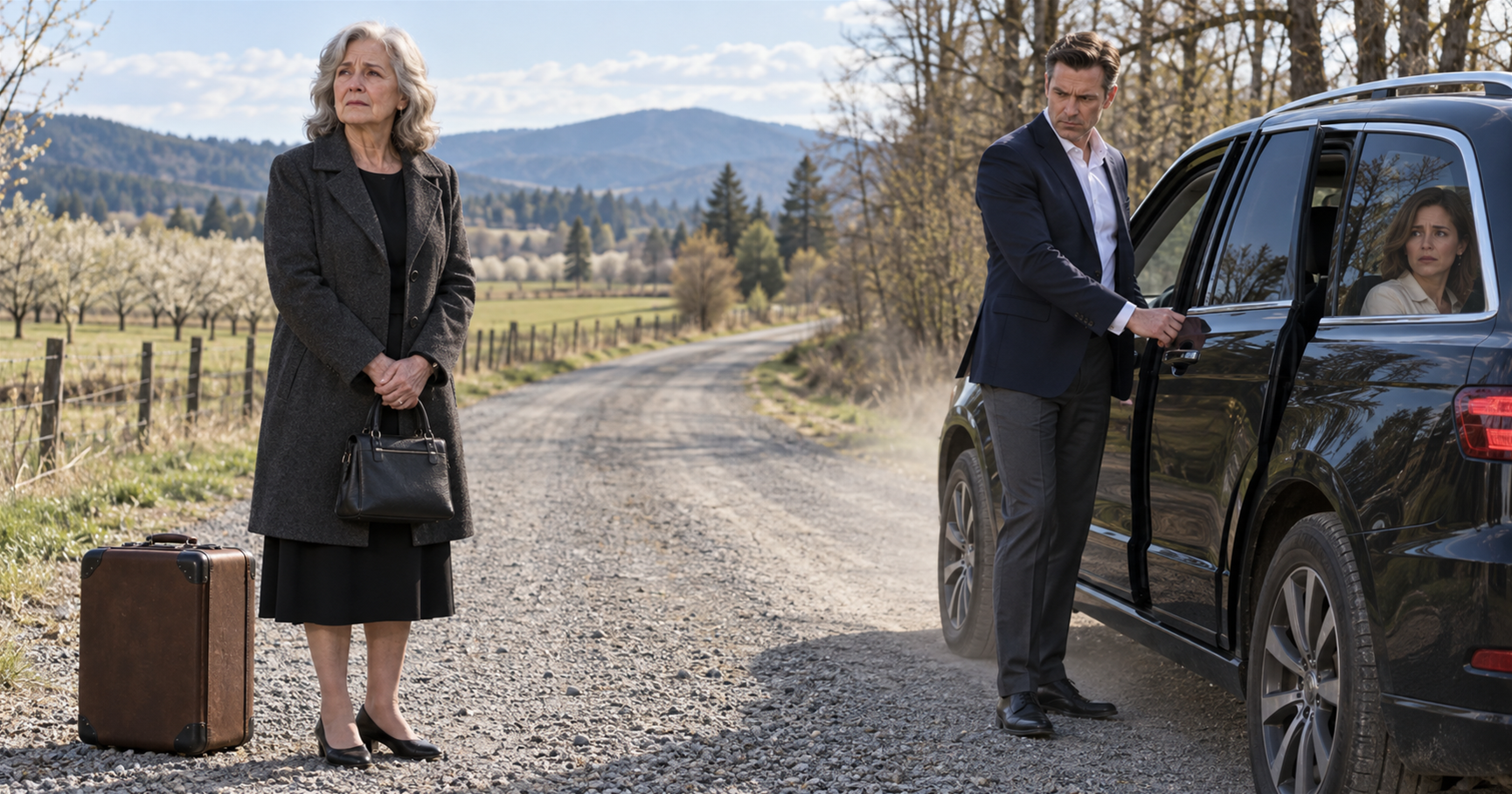
"After my husband's funeral, my son took me to a deserted road and said:" Chapter 1 The Morning After the Funeral
Chapter 1
The Morning After the Funeral
The morning after we buried my husband, I made the coffee Thomas had drunk for forty-three years.
Two scoops of grounds. Six cups of water. Nothing imported, nothing flavored, nothing that needed a machine with blinking lights.
I set his mug beside mine before I remembered there was no one left to drink from it.
For fourteen months, pancreatic cancer had taken something from him every week. First his appetite. Then his strength. Then the steady hands that had grafted pear branches and repaired irrigation valves in freezing rain.
Three days earlier, it had taken the rest.
Outside the kitchen window, the first pale blossoms were opening across Mercer Ridge Orchard. Thomas and I had planted the oldest rows when Grant was still a baby tied to my back in a blue carrier. We had survived late frosts, bad harvests, two recessions, and one fire that came close enough to blacken the south fence.
The orchard had always looked fragile in spring.
It never was.
Footsteps sounded on the stairs at eight fifteen.
My son entered first in gray trousers and a navy blazer. Grant was forty-two now, broad-shouldered and polished, with the careful expression he used when explaining investments to people he believed were slower than he was.
Brooke followed in a cream silk blouse and heels that sank into the old pine floor. My daughter had spent the funeral telling everyone she was launching a new wellness brand in Seattle. She had not mentioned that Thomas and I had already financed the last two.
They sat across from me without touching the toast.
“Mom,” Grant began, “Brooke and I have been talking.”
There are sentences that arrive wearing polite clothes. You do not see the knife until they sit down.
I poured my coffee. “About your father?”
Grant glanced at Brooke.
“About what happens next,” she said.
“What happens next is that Miguel checks the north irrigation line, I call the packing house, and we start thinning the early pears in two weeks.”
Brooke’s smile tightened. “That’s exactly what we mean. You shouldn’t have to worry about any of that now.”
“I have worried about it since 1982.”
“You’ve done more than enough,” Grant said. “But this property is too much for one person. The house alone is nearly four thousand square feet. Then there are the crews, the equipment, the contracts—”
“I know what is here.”
“Of course you do.” His voice had the smoothness of a closed door. “But knowing it and managing it at your age are different things.”
At my age.
My fingers ached around the mug. Arthritis had thickened two knuckles on my right hand, but those fingers had signed every payroll check during the years when we could not afford an office manager. They had driven tractors, packed fruit, balanced ledgers, and held Thomas’s hand while he died.
ADVERTISEMENT
I placed the mug down before either child could see it tremble.
Brooke leaned toward me. “We found a beautiful independent-living community outside Salem. Willow Creek. It has gardens, art classes, transportation, even a greenhouse.”
“How thoughtful.”
She missed the edge in my voice. “We could tour it this week. There’s an apartment available now, but they can’t hold it for long.”
“I buried my husband yesterday.”
For half a second, shame crossed her face.
Grant opened the leather portfolio beside his chair.
“That’s why we need to handle the practical decisions for you.”
He removed a stack of papers and aligned them with the edge of the table. Thomas used to do the same thing with seed catalogs. Seeing the gesture in Grant made something inside me recoil.
“Dad already put a plan in place,” he said.
The first page bore the name Mercer Ridge Agricultural Holdings, LLC. Beneath it were paragraphs dense with transfer language. I read slowly, not because I did not understand, but because Grant was watching for confusion.
The document claimed Thomas had transferred his controlling interest in the orchard company to Grant and Brooke six weeks before his death. Another paper conveyed the farmhouse parcel and most of the working acreage to the same company.
“Your father signed these?” I asked.
“He wanted the business protected.”
“From whom?”
Grant’s jaw shifted. “From uncertainty.”
Brooke slid a glossy folder toward me. On the cover, computer-generated houses stood where our oldest apple trees should have been.
NORTHLINE COMMUNITIES: CEDAR RIDGE DEVELOPMENT.
I opened it.
Curving streets crossed the pasture. A clubhouse covered the packing shed. The hill where Thomas and I had scattered the ashes of three old sheepdogs had become six premium lots with mountain views.
“They offered six-point-eight million dollars,” Brooke said. “We could close the option next week. You’d be taken care of for the rest of your life.”
“Taken care of with money from selling my home.”
“It wouldn’t be like that,” she said quickly.
“What would it be like?”
Grant tapped the papers. “Dad made the decision. We’re carrying it out.”
I turned to the signature page.
Thomas Mercer’s name appeared in dark blue ink, every letter smooth and evenly spaced. A notarial certificate sat beneath it, stamped by someone named Chloe Bennett. The date was April 3.
I saw Thomas as he had been that week: a blanket over his knees, a morphine pump beside the hospital bed, his hand unable to lift a spoon without help. On April 3, he had asked me to write Miguel’s birthday card because the pen kept slipping from his fingers.
The signature in front of me belonged to the man Thomas had been a year earlier.
Not the man he had been on April 3.
I looked up. “Where was this signed?”
“Here,” Grant said. “At the house.”
“Who was present?”
“The notary. Dad. Me, for part of it.”
“And the woman’s name is Chloe Bennett?”
His eyes sharpened. “It’s on the page.”
I let my shoulders sag.
Then I turned through every attachment while pretending the words exhausted me. I memorized Northline’s attorney, the option deadline, the recording reference typed at the top of the deed, and the name of the Portland firm printed in Grant’s footer.
Brooke reached for my hand. “You don’t need to understand all of it tonight.”
“It is morning.”
She released me.
I closed the folder. “I need to lie down.”
Grant studied me for a moment, deciding whether I had surrendered.
“We can continue tomorrow,” he said.
“Leave the papers.”
“I’ll leave copies.”
He collected the signed pages before I could object and returned only the glossy Northline folder and a thin summary. That told me almost as much as the signature had.
I rose slowly, allowing one hand to rest on the table. Grant stepped aside instead of helping me. Brooke began clearing cups with the nervous energy she had shown as a child after breaking something.
At the foot of the stairs sat a brown suitcase.
It was mine.
The brass zipper was closed. A luggage tag with my name had already been fastened to the handle.
I looked from the suitcase to my son.
Grant did not look embarrassed.
“We thought we’d take you there tomorrow.”
ADVERTISEMENT
You May Also Like
-
CompletedChapter 11

My husband disappeared in 2005. On my birthday, I received a card that said "LOOK IN THE BASEMENT."
For twenty years, Eleanor Carter believed her husband had died in the river. Then a birthday card in his handwriting led her to a hidden wall—and proof that he had buried one family to build another.Human Nature11.5k words5 0 -
CompletedChapter 11
He Laughed When I Resigned—Until He Read My Letter and Went Pale!
My father-in-law gave my promised promotion to his niece after eight weeks—then ordered me to train her. He told her I was forty-one, married to his son, and too afraid to start over. So I placed my resignation letter on his desk. He laughed before opening it. By the final line, his face had turned pale. “You can’t leave. She isn’t ready.” “Then you promoted the wrong woman.”Human Nature11.9k words5 0 -
CompletedChapter 11
The Wife He Never Saw
For three years, Willa Hart Vale has lived in the shadow of Celeste Rowan, the first love her husband believes died in a plane crash. Adrian chooses Celeste’s grieving family for every holiday, every emergency, and every moment that should belong to his wife. Then Willa is diagnosed with Stage IIIA breast cancer. She tells Adrian three times. He hears her—and still chooses Celeste’s memorial over Willa’s surgery. But Willa has stopped begging to be seen. Before entering the operating room alone, she files for divorce, removes Adrian from her medical decisions, protects her parents and her work, and schedules one final email. At noon, Adrian will learn the truth about the wife he ignored. And when the woman he mourned suddenly returns alive, he will discover that some choices cannot be undone.Human Nature|Glow-Up|Second Chance11.6k words5 0 -
CompletedChapter 11
When I could no longer drive, I asked my daughter if I could move closer, and then...
After a minor accident forces seventy-two-year-old widower Walt Bennett to stop driving, his isolated rural home becomes a trap. He asks his only daughter, Claire, for one small favor—not a room in her house, not money, not full-time care, but help looking at an apartment twenty minutes away. Before he can finish, his son-in-law says, “We are not running an assisted-living facility.” Claire hears every word and still tells Walt they are too busy to “handle” him. Walt does not argue. The next morning, he calls a realtor. He sells the family home, moves somewhere his daughter cannot control, and quietly begins rewriting an estate plan that once left everything to her. But after a stroke, Claire suddenly returns with flowers, apologies, and questions about whether the new documents can still be changed. Then Walt discovers that her husband knows the exact amount he received from the sale—an amount that was never public. As hidden debts, medical inquiries, and legal threats surface, Walt must decide whether forgiveness requires surrendering his safety—or whether the most powerful legacy he can leave is one his family can never inherit.Human Nature11.7k words5 0 -
CompletedChapter 11
My wife divorced me via email while I was on a mission abroad and emptied our...
Sergeant First Class Ethan Cole is thousands of miles from home when his wife ends their thirteen-year marriage in a three-line email. By the time he reads it, Claire has emptied their joint savings, moved another man into their house, and started rewriting Ethan's life as if he were never coming back. Ethan sends only one reply: “Understood.” Claire mistakes his silence for surrender. It is anything but. While preserving every email, bank record, and security-camera clip, Ethan discovers an unauthorized $180,000 home-equity application bearing a signature that is almost his. The wrong middle initial exposes the forgery, but the money trail leads far beyond an unfaithful wife and her new boyfriend. Someone is preparing to sell Ethan's home before his mission ends—and his may not be the first military family they have targeted. To reclaim his name, his home, and the future they tried to steal, Ethan must fight a battle no uniform prepared him for. This time, the enemy already knows where he lives.Human Nature12.4k words5 0 -
CompletedChapter 11
The Son They Buried Came Back
The Hale family told the world their youngest son was dead. Six years later, Evan Caldwell returns at their charity gala—alive, famous, and carrying proof that his parents used his body to save their favorite child. As the family fights to silence him, Evan turns a stolen childhood, a forged medical record, and a buried ICU recording into a reckoning no amount of money can stop.Human Nature|Glow-Up12.1k words5 0 -
CompletedChapter 11
The House He Never Owned
My seven-year-old daughter was asleep beneath an oxygen line when she asked, "Is Dad coming?" He had ignored seven calls. At that exact moment, his pregnant mistress was standing inside our home, wearing the last birthday gift my mother ever gave me. They had chosen my bedroom for themselves. They had chosen the guest wing for me. And they had chosen my daughter's favorite room for their new baby. I had spent months protecting what remained of my marriage. That morning, I stopped.Human Nature|Glow-Up11.7k words5 5 -
CompletedChapter 11
The Empty Place by the Door
My husband brought his mistress to our daughter's college meeting after she begged him not to. Then he told our eighteen-year-old daughter she needed to be mature about his new relationship. She came home crying. “It feels like Dad picked her,” she whispered. Three days later, my husband announced that he was bringing the same woman to our daughter's birthday dinner. He wanted the family to witness how calmly everyone accepted his choices. I could have refused. Instead, I told my lawyer, “He wants witnesses. I'm ready to give him witnesses.” That evening, his mistress arrived wearing a diamond bracelet I recognized from a company expense record. My husband raised his glass and asked everyone to move forward without bitterness. So I let him finish speaking. Then I told him what I had found.Human Nature|Glow-Up11.8k words5 0 -
CompletedChapter 11
The Woman in Black
Claire Bennett stepped onto the red carpet in black, and Ethan Whitmore’s fiancée blocked her before she reached the hotel. Madison Hale smiled for the cameras, then leaned closer. “You still had the nerve to show up?” Photographers crowded around them. Ethan froze beneath the wall of white roses. Claire didn’t look away. “I have nothing left to hide.” Madison glanced at Claire’s gown and laughed. “Pretty elegant for a woman who got dumped.” The entire red carpet went silent. Claire stepped forward. “And you accepted a man who came to you already used.” Madison’s smile vanished. “At least he chose me.” “Did he choose you, or did he just run toward whatever was easier?” Ethan suddenly moved between them, but Claire’s final words landed first. “A cheater doesn’t choose anyone. He just repeats his mistakes.” Camera flashes exploded. Furious, Madison ordered security to throw Claire out. Then the giant screen above the hotel entrance flickered...Human Nature|Dark Secrets|Plot Twist|Glow-Up|Redemption Arc15.4k words5 4 -
CompletedChapter 11
The Girl Who Texted the Wrong Man
Eight-year-old Emma is hiding in a closet while her mother’s violent boyfriend searches the house for her. Desperate and unable to call for help, she sends a text—but enters one digit wrong. The message reaches Matteo Ricci, the most feared crime boss in Boston. Matteo should ignore it. Instead, Emma’s words awaken a promise he buried twenty-five years ago. As he races through the rain toward a family he has never met, he must decide whether the power he built through fear can finally be used to protect someone innocent.Human Nature|Dark Secrets11.5k words5 2