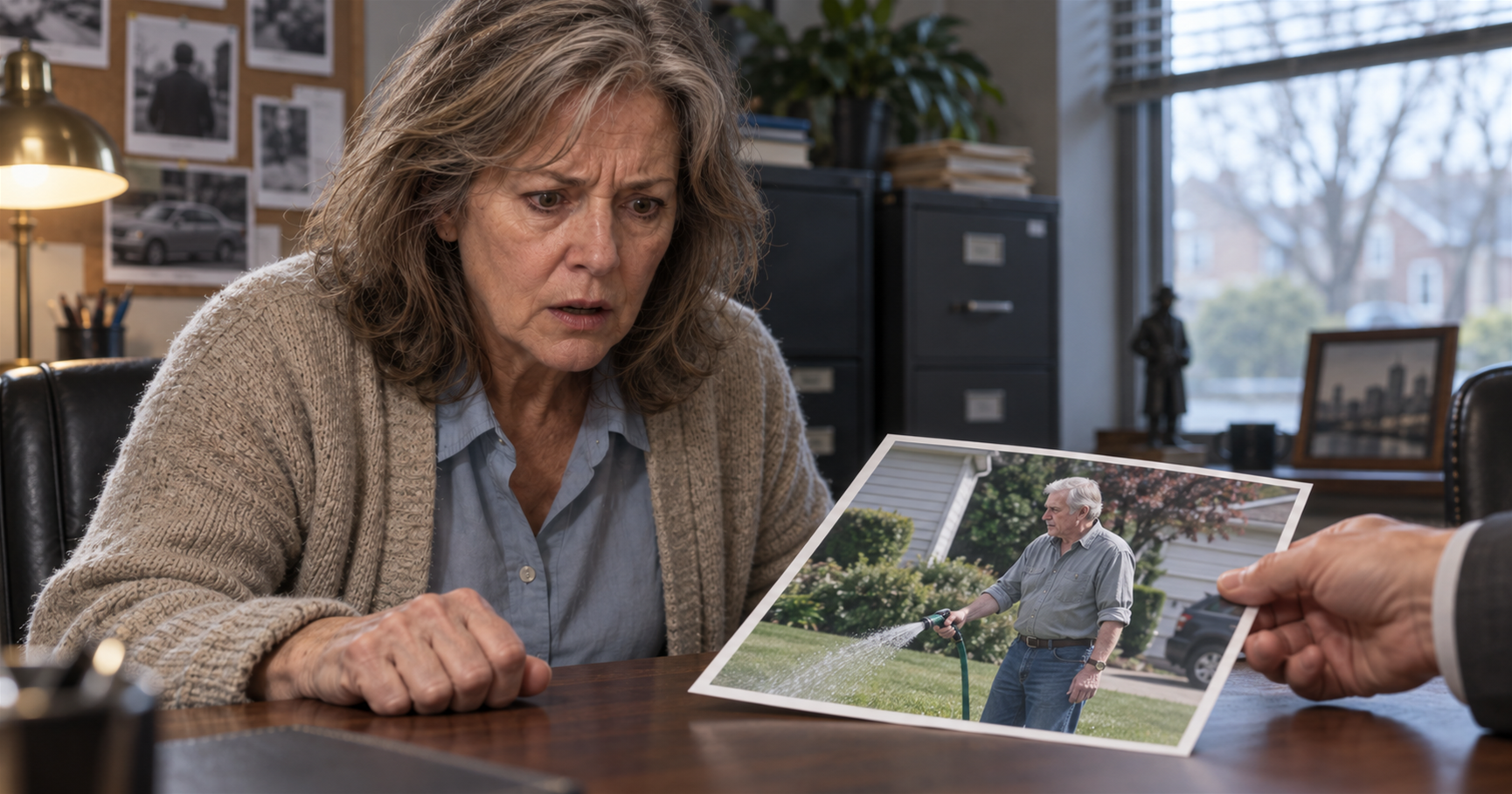
"My husband disappeared in 2005. On my birthday, I received a card that said "LOOK IN THE BASEMENT."" Chapter 6 The Man on the Bench
Chapter 6
The Man on the Bench
I arrived in Cambridge forty minutes early.
Grace had my route, Dana had the make and license plate of my car, and Rebecca had told me three separate times not to sign anything. I sent all of them the same message after parking.
I'm here. I will check in at one.
The park was busy enough to be safe and quiet enough to hear a lie clearly. Children climbed over a red playground structure near the entrance. Two men played chess at a concrete table. Beyond them, a walking path curved past bare trees and a narrow pond.
I chose a bench visible from the parking lot.
At 11:58, a dark sedan entered and stopped three rows from my car.
Thomas stepped out.
For one irrational second, I expected the man from 2005—the brown hair, the straight shoulders, the tweed jacket he wore even when it was too warm. The man crossing the lot was older and smaller. His hair was white. His navy windbreaker hung loosely from his frame.
But he still checked his left pocket after locking the car.
Wallet, keys, phone.
He had performed that little inventory every time we left a restaurant.
Thomas saw me and stopped.
I did not stand.
He approached slowly and sat at the far end of the bench. Between us was enough room for another person, perhaps the woman I had been when he left.
"Eleanor."
Daniel Mercer's voice belonged to my husband.
"Thomas."
His eyes closed briefly at the name.
"I wasn't sure you would come."
"You were sure enough to ask."
"You look well," he said.
It was the kind of sentence people offered at reunions, a bridge made from nothing. Once, I would have thanked him. I would have touched my hair and searched his face for approval.
"You look alive," I said.
His gaze dropped.
"I deserve that."
"This is not about what you deserve. It is about what you did."
He nodded as if my distinction impressed him, as if he were still the teacher and I had finally given the correct answer. That familiar condescension steadied me more than anger could have.
He held a folded sheet of paper. His thumb worried one corner until it softened.
"I don't know how to begin."
"June 21, 2005, would be a reasonable place."
He looked toward the pond.
"I was drowning then. Not in the way everyone thought. I would wake up and feel as if there were no air in the house. Every day was the same. School, dinner, bills, sleep. I didn't know who I was anymore."
"So you became Daniel."
"It wasn't that simple."
"You obtained a license, rented storage space, opened an account, moved $18,700, and kept photographs of another family behind my furnace. Which part was complicated?"
The paper stopped moving in his hand.
"You cataloged everything."
ADVERTISEMENT
"You left evidence."
"I never meant for you to find it like that."
"You told me to look in the basement."
He flinched.
"I mean twenty years ago. I thought I had taken everything important."
"You took your wedding ring off before you left the car. That must have felt important."
"Eleanor—"
"Grace and I stood beside an empty coffin. People told her that her father had killed himself. She spent half her life wondering whether you were terrified when you died."
"I know."
"No. You know the sentence. You do not know what it cost her."
His mouth tightened.
"I thought a clean break would be kinder."
"A divorce would have been a clean break. A goodbye would have been a clean break. You built a grave and made us live beside it."
A woman pushing a stroller passed along the path. Thomas waited until she was out of hearing.
"I was ashamed," he said. "Claire had Owen and Lily. Things had gone too far. Every truth I told would have hurt someone."
"So you chose the two people whose pain you would never have to watch."
He looked at me then.
The old Thomas would have reached for my hand when his arguments failed. This one gripped the paper instead.
"Claire doesn't know," he said. "Neither do the kids. Whatever you think of me, they are innocent."
"Grace was innocent."
"Please don't do this to them."
"Do what? Tell the truth?"
"Destroy their family."
"You keep using other people as places to hide. First you hid behind my grief. Now you're hiding behind theirs."
Color rose along his neck.
"You don't understand what is at stake."
"I understand perfectly. You are afraid Claire will see Thomas Carter sitting inside Daniel Mercer's clothes."
He glanced toward the parking lot as if his second name might be waiting there to rescue him.
"Have you contacted her?"
"No."
Relief crossed his face too quickly.
"Thank God. Eleanor, if you give me time, I can explain this properly. I can protect everyone."
"You have had twenty years."
"A few weeks. That's all I'm asking."
"Rebecca Sloan has already begun the process of confirming that you are alive and that our marriage was never dissolved. Dana's report and copies of the basement records are preserved in more than one place. You cannot put this back behind the wall."
For the first time, he looked frightened.
"You hired a lawyer?"
"Did you expect me to hire a priest?"
"We can settle this privately."
"You mean silently."
"I mean without hurting people who had nothing to do with what happened between us."
"What happened was not between us. It happened to us. You decided. Grace and I paid."
His hand trembled as he unfolded the paper. I saw several lines written in neat blue ink—an apology rehearsed in advance.
"I did love you," he said.
"That does not improve what you did."
"I loved Grace too."
"Then why did you email her under a false name?"
The page slipped from his fingers and landed near his shoe.
"She showed you?"
"You tried to make her think I was hiding the truth for my own sake."
"I only wanted to know whether she was all right."
"You know where she works. You know where she lives. You have been watching from a distance while she believed you were dead. Do not call that love unless you are willing to let her decide what it was."
Thomas bent to retrieve the page, but I placed my shoe over one corner.
"No more prepared speeches," I said. "Answer the question I came to ask."
He straightened slowly.
"What question?"
"Why now?"
The wind moved through the bare branches above us. On the playground, a child shouted for his father, and Thomas's eyes shifted toward the sound.
"Why send a card after twenty years?" I asked. "Why use your handwriting? Why point me toward evidence you spent months hiding?"
"I wrote the card," he said.
"I know."
"I paid a courier to leave it under your door. I needed to be certain you received it before anyone intercepted it."
"Anyone in your house?"
His silence answered.
"You did not confess because you suddenly grew a conscience," I said. "Something happened."
Thomas stared at the pond. The face beside me was old, but the instinct was unchanged: delay, soften, offer only the truth he could still control.
"Tell me," I said.
He looked down at the paper trapped beneath my shoe, then finally met my eyes.
"I sent it because my son found the name Thomas Carter—and gave me thirty days to tell the truth."
ADVERTISEMENT
You May Also Like
-
CompletedChapter 11

He Laughed When I Resigned—Until He Read My Letter and Went Pale!
My father-in-law gave my promised promotion to his niece after eight weeks—then ordered me to train her. He told her I was forty-one, married to his son, and too afraid to start over. So I placed my resignation letter on his desk. He laughed before opening it. By the final line, his face had turned pale. “You can’t leave. She isn’t ready.” “Then you promoted the wrong woman.”Human Nature11.9k words5 0 -
CompletedChapter 11
The Wife He Never Saw
For three years, Willa Hart Vale has lived in the shadow of Celeste Rowan, the first love her husband believes died in a plane crash. Adrian chooses Celeste’s grieving family for every holiday, every emergency, and every moment that should belong to his wife. Then Willa is diagnosed with Stage IIIA breast cancer. She tells Adrian three times. He hears her—and still chooses Celeste’s memorial over Willa’s surgery. But Willa has stopped begging to be seen. Before entering the operating room alone, she files for divorce, removes Adrian from her medical decisions, protects her parents and her work, and schedules one final email. At noon, Adrian will learn the truth about the wife he ignored. And when the woman he mourned suddenly returns alive, he will discover that some choices cannot be undone.Human Nature|Glow-Up|Second Chance11.6k words5 0 -
CompletedChapter 11
After my husband's funeral, my son took me to a deserted road and said:
The morning after Elaine Mercer buries her husband of forty-three years, her adult children arrive at the kitchen table dressed for a business meeting. They already have a retirement community chosen for her, a developer offering $6.8 million for the family orchard, and documents claiming their dying father transferred control before his death. Then Elaine sees the signature. On the date Thomas supposedly signed, he could barely hold a spoon. Elaine hides her suspicion and agrees to visit the retirement community. Instead, her son drives her to an isolated gravel road, sets down a suitcase, and orders her out of the car. Grant thinks he has taken her home, her business, and her last chance to resist. He does not know what Elaine placed in her handbag before leaving the farmhouse: the original deed to eighteen acres purchased before her marriage—land containing the reservoir, pump house, and access route the entire development needs. Abandoned, grieving, and underestimated, Elaine begins walking toward town. What follows is not a loud revenge story, but a calculated fight over forged documents, hidden debt, family betrayal, and the true value of the life she helped build.Human Nature11.5k words5 0 -
CompletedChapter 11
When I could no longer drive, I asked my daughter if I could move closer, and then...
After a minor accident forces seventy-two-year-old widower Walt Bennett to stop driving, his isolated rural home becomes a trap. He asks his only daughter, Claire, for one small favor—not a room in her house, not money, not full-time care, but help looking at an apartment twenty minutes away. Before he can finish, his son-in-law says, “We are not running an assisted-living facility.” Claire hears every word and still tells Walt they are too busy to “handle” him. Walt does not argue. The next morning, he calls a realtor. He sells the family home, moves somewhere his daughter cannot control, and quietly begins rewriting an estate plan that once left everything to her. But after a stroke, Claire suddenly returns with flowers, apologies, and questions about whether the new documents can still be changed. Then Walt discovers that her husband knows the exact amount he received from the sale—an amount that was never public. As hidden debts, medical inquiries, and legal threats surface, Walt must decide whether forgiveness requires surrendering his safety—or whether the most powerful legacy he can leave is one his family can never inherit.Human Nature11.7k words5 0 -
CompletedChapter 11
My wife divorced me via email while I was on a mission abroad and emptied our...
Sergeant First Class Ethan Cole is thousands of miles from home when his wife ends their thirteen-year marriage in a three-line email. By the time he reads it, Claire has emptied their joint savings, moved another man into their house, and started rewriting Ethan's life as if he were never coming back. Ethan sends only one reply: “Understood.” Claire mistakes his silence for surrender. It is anything but. While preserving every email, bank record, and security-camera clip, Ethan discovers an unauthorized $180,000 home-equity application bearing a signature that is almost his. The wrong middle initial exposes the forgery, but the money trail leads far beyond an unfaithful wife and her new boyfriend. Someone is preparing to sell Ethan's home before his mission ends—and his may not be the first military family they have targeted. To reclaim his name, his home, and the future they tried to steal, Ethan must fight a battle no uniform prepared him for. This time, the enemy already knows where he lives.Human Nature12.4k words5 0 -
CompletedChapter 11
The Son They Buried Came Back
The Hale family told the world their youngest son was dead. Six years later, Evan Caldwell returns at their charity gala—alive, famous, and carrying proof that his parents used his body to save their favorite child. As the family fights to silence him, Evan turns a stolen childhood, a forged medical record, and a buried ICU recording into a reckoning no amount of money can stop.Human Nature|Glow-Up12.1k words5 0 -
CompletedChapter 11
The House He Never Owned
My seven-year-old daughter was asleep beneath an oxygen line when she asked, "Is Dad coming?" He had ignored seven calls. At that exact moment, his pregnant mistress was standing inside our home, wearing the last birthday gift my mother ever gave me. They had chosen my bedroom for themselves. They had chosen the guest wing for me. And they had chosen my daughter's favorite room for their new baby. I had spent months protecting what remained of my marriage. That morning, I stopped.Human Nature|Glow-Up11.7k words5 5 -
CompletedChapter 11
The Empty Place by the Door
My husband brought his mistress to our daughter's college meeting after she begged him not to. Then he told our eighteen-year-old daughter she needed to be mature about his new relationship. She came home crying. “It feels like Dad picked her,” she whispered. Three days later, my husband announced that he was bringing the same woman to our daughter's birthday dinner. He wanted the family to witness how calmly everyone accepted his choices. I could have refused. Instead, I told my lawyer, “He wants witnesses. I'm ready to give him witnesses.” That evening, his mistress arrived wearing a diamond bracelet I recognized from a company expense record. My husband raised his glass and asked everyone to move forward without bitterness. So I let him finish speaking. Then I told him what I had found.Human Nature|Glow-Up11.8k words5 0 -
CompletedChapter 11
The Woman in Black
Claire Bennett stepped onto the red carpet in black, and Ethan Whitmore’s fiancée blocked her before she reached the hotel. Madison Hale smiled for the cameras, then leaned closer. “You still had the nerve to show up?” Photographers crowded around them. Ethan froze beneath the wall of white roses. Claire didn’t look away. “I have nothing left to hide.” Madison glanced at Claire’s gown and laughed. “Pretty elegant for a woman who got dumped.” The entire red carpet went silent. Claire stepped forward. “And you accepted a man who came to you already used.” Madison’s smile vanished. “At least he chose me.” “Did he choose you, or did he just run toward whatever was easier?” Ethan suddenly moved between them, but Claire’s final words landed first. “A cheater doesn’t choose anyone. He just repeats his mistakes.” Camera flashes exploded. Furious, Madison ordered security to throw Claire out. Then the giant screen above the hotel entrance flickered...Human Nature|Dark Secrets|Plot Twist|Glow-Up|Redemption Arc15.4k words5 4 -
CompletedChapter 11
The Girl Who Texted the Wrong Man
Eight-year-old Emma is hiding in a closet while her mother’s violent boyfriend searches the house for her. Desperate and unable to call for help, she sends a text—but enters one digit wrong. The message reaches Matteo Ricci, the most feared crime boss in Boston. Matteo should ignore it. Instead, Emma’s words awaken a promise he buried twenty-five years ago. As he races through the rain toward a family he has never met, he must decide whether the power he built through fear can finally be used to protect someone innocent.Human Nature|Dark Secrets11.5k words5 2