"My mother-in-law put something in my drink during a family dinner; I swapped glasses with my husband." Chapter 1 The Special Glass
Chapter 1
The Special Glass
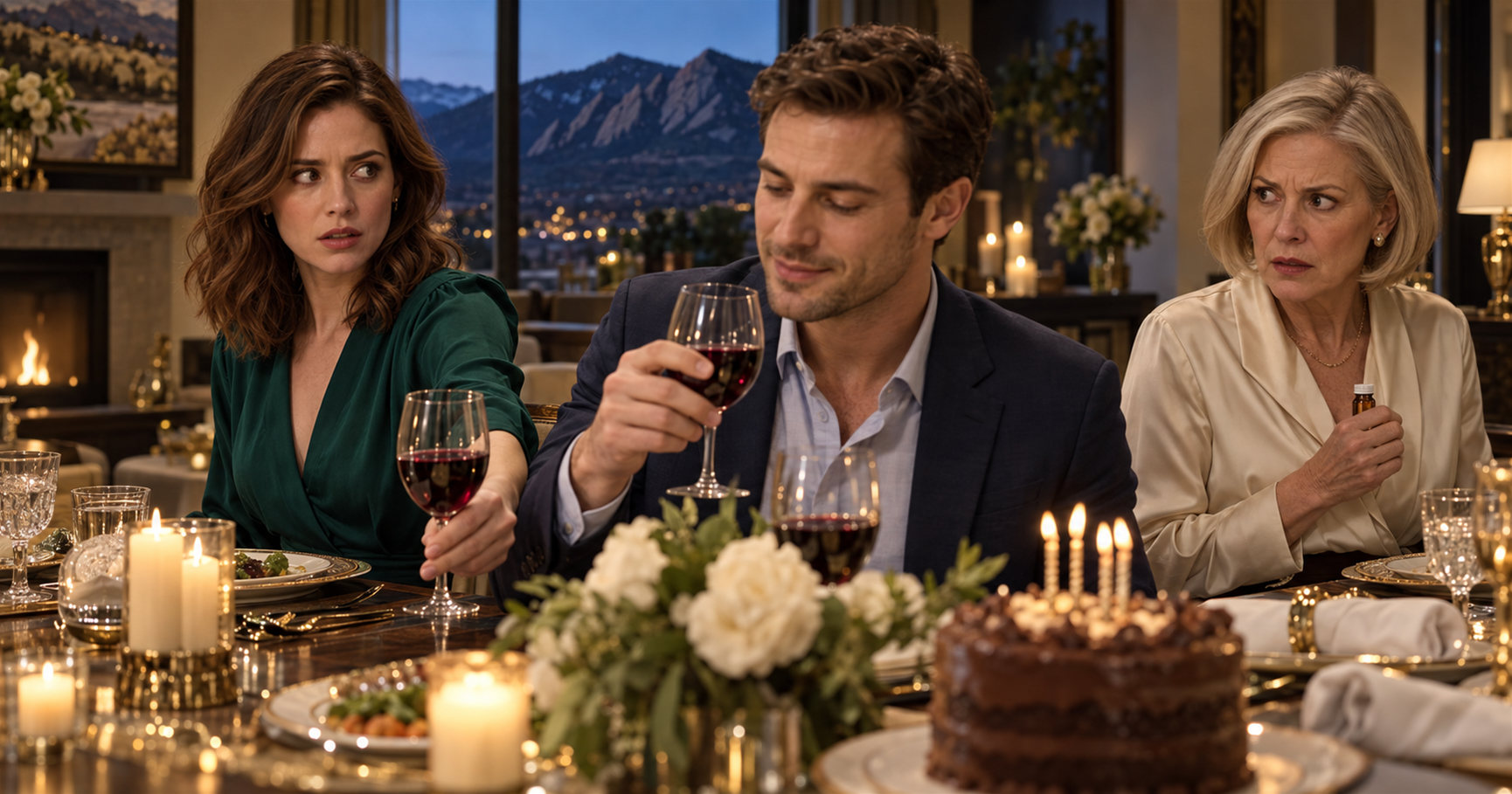
I saw my mother-in-law tip a small glass vial over my drink when she thought I was looking for dessert plates.
The liquid vanished into the pale gold wine without changing its color. Diane Caldwell slipped the vial into the pocket of her silk blouse, turned, and smiled at me.
“There you are, Claire. I made this one especially for you.”
She lifted the glass by the stem. Her hand was steady, but her smile was too wide.
Two minutes earlier, I had been tired enough to ignore almost anything.
I had spent four days above eleven thousand feet photographing a bighorn ewe and her lamb for a Rocky Mountain wildlife feature. Wind had split the skin across my knuckles. I had slept six hours in two nights. My first solo gallery show in Denver opened on Sunday, and I still had twelve prints to inspect.
But it was Diane’s sixtieth birthday, and my husband had asked me to come.
“Just dinner,” Ethan had promised as we drove toward his parents’ house in Boulder. “We’ll leave before nine.”
We both knew his family never let anything be just dinner.
Richard had started before the salad.
“So,” my father-in-law said, cutting into an heirloom tomato, “is the mountain adventure paying actual money, or is this one for exposure?”
“The magazine pays,” I said.
“Enough to cover the equipment?”
Ethan put down his fork. “Dad.”
Richard raised one shoulder. “I’m interested. Photography is an expensive hobby.”
“It’s her career,” Ethan said.
Diane touched her son’s wrist as if calming an agitated child. “Your father only worries. Consulting has benefits, retirement matching, predictable hours. Creative work can be so unstable.”
Across the table, Ethan’s sister, Natalie, stared at her plate. Her husband, Owen, gave me a brief look that said he had heard his own version of this speech.
I had been married to Ethan for three years. I had spent all three bringing expensive wine to the Caldwells’ house, remembering birthdays, praising Diane’s centerpieces, and swallowing every sentence that ended with the suggestion that Ethan had married beneath him.
That night, I had brought a framed photograph of dawn breaking over Longs Peak. Diane thanked me and set it behind two unopened gifts.
After the main course, she announced that she had made her famous chocolate torte. Everyone applauded as if she had cured something.
I offered to help.
In the kitchen, six dessert glasses stood on a silver tray. Five were clustered together. The sixth sat near the sink beside Diane’s purse.
Then she took out the vial.
Now she stood between me and the tray, holding that separate glass toward me.
“What’s in it?” I asked.
“White wine, elderflower, and a little family secret.” Her eyes stayed on mine. “For my favorite daughter-in-law.”
I was her only daughter-in-law.
“You didn’t have to go to any trouble.”
ADVERTISEMENT
“It was no trouble at all.” She moved the glass closer. “Try it.”
There are moments when fear arrives loudly. A slammed door. Tires skidding. A branch cracking behind you in the dark.
This fear was quiet.
It was a clear film on the surface of a drink. It was the memory of Diane asking, three times that week, whether my gallery opening could be postponed. It was the way she had smiled when I told her a curator from New York might attend.
I took the glass.
“Perfect,” she said.
“Let me carry the tray.”
Her fingers tightened on its handles. “I’ve got it.”
“And risk the birthday girl spilling dessert?” I smiled and lifted the other end before she could object. “Never.”
We carried the tray into the dining room together.
Ethan sat to my right. Richard sat at the head of the table, checking an email. Diane began passing out plates, which gave me four seconds when every eye was elsewhere.
I set my glass beside Ethan’s water. Then I asked Richard about the building his firm had just bought downtown.
He launched into an answer.
While Diane turned to cut the torte, I switched my glass with Ethan’s untouched wine.
I told myself he would take one sip. I told myself that if the drink tasted wrong, he would stop. More shamefully, I told myself Diane would never put anything truly dangerous into a glass meant for me.
I needed to know whether I had seen what I thought I had seen.
Ethan lifted the wine.
My pulse struck hard against my throat.
“Wait,” I said.
He paused with the rim near his mouth. “What?”
Diane looked at me.
The challenge in her expression lasted less than a second, but I saw it.
I picked up Ethan’s original glass—the one now in front of me—and forced a laugh. “Nothing. I thought this was yours.”
He took a long drink.
Diane’s face emptied.
For the next twenty minutes, nothing happened.
Richard talked about the market. Diane pushed torte onto everyone. Natalie asked about my show, and I described the largest print, a cow elk standing in smoke after a controlled burn.
Ethan squeezed my knee under the table.
“You okay?” he murmured.
“Just tired.”
I hated how normal he sounded.
At thirty minutes, he rubbed both eyes.
At thirty-five, he dropped his fork.
At forty, his words began sticking together.
“I think I need air.” He pushed back his chair and nearly fell.
I caught his arm. His full weight collapsed against me.
“Ethan?”
His pupils looked wrong. His face had gone slack, and sweat shone along his hairline.
Diane rushed around the table. “He’s exhausted. Richard, help him upstairs.”
“No.” I pulled out my phone. “I’m calling 911.”
Her hand closed over my wrist.
“Don’t be dramatic. He had wine on an empty stomach.”
“He ate three courses.”
“Claire,” Richard snapped. “Put the phone down.”
Ethan tried to say my name. It came out as air.
I made the call.
While Richard lowered him to the rug, Diane disappeared into the dining room. China clattered. Water rushed in the kitchen sink.
She was clearing the table.
I opened my camera and photographed both wine glasses where they stood, the half-eaten dessert, and the wet ring left beside Ethan’s plate. Then I pulled a clean food-storage bag from a drawer, wrapped my hand in a dish towel, and sealed the glass he had used inside it.
Diane came through the doorway and stopped.
“Give me that,” she said.
“No.”
For once, she did not pretend to misunderstand me.
The paramedics arrived six minutes later. I rode with Ethan to the hospital, the sealed glass inside my camera bag and Diane’s stare following me all the way to the ambulance doors.
Near midnight, a doctor found me outside the treatment room.
“Your husband is stable,” she said. “But what we’re seeing is not consistent with two glasses of wine.”
Relief almost folded me in half.
Then I heard heels clicking down the corridor.
Diane stopped beside me. Richard stood behind her, grim and silent.
She waited until the doctor walked away. Then she leaned close enough for me to smell her perfume.
“What exactly did you do with that glass?” she whispered.
ADVERTISEMENT
You May Also Like
-
CompletedChapter 11

The Wedding Toast That Buried Them
Four weeks before her wedding, family-law attorney Emma Hart sees her fiancé kissing her younger sister outside a roadside motel. Instead of confronting them, she preserves the evidence, protects her assets, and waits. Then her sister takes the microphone at the wedding and announces that she is carrying the groom’s baby. But when Emma’s mother demands forgiveness, she awakens a twenty-two-year-old secret powerful enough to destroy far more than one marriage.Human Nature|Glow-Up11.2k words5 0 -
CompletedChapter 11
She Raised Her Golden Daughter on My Inheritance
Emma spent eighteen years being told she was lucky anyone wanted her. Then her biological mother returned with proof: Emma's adoptive parents had received $8,000 a month for her care while forcing her to work—and they had built their golden daughter's life with the money. When Emma discovered a $2.4 million trust in her name, her adoptive father disguised an asset transfer as a wedding loan. He wanted her signature in front of 120 guests. Emma gave him the stage. She just didn't give him the ending he expected.Human Nature11.2k words5 0 -
CompletedChapter 11
The Girl Who Gave the Devil a Flower
Adrian Vale is the man powerful people refuse to look in the eye. At a glittering lakeside wedding, every chair near him remains empty—until four-year-old Lucy Ellis walks straight across the ballroom, tells him he looks lonely, and places a bruised white flower in his hand. Then Adrian notices the wooden swallow around her neck. It bears the unmistakable mark of Samuel Reed, the mechanic who once rescued a homeless teenage boy and gave him a place to land. Samuel is gone now. The exhausted banquet worker searching for Lucy is his daughter, Mara—and she wants nothing from the dangerous man her father once saved. But someone else has noticed Adrian's new weakness. To protect Mara and Lucy, he may have to surrender the empire that made everyone fear him. And Mara must decide whether a man built by violence can truly choose a different life—or whether accepting his protection will cost her the independence she fought so hard to keep.Human Nature11.3k words5 0 -
CompletedChapter 11
My husband disappeared in 2005. On my birthday, I received a card that said "LOOK IN THE BASEMENT."
For twenty years, Eleanor Carter believed her husband had died in the river. Then a birthday card in his handwriting led her to a hidden wall—and proof that he had buried one family to build another.Human Nature11.5k words5 0 -
CompletedChapter 11
He Laughed When I Resigned—Until He Read My Letter and Went Pale!
My father-in-law gave my promised promotion to his niece after eight weeks—then ordered me to train her. He told her I was forty-one, married to his son, and too afraid to start over. So I placed my resignation letter on his desk. He laughed before opening it. By the final line, his face had turned pale. “You can’t leave. She isn’t ready.” “Then you promoted the wrong woman.”Human Nature11.9k words5 0 -
CompletedChapter 11
The Wife He Never Saw
For three years, Willa Hart Vale has lived in the shadow of Celeste Rowan, the first love her husband believes died in a plane crash. Adrian chooses Celeste’s grieving family for every holiday, every emergency, and every moment that should belong to his wife. Then Willa is diagnosed with Stage IIIA breast cancer. She tells Adrian three times. He hears her—and still chooses Celeste’s memorial over Willa’s surgery. But Willa has stopped begging to be seen. Before entering the operating room alone, she files for divorce, removes Adrian from her medical decisions, protects her parents and her work, and schedules one final email. At noon, Adrian will learn the truth about the wife he ignored. And when the woman he mourned suddenly returns alive, he will discover that some choices cannot be undone.Human Nature|Glow-Up|Second Chance11.6k words5 0 -
CompletedChapter 11
After my husband's funeral, my son took me to a deserted road and said:
The morning after Elaine Mercer buries her husband of forty-three years, her adult children arrive at the kitchen table dressed for a business meeting. They already have a retirement community chosen for her, a developer offering $6.8 million for the family orchard, and documents claiming their dying father transferred control before his death. Then Elaine sees the signature. On the date Thomas supposedly signed, he could barely hold a spoon. Elaine hides her suspicion and agrees to visit the retirement community. Instead, her son drives her to an isolated gravel road, sets down a suitcase, and orders her out of the car. Grant thinks he has taken her home, her business, and her last chance to resist. He does not know what Elaine placed in her handbag before leaving the farmhouse: the original deed to eighteen acres purchased before her marriage—land containing the reservoir, pump house, and access route the entire development needs. Abandoned, grieving, and underestimated, Elaine begins walking toward town. What follows is not a loud revenge story, but a calculated fight over forged documents, hidden debt, family betrayal, and the true value of the life she helped build.Human Nature11.5k words5 0 -
CompletedChapter 11
When I could no longer drive, I asked my daughter if I could move closer, and then...
After a minor accident forces seventy-two-year-old widower Walt Bennett to stop driving, his isolated rural home becomes a trap. He asks his only daughter, Claire, for one small favor—not a room in her house, not money, not full-time care, but help looking at an apartment twenty minutes away. Before he can finish, his son-in-law says, “We are not running an assisted-living facility.” Claire hears every word and still tells Walt they are too busy to “handle” him. Walt does not argue. The next morning, he calls a realtor. He sells the family home, moves somewhere his daughter cannot control, and quietly begins rewriting an estate plan that once left everything to her. But after a stroke, Claire suddenly returns with flowers, apologies, and questions about whether the new documents can still be changed. Then Walt discovers that her husband knows the exact amount he received from the sale—an amount that was never public. As hidden debts, medical inquiries, and legal threats surface, Walt must decide whether forgiveness requires surrendering his safety—or whether the most powerful legacy he can leave is one his family can never inherit.Human Nature11.7k words5 0 -
CompletedChapter 11
My wife divorced me via email while I was on a mission abroad and emptied our...
Sergeant First Class Ethan Cole is thousands of miles from home when his wife ends their thirteen-year marriage in a three-line email. By the time he reads it, Claire has emptied their joint savings, moved another man into their house, and started rewriting Ethan's life as if he were never coming back. Ethan sends only one reply: “Understood.” Claire mistakes his silence for surrender. It is anything but. While preserving every email, bank record, and security-camera clip, Ethan discovers an unauthorized $180,000 home-equity application bearing a signature that is almost his. The wrong middle initial exposes the forgery, but the money trail leads far beyond an unfaithful wife and her new boyfriend. Someone is preparing to sell Ethan's home before his mission ends—and his may not be the first military family they have targeted. To reclaim his name, his home, and the future they tried to steal, Ethan must fight a battle no uniform prepared him for. This time, the enemy already knows where he lives.Human Nature12.4k words5 0 -
CompletedChapter 11
The Son They Buried Came Back
The Hale family told the world their youngest son was dead. Six years later, Evan Caldwell returns at their charity gala—alive, famous, and carrying proof that his parents used his body to save their favorite child. As the family fights to silence him, Evan turns a stolen childhood, a forged medical record, and a buried ICU recording into a reckoning no amount of money can stop.Human Nature|Glow-Up12.1k words5 0