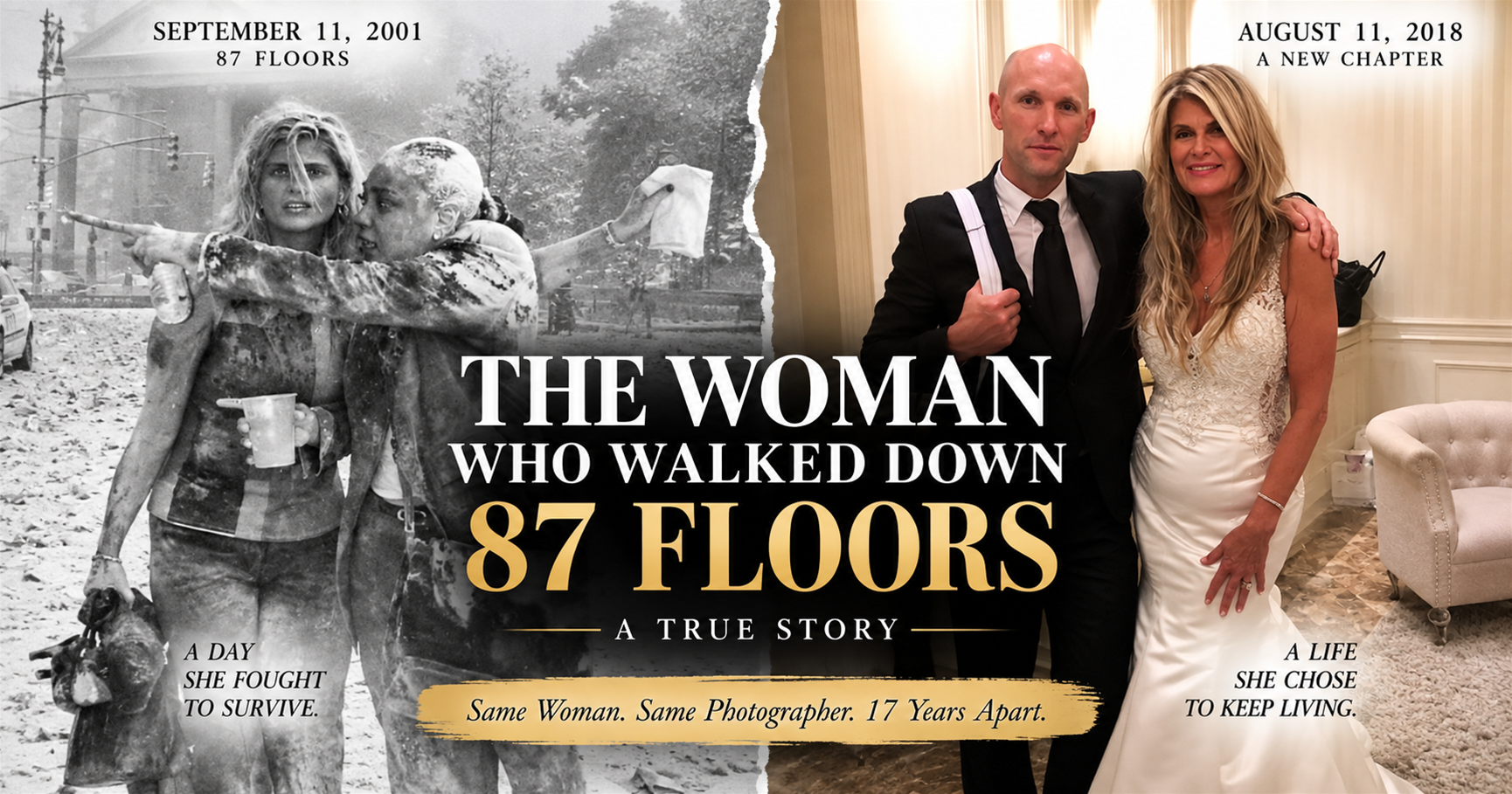
"The Woman Who Walked Down 87 Floors" Chapter 2 — 8:46 A.M.
At 8:46 that morning, Joanne Capestro was 87 floors above Manhattan.
She had almost not gone to work.
Joanne had bronchitis.
She felt tired and run-down, but September 11, 2001 was a Tuesday, and there was work to do.
So she went anyway.
She arrived at the World Trade Center carrying a cup of take-out tea and made her way up to the offices of the May Davis Group in the North Tower.
The 87th floor.
It was the kind of morning nobody remembers until something happens that makes every ordinary detail important.
The elevator ride.
The desk.
The telephone.
The cup sitting beside the paperwork.
Outside the windows was New York City.
Inside was another workday.
Then, at 8:46 a.m., American Airlines Flight 11 struck the North Tower.
Joanne was below the impact zone.
She didn't see the aircraft coming.
What she experienced inside was the building itself.
The 9/11 Memorial & Museum records that Joanne felt something like an earthquake.
The tower moved.
Then came the smell.
Jet fuel.
Something had happened above them.
Something enormous.
And suddenly the fact that Joanne worked on the 87th floor mattered more than anything else.
There were no smartphones to pull from pockets.
No social-media feeds explaining what millions of people outside were beginning to see on television.
Inside the tower, people had only fragments of information.
A violent impact.
A building that had moved beneath their feet.
The smell of fuel.
Confusion.
And one overwhelming question:
How do we get out?
Joanne and several colleagues began looking for a way down.
They found a usable stairwell.
There were 87 floors between them and the street.
They started descending.
The journey sounds simple when reduced to a sentence:
She walked down 87 flights of stairs.
But an office tower does not feel like a number when the elevator is gone.
It becomes one landing.
One door.
One flight.
Then another.
And another.
And another.
Joanne was wearing high heels.
Years later, that detail would become part of her survival story.
But that morning they were simply the shoes she had worn to work.
She kept going.
Something else was happening inside the stairwell.
People were moving in opposite directions.
Office workers were coming down.
Emergency personnel were going up.
The evacuees were moving toward the street.
The rescuers were climbing toward the damaged floors.
Every floor Joanne descended took her farther from the impact.
Every floor the firefighters climbed took them closer to it.
There was no way for Joanne to know what would happen to the building.
There was no way for the people climbing upward to know either.
Everyone had only the information available at that moment.
So the two streams passed each other on the stairs.
One descending.
One ascending.
And Joanne continued down.
87.
88.
89.
The numbers kept falling.
But slowly.
There were still more than eighty floors separating her from the street.
ADVERTISEMENT
Then seventy.
Then sixty.
The descent continued.
Somewhere along the way was one of Joanne's coworkers:
Harry Ramos.
Harry worked at May Davis Group too.
He was also trying to escape the North Tower.
They kept descending.
Eventually they reached approximately the 30th floor.
And there, the story of Harry Ramos changed.
According to later accounts of Joanne's escape, Harry encountered someone who needed help.
He stopped.
Joanne continued downward.
The two expected to meet again outside.
But Harry Ramos never made it out of the North Tower.
That fact would become part of Joanne's memory of the day—and years later, another object recovered from Ground Zero would carry his name back into her story. The 9/11 Memorial & Museum records that Joanne eventually donated her recovered World Trade Center identification card in memory of Harry Ramos.
But Joanne did not know any of that yet.
On the morning of September 11, there was only the stairwell.
And the street was still dozens of floors below.
She continued.
Floor after floor.
The farther she descended, the closer she came to something that had seemed almost impossibly distant only minutes earlier:
ground level.
Eventually, Joanne reached the bottom.
She emerged from the North Tower.
After starting on the 87th floor, she had made it outside.
CBS would later summarize her escape simply: she walked down 87 flights and got outside, barely reaching safety.
But Joanne's escape from the building was not the end of her escape.
It was only the beginning of the next part.
Because while she had been descending inside the North Tower, the disaster outside had changed.
At 9:03 a.m., a second aircraft had struck the South Tower.
Now both towers were burning.
Joanne was finally at street level.
She had survived the stairs.
She was outside.
And then the South Tower collapsed.
The 9/11 Memorial & Museum's account places Joanne reaching street level just as the South Tower came down.
The streets disappeared behind a wall of dust and debris.
Joanne ran.
Near St. Paul's Chapel, she sheltered behind a vehicle.
A firefighter helped her.
Eventually she encountered a coworker who accompanied her away from the area.
The woman who had entered the World Trade Center that morning carrying tea was now covered in gray dust.
She would not make it home to Brooklyn until late that afternoon.
But something else from her ordinary morning was missing.
Her World Trade Center identification card.
Joanne had no reason to think she would ever see it again.
The North Tower would collapse at 10:28 a.m.
Her office on the 87th floor would disappear with it.
Yet somewhere inside the enormous field of wreckage left at Ground Zero...
Joanne Capestro's ID card survived.
And years later, it would come back to her.
— End of Chapter 2 —
Next: Chapter 3 — 87 Flights of Stairs
ADVERTISEMENT
You May Also Like
-
CompletedChapter 10

THE MAN NOBODY COULD NAME
Survivors of the South Tower remembered an unidentified young man in a red bandana who found a stairway, helped the injured, and repeatedly returned to the devastated 78th floor. Months later, Alison Crowther recognized the detail that revealed the rescuer as her 24-year-old son, Welles. His story connects eyewitness testimony, a family object, and one of the most enduring acts of civilian heroism from September 11.Stories Behind 9/114.8k words5 45 -
CompletedChapter 10
THE WOMAN THEY REFUSED TO LEAVE BEHIND
Josephine Harris was descending from the 73rd floor of the North Tower when an injured leg slowed her. Six firefighters from Ladder Company 6 refused to leave her and matched her pace toward the lower floors. When the tower collapsed around them, a surviving section of Stairwell B turned their decision into one of September 11’s most extraordinary—and most carefully misunderstood—survival stories.Stories Behind 9/116.8k words5 42 -
CompletedChapter 10
THE MORNING HE NEVER REACHED THE 105TH FLOOR
Howard Lutnick survived September 11 because he took his oldest son to his first day of kindergarten instead of going to Cantor Fitzgerald’s offices high in the North Tower. The company lost 658 employees, including his brother and best friend. This verified story follows what came next: controversy, a five-year profit pledge, a decade of health coverage, an open door for the children left behind, and an annual charitable tradition built from the firm’s devastating loss.Stories Behind 9/116.8k words5 49 -
CompletedChapter 10
THE GUIDE DOG WHO WENT DOWN 78 FLOORS
Michael Hingson was working on the 78th floor of the North Tower when Flight 11 struck above him. This verified account follows Michael, his guide dog Roselle and colleague David Frank through the stairwell, past firefighters climbing upward, into the street and below ground during the South Tower’s collapse. More than a heroic-dog story, it reveals how a real guide-dog partnership—and several people sharing different kinds of information—survived one of the defining events of September 11.Stories Behind 9/116.9k words5 69 -
CompletedChapter 10
THE CHAIR THAT CAME DOWN 69 FLOORS
When Flight 11 struck the North Tower, Port Authority accountant John Abruzzo could not evacuate by stairs. Ten coworkers placed him in an emergency chair installed after the 1993 bombing and carried him down 69 floors. Their documented escape—and the chair now preserved by the 9/11 Museum—reveals how preparation, disability inclusion, and an extraordinary decision made before the tower fell changed eleven lives.Stories Behind 9/11|Survival7.1k words5 277