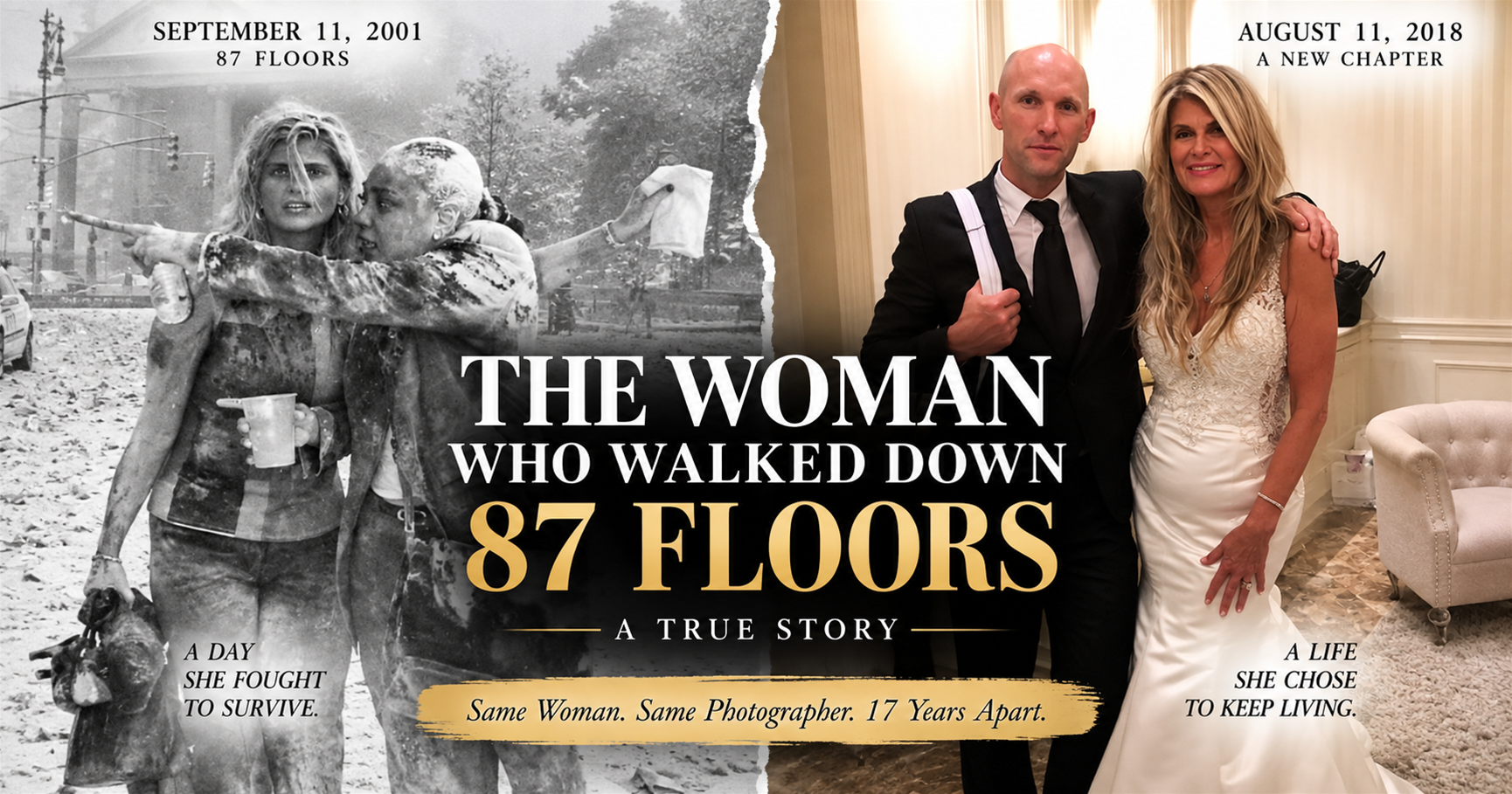
"The Woman Who Walked Down 87 Floors" Chapter 5 — When the Sky Turned Black
Joanne Capestro had made it out.
Eighty-seven floors.
Dozens of stairwell landings.
Heat.
Jet fuel fumes.
Firefighters climbing past her in the opposite direction.
And finally—
the street.
For the first time since American Airlines Flight 11 struck the North Tower, there was no ceiling above Joanne's head.
She was outside.
She was alive.
But she was not safe.
Because at almost exactly the moment Joanne reached street level, another skyscraper began to fall.
The South Tower was collapsing.
It was 9:59 a.m.
For 56 minutes, the South Tower had burned after being struck by United Airlines Flight 175.
Then it began to come down.
From the streets of Lower Manhattan, the sound was enormous.
People started running.
Joanne ran too.
She had just spent roughly twenty minutes coming down from the 87th floor.
Now there was no staircase.
No floor number.
No orderly line.
Only the street.
And something enormous coming from behind her.
The collapse pushed a massive cloud of dust and debris through Lower Manhattan.
Buildings disappeared behind it.
Cars disappeared.
People disappeared.
Daylight itself seemed to disappear.
Joanne ran toward St. Paul's Chapel. The 9/11 Memorial & Museum's account specifically records that she fled in terror in that direction as the South Tower collapsed.
Then the cloud reached her.
Everything changed.
The woman who had gone to work that morning in office clothes was covered in dust.
Her hair.
Her face.
Her clothes.
The air around her.
Joanne sought shelter behind a vehicle near St. Paul's Chapel.
According to the Museum's collection record, a firefighter assisted her there.
Then the worst of the cloud began to move past.
Joanne was still alive.
She emerged into a Lower Manhattan that no longer looked like the place where she had arrived for work that morning.
Dust covered everything.
Paper and debris filled the streets.
People walked through the haze looking almost colorless.
Some still wore clean business clothes because they had been farther from the collapse.
Others were coated from head to toe.
Joanne belonged to the second group.
And she was alone.
Her May Davis coworkers had scattered during the evacuation.
Harry Ramos would never come out.
Joanne still had to get away from the World Trade Center.
Then, through the dust, she encountered someone she knew.
Her coworker Dominique.
Against extraordinary odds, the two women had found each other again in the streets.
They decided to continue together.
By then Joanne was no longer wearing the heels that had carried her down much of the tower.
She was moving in stockinged feet.
Dominique stayed beside her.
Joanne put an arm around her coworker.
They walked.
There was no dramatic conversation recorded between them.
No perfect sentence preserved for history.
What survives instead is something more powerful:
a photograph.
But the man who would take it had experienced an entirely different morning.
His name was Phil Penman.
ADVERTISEMENT
And when the first plane hit, Phil wasn't inside the World Trade Center.
He was a photographer.
He grabbed his camera and headed toward the disaster.
Penman photographed what unfolded around him.
Emergency workers.
Survivors.
The streets.
The aftermath.
He later described those hours as only the beginning of a much longer emotional experience. For the following year, his work repeatedly brought him into contact with funerals and families who had lost loved ones.
But on September 11 itself, he kept photographing.
At one point he was inside, photographing the strange mixture of people taking shelter.
Some looked almost untouched.
Others were completely coated in ash.
Then he returned to the street.
People began emerging from the debris cloud.
Phil raised his camera.
One photograph.
Then another.
Faces appeared through the gray.
He didn't know most of their names.
They didn't know his.
Then two women came into view.
They were walking near Broadway and Park Row.
Both were covered in dust.
One woman had her arm around the other.
The woman on the left was Joanne Capestro.
The same Joanne who had started her morning on the 87th floor.
The same Joanne who had walked down the North Tower.
The same Joanne who had reached street level as the South Tower collapsed.
Phil Penman saw her through his viewfinder.
Joanne stared forward.
She did not pose.
She did not stop.
She did not know the photographer.
Phil pressed the shutter.
Click.
The moment lasted a fraction of a second.
Then Joanne and Dominique kept walking.
Phil continued photographing.
Nobody standing on that street could have known what would happen to the image.
Joanne eventually made her way away from the area.
She would not reach her home in Brooklyn until late that afternoon.
Phil's photographs would eventually travel much farther.
They were published.
Preserved.
Seen by people who had never met the survivors inside them.
And years later, photographs from that morning would enter the collection of the National September 11 Memorial & Museum.
One of them showed two women emerging from the dust.
The Museum identifies the woman on the left:
Joanne “JoJo” Capestro.
For Joanne, however, September 11 did not end when she reached Brooklyn.
She had survived.
Harry Ramos had not.
Her office was gone.
People she knew were gone.
And the woman photographed walking through Lower Manhattan would have to learn how to live with having been one of the people who made it out.
The 9/11 Memorial later documented Joanne's struggle with survivor guilt, grief and post-traumatic stress in the months following the attacks.
Phil had his own aftermath.
The photographer who captured strangers in the streets continued documenting families and funerals.
Years passed.
Joanne lived her life.
Phil lived his.
The photograph existed between them.
But they did not know each other.
Then, in 2016, Phil brought his September 11 photographs to the 9/11 Memorial Museum.
Museum staff began reviewing them.
They stopped at one image.
Two women.
Covered in dust.
Walking together.
The curators recognized one of them.
They already knew her.
Because Joanne Capestro had previously donated objects from September 11 to the Museum.
For years, Phil had possessed a photograph of a stranger.
Now the stranger had a name.
Joanne Capestro.
And the Museum had a question.
Would the photographer like to meet the woman in his picture?
— End of Chapter 5 —
Next: Chapter 6 — The Photograph
ADVERTISEMENT
You May Also Like
-
CompletedChapter 10

THE MAN NOBODY COULD NAME
Survivors of the South Tower remembered an unidentified young man in a red bandana who found a stairway, helped the injured, and repeatedly returned to the devastated 78th floor. Months later, Alison Crowther recognized the detail that revealed the rescuer as her 24-year-old son, Welles. His story connects eyewitness testimony, a family object, and one of the most enduring acts of civilian heroism from September 11.Stories Behind 9/114.8k words5 45 -
CompletedChapter 10
THE WOMAN THEY REFUSED TO LEAVE BEHIND
Josephine Harris was descending from the 73rd floor of the North Tower when an injured leg slowed her. Six firefighters from Ladder Company 6 refused to leave her and matched her pace toward the lower floors. When the tower collapsed around them, a surviving section of Stairwell B turned their decision into one of September 11’s most extraordinary—and most carefully misunderstood—survival stories.Stories Behind 9/116.8k words5 42 -
CompletedChapter 10
THE MORNING HE NEVER REACHED THE 105TH FLOOR
Howard Lutnick survived September 11 because he took his oldest son to his first day of kindergarten instead of going to Cantor Fitzgerald’s offices high in the North Tower. The company lost 658 employees, including his brother and best friend. This verified story follows what came next: controversy, a five-year profit pledge, a decade of health coverage, an open door for the children left behind, and an annual charitable tradition built from the firm’s devastating loss.Stories Behind 9/116.8k words5 49 -
CompletedChapter 10
THE GUIDE DOG WHO WENT DOWN 78 FLOORS
Michael Hingson was working on the 78th floor of the North Tower when Flight 11 struck above him. This verified account follows Michael, his guide dog Roselle and colleague David Frank through the stairwell, past firefighters climbing upward, into the street and below ground during the South Tower’s collapse. More than a heroic-dog story, it reveals how a real guide-dog partnership—and several people sharing different kinds of information—survived one of the defining events of September 11.Stories Behind 9/116.9k words5 69 -
CompletedChapter 10
THE CHAIR THAT CAME DOWN 69 FLOORS
When Flight 11 struck the North Tower, Port Authority accountant John Abruzzo could not evacuate by stairs. Ten coworkers placed him in an emergency chair installed after the 1993 bombing and carried him down 69 floors. Their documented escape—and the chair now preserved by the 9/11 Museum—reveals how preparation, disability inclusion, and an extraordinary decision made before the tower fell changed eleven lives.Stories Behind 9/11|Survival7.1k words5 277