Current location: Novel nest The Woman Who Walked Down 87 Floors Chapter 6 — The Photograph

"The Woman Who Walked Down 87 Floors" Chapter 6 — The Photograph

For fifteen years, Phil Penman had a photograph of a woman whose name he did not know.

He knew where he had taken it.

Lower Manhattan.

September 11, 2001.

He knew what had happened only minutes before.

The South Tower had collapsed.

A cloud of dust and debris had swallowed the streets around the World Trade Center.

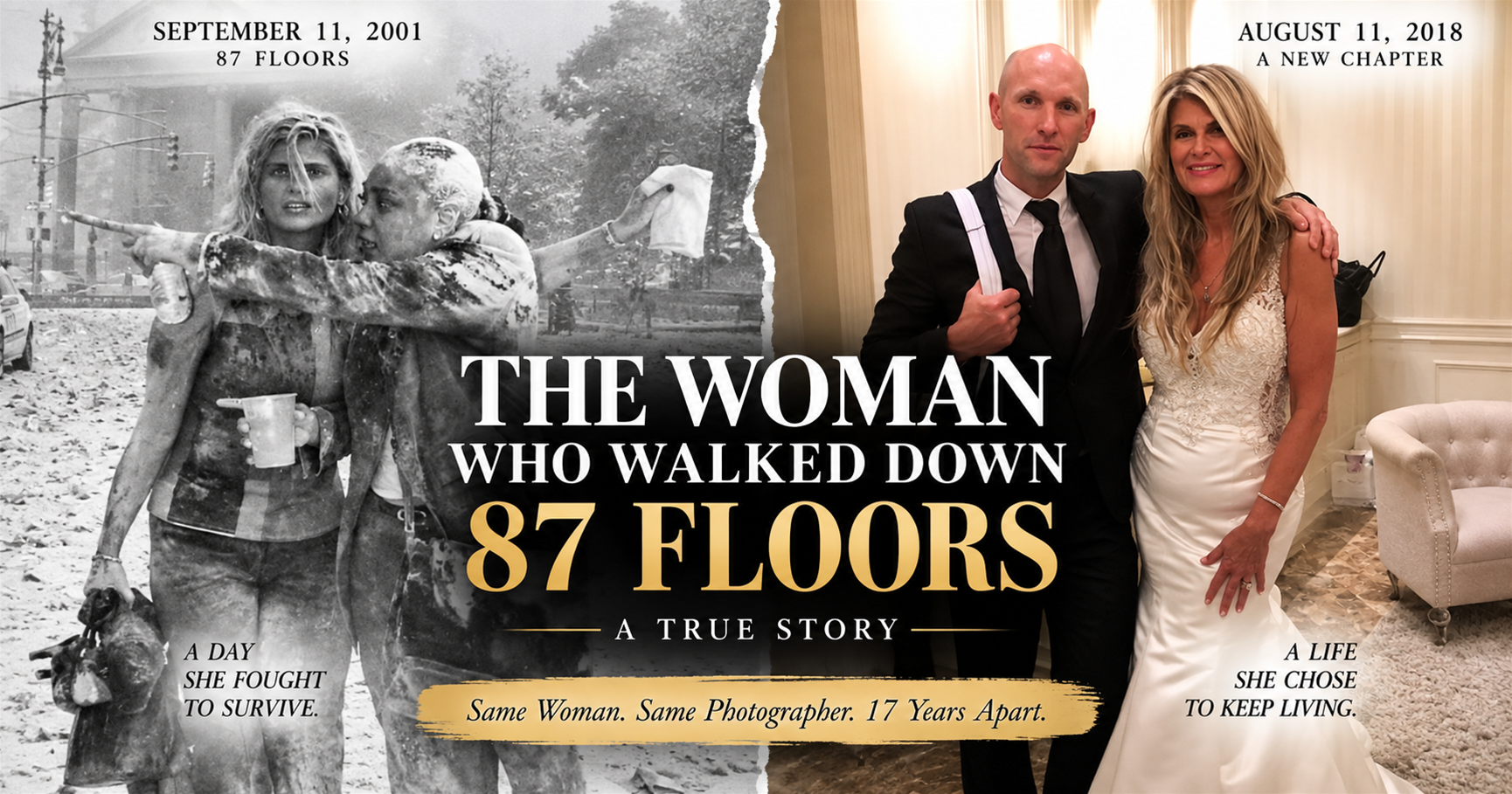
And when people began emerging from that cloud, Phil had raised his camera.

Among them were two women.

Both were covered in gray dust.

One walked in stockinged feet.

Her arm was around her coworker.

Her eyes looked straight ahead.

Phil pressed the shutter.

Then the women continued walking.

There was no introduction.

No exchange of names.

No reason to believe their paths would ever cross again.

The woman on the left was Joanne “JoJo” Capestro.

But Phil wouldn't learn that for years.

The photograph had captured only a fraction of a second.

What it could not show was everything Joanne had already survived.

That morning, she had arrived at work sick with bronchitis.

She had carried take-out tea into the North Tower and gone to her office at May Davis Group.

The 87th floor.

At 8:46 a.m., American Airlines Flight 11 struck the tower above her.

The impact knocked Joanne from her seat.

Her tea spilled.

Ceiling tiles fell.

She smelled jet fuel.

Joanne and her coworkers found the nearest emergency stairwell—the only one on their floor that remained intact—and began descending.

On the stairs, civilians kept to one side.

Emergency responders carrying heavy equipment moved upward on the other.

Joanne kept going down.

Eventually, the May Davis employees became separated.

One of them, Harry Ramos, would never make it outside.

Joanne did.

She reached street level around the time the South Tower collapsed.

Then she ran toward St. Paul's Chapel.

When the debris cloud began to clear, Joanne found another May Davis friend, Dominique.

Together they continued away from the World Trade Center.

Joanne was in stockinged feet.

Dust covered both women.

And somewhere along their path, they walked directly into Phil Penman's viewfinder.

Click.

One second.

One photograph.

Two strangers.

Then their lives separated.

Phil's photograph traveled farther than Joanne did that day.

His September 11 images were published internationally.

But for Phil, photographing the attacks wasn't something that ended when he put down his camera.

For the following year, assignments repeatedly brought him back to the human consequences of September 11.

Funerals.

Families who had lost loved ones.

Stories connected to the attacks.

Years later, Phil described the emotional impact of continually witnessing other people's grief.

Joanne was dealing with a different aftermath.

She had survived.

But survival brought its own burden.

The 9/11 Memorial & Museum records that Joanne struggled with post-traumatic stress, survivor guilt and grief over Harry Ramos.

Her coworker had been inside the same building.

He had begun the same evacuation.

Joanne reached the street.

ADVERTISEMENT

Harry didn't.

Life continued.

But September 11 remained with both Joanne and Phil.

In different ways.

Joanne kept objects from that morning.

Her dust-covered clothing.

Items from her pocketbook.

Objects that had once been completely ordinary had become physical pieces of a day she would never forget.

Eventually, she donated material connected with her experience to the National September 11 Memorial & Museum.

Phil kept his photographs.

Years became a decade.

Then more.

The photographer knew the faces in his images represented real people with entire lives beyond the moment he had captured.

But he didn't necessarily know who they were.

Then came 2016.

Phil decided to show his September 11 work to the 9/11 Memorial Museum.

Museum curators began reviewing the photographs.

Image after image.

The towers.

The streets.

The dust.

The people.

Then they reached photographs containing a familiar face.

The woman covered in dust.

The woman walking beside her coworker.

The woman Phil had photographed without ever learning her name.

Museum staff recognized her.

They knew exactly who she was.

Joanne Capestro.

There was a reason.

Joanne had already donated objects from September 11 to the Museum.

The curatorial team had encountered her story before.

Now, years later, another piece of that story had appeared in front of them.

Except this time it had come from the other side of the camera.

The Museum had Joanne's story.

Phil had Joanne's photograph.

And until that moment, those two pieces had never fully connected.

The curators wondered whether Phil might want to meet the woman he had photographed.

And whether Joanne might want to meet him.

After all those years, the stranger finally had a name.

A meeting was arranged at Joanne's downtown office.

There was no dust cloud this time.

No collapsing tower.

No reason to run.

Phil walked in.

Joanne saw him.

They hugged.

Phil later recalled that they talked about what each of them had experienced since September 11 and how their lives had changed.

For the first time, Joanne was standing face-to-face with the man who had preserved one of the most extraordinary moments of her life.

And Phil was finally speaking to the woman who had walked through his camera frame fifteen years earlier.

Joanne thanked him.

Not simply for taking a photograph.

But for what that photograph eventually meant to her.

She later explained it in a short sentence:

“That picture gave me a lot of closure.”

Think about what the photograph showed.

Joanne was covered in dust.

Her office was gone.

Her coworker Harry would never return.

She had just escaped one of the most catastrophic events in American history.

Yet the photograph also proved something else.

She was there.

Outside.

Walking.

Alive.

The camera had frozen the evidence.

Perhaps that was part of why the image mattered so much years later.

It didn't show Joanne on the 87th floor.

It didn't show the aircraft hitting the tower.

It didn't show the staircase.

It didn't show Harry Ramos.

It didn't show the moment the South Tower collapsed.

It showed what came afterward.

A woman continuing to walk.

Joanne and Phil did not lose contact after that meeting.

They stayed in touch.

Their relationship was unusual.

They had not met through school.

Or work.

Or friends.

They were connected by a fraction of a second on one of the darkest mornings in New York City's history.

Phil had been behind the camera.

Joanne had been in front of it.

Neither had chosen the circumstances that brought them together.

But now they knew each other.

Years continued to pass.

Joanne rebuilt her life.

She became involved in charitable work, including fundraising connected with Hurricane Sandy, Hurricane Harvey and the American Cancer Society. The 9/11 Memorial documented those efforts when recounting her connection with Phil.

Phil continued his photography.

September 11 remained part of both their lives.

But it was no longer the only thing connecting them.

Then, seventeen years after the photograph was taken, Joanne was preparing for something completely different.

A wedding.

Her wedding.

She was going to marry Robert Vasquez.

There would be flowers.

Family.

Friends.

A white dress.

And photographs.

Joanne needed someone behind the camera.

There were thousands of wedding photographers she could have called.

Instead, she chose the photographer who had captured her on September 11.

Phil Penman.

Phil accepted.

On August 11, 2018, he raised his camera toward Joanne Capestro again. Phil's own archive identifies the date and records Joanne's marriage to Robert Vasquez.

Seventeen years earlier, she had stood before his lens covered in gray dust.

This time—

Joanne was wearing white.

— End of Chapter 6 —

Next: Chapter 7 — Seventeen Years Later

ADVERTISEMENT

You May Also Like

Compartilhar Link

Copie o link abaixo para compartilhar com seus amigos: