Current location: Novel nest The Woman Who Walked Down 87 Floors Chapter 7 — Seventeen Years Later

"The Woman Who Walked Down 87 Floors" Chapter 7 — Seventeen Years Later

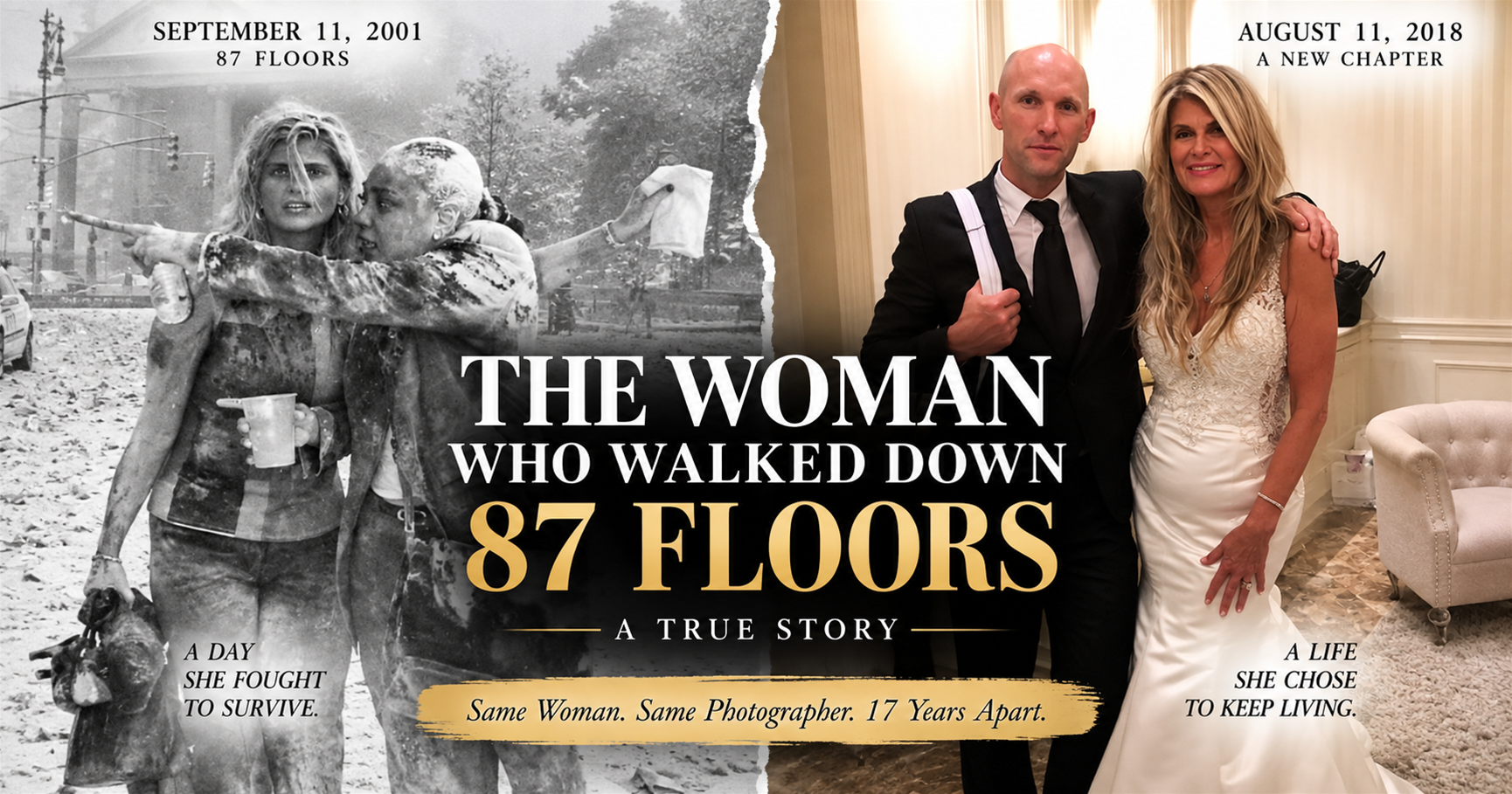
Seventeen years earlier, Phil Penman had photographed Joanne Capestro on one of the worst days of her life.

She was covered in gray dust.

Her hair was coated with it.

Her clothes were almost colorless.

She had just escaped from the 87th floor of the North Tower and survived the collapse of the South Tower nearby.

Phil had raised his camera.

Pressed the shutter.

And watched her continue walking.

Neither knew the other's name.

Now it was 2018.

And Joanne wanted Phil to photograph her again.

This time, there would be no dust.

No sirens.

No collapsing buildings.

Joanne would be wearing a wedding dress.

By then, Joanne and Phil were no longer strangers.

They had finally met after the National September 11 Memorial & Museum connected them in 2016.

Phil had brought photographs from September 11 to the Museum.

Curators recognized Joanne because she had previously donated objects connected with her escape.

The anonymous woman in Phil's photograph suddenly had a name.

Joanne Capestro.

A meeting followed.

Joanne and Phil hugged.

They talked about September 11 and about the lives they had lived since.

For Joanne, seeing the photograph—and meeting the man behind it—carried an emotional significance that had taken years to understand.

She later told the Museum:

“That picture gave me a lot of closure.”

After that meeting, they stayed in touch.

Then Joanne began preparing for another major day in her life.

She was getting married.

The groom was Robert Vasquez.

The wedding was scheduled for August 11, 2018.

Joanne needed someone to photograph it.

She could have chosen a photographer whose portfolio was filled with weddings.

Someone whose first photographs of her would be taken beneath flowers and soft lights.

Instead, she turned to the man whose camera had first captured her seventeen years earlier.

Phil Penman.

Phil's own account records the wedding date and describes being reunited with Joanne when she married Robert Vasquez.

There is something almost impossible about the symmetry.

September 11, 2001:

Phil saw Joanne walking through Lower Manhattan.

She did not know he was there.

He photographed her without knowing her name.

August 11, 2018:

Joanne knew exactly who was behind the camera.

And she had asked him to be there.

On her wedding day, Joanne looked completely different from the woman in the photograph that had connected them.

The gray dust was gone.

The office clothes were gone.

The streets of Lower Manhattan were gone.

She wore white.

Around her were people who had come not because something terrible had happened—

but because something joyful was about to happen.

Phil lifted his camera again.

Seventeen years disappeared in an instant.

The first time, Joanne had been trying to get home alive.

This time, she was beginning a marriage.

The first time, Phil had captured a moment Joanne never planned to have photographed.

This time, Joanne wanted him there.

The contrast was not lost on either of them.

ADVERTISEMENT

For Joanne, September 11 had never simply become something that happened long ago.

The attacks had changed her life.

Her coworker Harry Ramos was killed.

She had struggled with survivor guilt and post-traumatic stress.

She had carried physical objects from that day into the years that followed.

The shoes.

The clothes.

The identification card that was eventually recovered from Ground Zero.

Some of those objects would later become part of the 9/11 Memorial Museum's collection.

They were reminders of the person Joanne had been that morning.

An executive assistant going to work despite having bronchitis.

A woman carrying tea.

A woman wearing black heels.

A woman with meetings and paperwork ahead of her.

Then 8:46 a.m. happened.

After that, even ordinary objects became evidence of survival.

But Joanne's life did not end on September 11.

That mattered.

She continued forward.

She became involved in charitable causes.

She built new memories.

And eventually, she stood in front of Phil Penman's camera for a reason that had nothing to do with catastrophe.

There is an obvious temptation when looking at the two moments to call them "before and after."

But they aren't.

Both photographs are after.

Joanne's life before September 11 is largely invisible in Phil's famous image.

What his camera captured was a woman who had already survived.

And what his camera captured seventeen years later was the same woman continuing to live.

That distinction matters.

The wedding photograph did not erase the photograph from 2001.

It couldn't.

The white dress did not replace the gray dust.

The happiness of one day did not undo the grief of another.

Both existed.

And Phil had been there to document them.

For a photographer, images normally outlive the instant in which they are made.

People move.

Expressions change.

Buildings change.

Years pass.

The photograph remains.

Phil's picture of Joanne had done exactly that.

It preserved a fraction of September 11 that neither of them could return to.

Then something unusual happened.

The person inside the photograph came back into the photographer's life.

Not as an anonymous survivor.

As Joanne.

And eventually as a bride.

Phil photographed the wedding.

Joanne married Robert.

The day became another part of the connection that had begun on a dust-covered Manhattan street seventeen years earlier.

There was another remarkable detail in Joanne's story.

The objects from September 11 had survived too.

The black heels that carried her down 87 floors.

Her identification card.

Her clothing.

Things that once belonged to an ordinary Tuesday morning were now preserved because the morning stopped being ordinary.

Joanne eventually donated material to the Museum.

Her recovered WTC identification card carries a particularly meaningful dedication:

In memory of Harry Ramos.

Harry had started September 11 in the same May Davis office.

He had descended the same tower.

But when he encountered Victor Wald struggling to continue, Harry stayed to help.

Harry never reached the street.

Joanne did.

Seventeen years later, Joanne stood in a wedding dress.

That simple fact carries more weight when Harry's absence is remembered.

Survival meant that Joanne was given years Harry never received.

And those years contained more than September 11.

The wedding ended.

The photographs remained.

Now there were images of Joanne from two extraordinary moments separated by seventeen years.

In one:

Dust.

Shock.

A city in chaos.

In the other:

A wedding dress.

Family.

A celebration.

And behind both cameras was the same man.

Phil Penman.

Years later, Joanne found a simple way to describe what that meant.

Phil had photographed her on one of the worst days of her life.

And then he photographed one of the best.

The story could have ended there.

It almost sounds designed to end there.

A photograph from tragedy.

A photograph from happiness.

Seventeen years between them.

But Joanne's connection to September 11 continued.

The shoes she had worn down 87 floors were still preserved.

The photograph was still preserved.

Her identification card was still preserved.

And as the 25th anniversary of September 11 approached in 2026, Joanne returned again to the story of the objects that had followed her out of the North Tower.

One object in particular looked almost insignificant.

A pair of old black heels.

But behind museum glass, they carried a question people were still asking twenty-five years later:

How did she walk down 87 floors in those shoes?

Joanne knew the answer.

Because she had done it.

And twenty-five years later, she could stand in front of those shoes and tell the story herself.

— End of Chapter 7 —

Next: Chapter 8 — The Shoes Behind Glass

ADVERTISEMENT

You May Also Like

Compartilhar Link

Copie o link abaixo para compartilhar com seus amigos: