Current location: Novel nest The Woman Who Walked Down 87 Floors Chapter 8 — The Shoes Behind Glass

"The Woman Who Walked Down 87 Floors" Chapter 8 — The Shoes Behind Glass

Twenty-five years later, Joanne Capestro stood in front of a glass case.

Inside was a pair of old black high heels.

The color had faded.

The shoes looked worn.

Ordinary.

A visitor who knew nothing about them might have walked past without stopping.

But Joanne knew exactly what they were.

She had been wearing them at 8:46 a.m. on September 11, 2001.

She had been wearing them when American Airlines Flight 11 struck the North Tower.

And she had been wearing them when she began walking down from the 87th floor.

Now, in August 2026, the shoes were no longer in Joanne's closet.

They were inside the National September 11 Memorial & Museum.

And the woman who had worn them was standing on the other side of the glass.

Joanne was 64 now.

Twenty-five years had passed.

She was no longer the 39-year-old May Davis Group employee who had gone to work that Tuesday morning despite having bronchitis.

Her life had continued.

She had survived.

She had struggled with the aftermath.

She had married.

She had watched the photograph Phil Penman took of her become part of the historical record.

But the shoes had remained.

They were a physical connection to the woman she had been before the world changed.

Joanne had donated them to the Museum roughly a decade earlier.

They were Nine West slingback heels.

Originally black.

Time had faded them.

But Joanne remembered exactly how they looked when she put them on that morning.

They were simply work shoes.

There was nothing historic about them.

Not yet.

At 8:46 a.m., Joanne was working on the 87th floor when the aircraft struck above her.

She remembered an explosion behind her.

She smelled burning jet fuel.

Ceiling tiles came down.

The glass walls of a conference room shattered.

The tower moved so violently that Joanne feared it might topple.

Then she and her coworkers found a staircase.

And started down.

Joanne was still wearing the heels.

People noticed.

Some looked at the shoes and doubted she could make it all the way down.

Joanne remembered those reactions twenty-five years later.

Standing near the same shoes in the Museum, she recalled people thinking she would never get out of the building in them.

But Joanne did.

With the heels still on.

Floor after floor disappeared above her.

87.

88.

89.

The stairwell filled with people moving downward.

And firefighters moving upward.

Joanne still remembered seeing them.

She was trying to escape the danger.

They were climbing toward it.

Twenty-five years later, that memory remained vivid.

So did Harry Ramos.

Harry had worked with Joanne at May Davis Group.

He was the company's head trader.

He had begun the evacuation too.

But Harry stopped to help others.

He never escaped the North Tower.

Whenever Joanne visits the Memorial's reflecting pool, she makes a point of touching Harry's name.

For Joanne, the Museum was therefore never simply a place containing artifacts from something that happened long ago.

ADVERTISEMENT

People she knew were represented there.

Pieces of her own life were there.

And behind glass sat the shoes that had carried her away from the place where Harry died.

Joanne reached the concourse.

But even after walking down dozens of floors, she still wasn't safely outside.

She later recalled seeing devastation at the concourse level and fainting.

A police officer revived her.

She continued toward the exit.

Then she reached the street.

For a moment, there was open sky above her.

Then came the roar.

The South Tower was collapsing.

Joanne ran.

A priest pulled her toward shelter beneath a vehicle.

Debris struck the car.

Joanne later recalled losing consciousness.

When she came around, the priest was still there, praying.

She survived again.

But she never found that priest afterward.

The woman who had started the morning worrying about an ordinary workday was now covered from head to toe in white-gray dust.

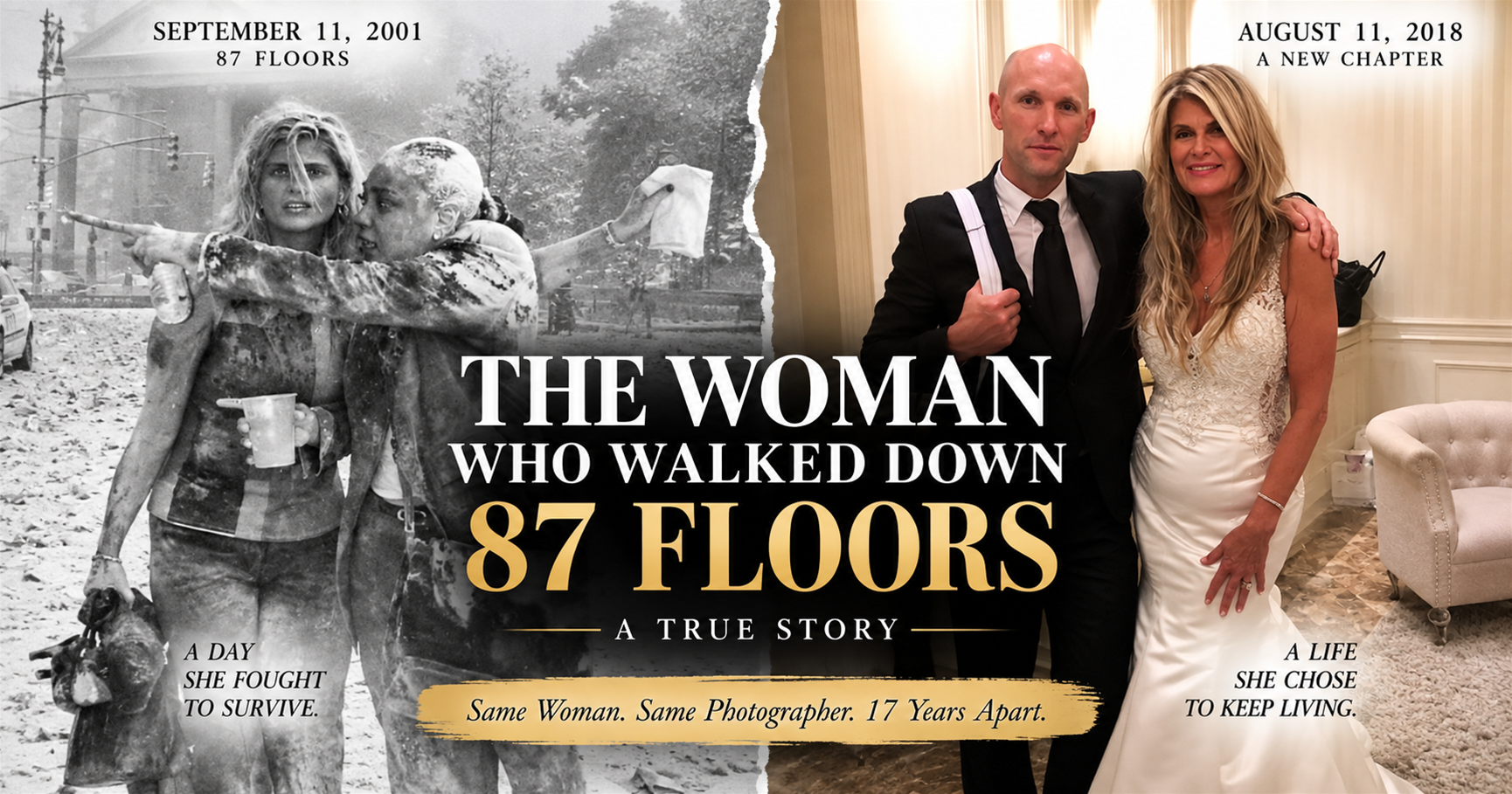
Later, Phil Penman photographed her walking away from the World Trade Center.

That photograph survived.

So did Joanne.

And so did the shoes.

But the shoes weren't the only ordinary object from Joanne's life that September 11 turned into history.

There was also a small piece of green plastic.

Her World Trade Center identification card.

It showed Joanne's photograph.

Her name.

Capestro | Joanne.

And beneath it:

May Davis Group.

Employees needed WTC identification cards to pass security and access the elevators. Green cards like Joanne's indicated full-time tenants or building operating staff.

On September 10, it was simply something Joanne needed to get to work.

After September 11, it was gone.

Her office was gone.

The North Tower was gone.

Joanne could reasonably have assumed the card was gone too.

It wasn't.

Someone recovered Joanne's ID from Ground Zero.

The card survived.

It was dusty.

But Joanne's photograph was still visible.

Her name was still visible.

May Davis Group was still printed across the bottom.

Eventually, the card also entered the Museum's collection.

There it became something more than an employee badge.

It was evidence of an ordinary life that existed inside the World Trade Center before 8:46 a.m.

A woman had used it to enter her workplace.

She had gone upstairs.

She had sat at her desk.

Then history happened around her.

The building disappeared.

Yet the little plastic card came back.

And when Joanne donated it, she chose to connect it permanently with the coworker who had not returned.

The Museum records the credit line:

Gift of Joanne “JoJo” Capestro in memory of Harry Ramos.

In August 2026, Joanne returned to the Museum again.

She visits frequently.

She also attends the September 11 anniversary memorial ceremony every year.

Some survivors find returning difficult.

Joanne understands that.

But she describes the Museum differently.

For her, it has become a place of reflection and serenity.

She can walk through a building filled with objects from that day and encounter pieces of her own life.

ADVERTISEMENT

The shoes.

The ID card.

The memories attached to them.

And outside, Harry's name.

For years after September 11, Joanne struggled with a question many survivors have described in different forms.

Why did she survive?

Why did others not?

She had survived the impact.

She had survived 87 floors.

She had survived the South Tower's collapse nearby.

She had survived the dust cloud.

Harry Ramos had not.

The psychological aftermath lasted much longer than the physical escape.

The 9/11 Memorial has documented Joanne's survivor guilt and PTSD in the months and years that followed.

Twenty-five years later, Joanne described finding a purpose in continuing to tell what happened.

She wants younger generations—especially children born long after 2001—to understand September 11 and remember the people who were there.

That changed the meaning of the shoes.

They were no longer merely something Joanne had survived in.

They had become something she could use to explain survival to people who had no memory of the day.

A museum contains enormous objects.

Pieces of buildings.

Damaged emergency vehicles.

Steel.

Things whose scale immediately tells visitors that something extraordinary happened.

Then there are objects like Joanne's shoes.

Small enough to hold in two hands.

A pair of black heels.

Nothing about them was designed to survive history.

But they did.

Joanne did too.

Twenty-five years after she walked down those stairs, she could stand beside the glass and look at the shoes worn by the younger version of herself.

The woman who had put them on without knowing what the day would demand from them.

The woman who had walked into the North Tower.

The woman who came back out.

Joanne looked at them in 2026 and said that seeing them now felt like “a lifetime ago.”

In many ways, it was.

But there was still one place Joanne returned to whenever she visited the Memorial.

Not the shoes.

Not the ID card.

Outside the Museum was the footprint where the North Tower once stood.

Around the enormous reflecting pool were the names of those who never came home.

Joanne knew exactly which name she was looking for.

She walked toward the panel.

Reached out her hand.

And touched:

HARRY RAMOS.

— End of Chapter 8 —

Next: Chapter 9 — The Name She Always Touches

ADVERTISEMENT

You May Also Like

Compartilhar Link

Copie o link abaixo para compartilhar com seus amigos: