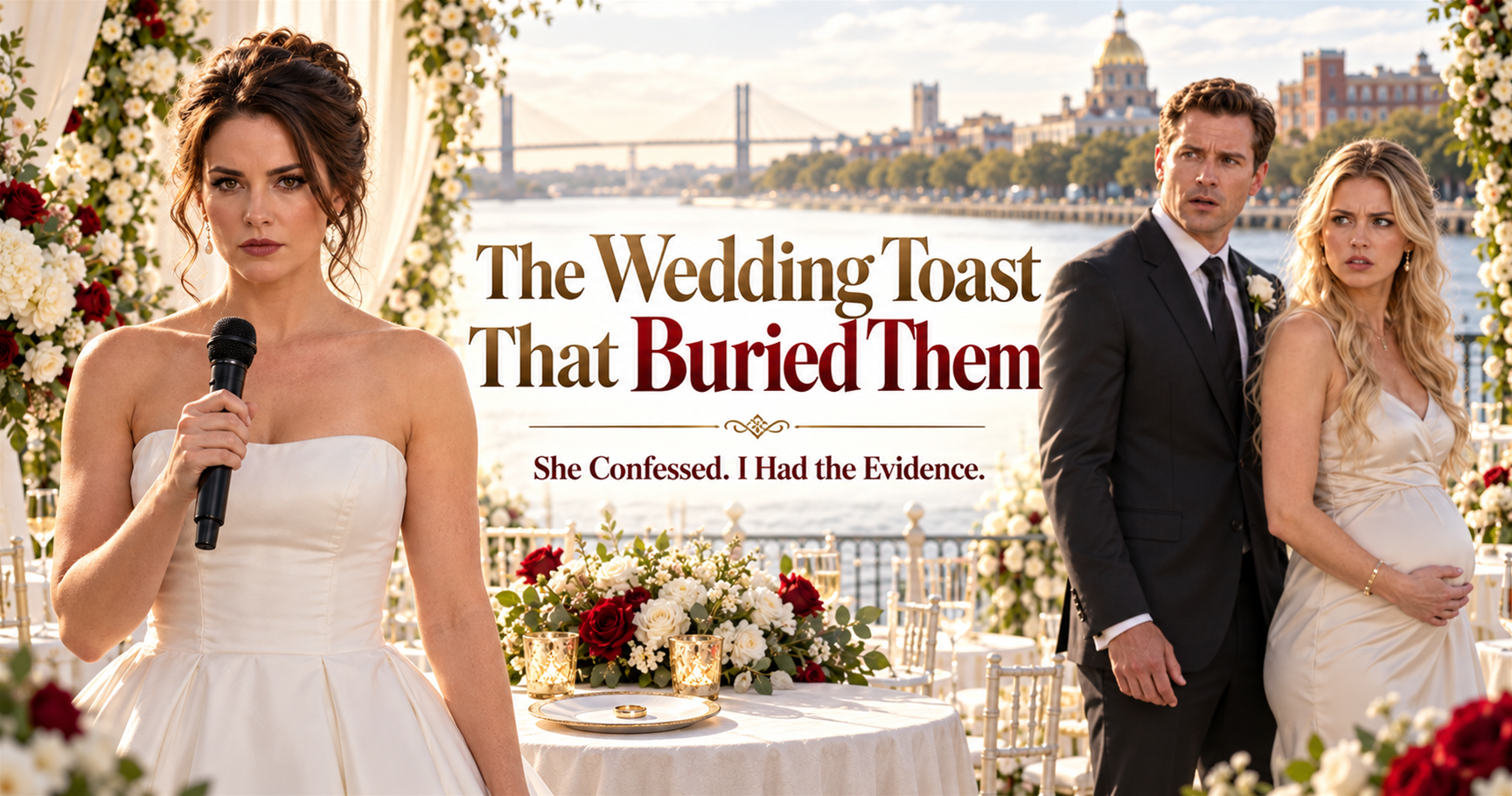
"The Wedding Toast That Buried Them" Chapter 3 — The Contract He Thought He Understood
Chapter 3 — The Contract He Thought He Understood
I did not ask Kelsey whether the pregnancy test was hers.
I did not show it to Ryan.
A photograph was not proof, and uncertainty could be useful when everyone else mistook confidence for control.
Over the next five days, I behaved exactly as I always had. I answered Ryan’s questions about table assignments. I approved the bourbon tasting for the rehearsal dinner. I rescheduled my dress fitting and stood beneath white lights while a seamstress pinned the hem.
At home, I smiled when Ryan kissed me.
At work, I closed every door he might use to reach my assets.
The alert came on Tuesday morning.
A charge for $2,840 had been attempted on the supplemental card linked to our wedding account. The merchant was Bellamy House, a boutique where Kelsey bought dresses she could not afford.
The bank had declined it because of the new limit.
I called Ryan.
“Did you try to charge something at Bellamy House?”
There was a pause just long enough to become evidence.
“Kelsey needed a dress for the wedding,” he said. “Diane’s card wasn’t working, so I offered to help.”
“With our wedding reserve?”
“It’s not a big deal. She said she’d pay it back.”
Kelsey had never paid anyone back in her life.
“That account is for contracted vendors,” I said. “Not guest clothing.”
“Why are you being so rigid?”
“Because the caterer does not accept promises from my sister.”
He exhaled sharply. “Fine. I’ll handle it.”
“Use your own card.”
“Obviously.”
We ended the call.
I downloaded the attempted-charge notice and added it to the financial file.
Ryan was not merely betraying me with Kelsey. He had begun testing whether I would finance the betrayal.
The final prenup arrived from Evelyn that afternoon.
It was not a weapon. Weapons were dramatic and unpredictable. This was architecture: clear walls, locked doors, weight placed where the structure could bear it.
My partnership interest remained mine. My apartment and its existing equity remained mine. Ryan kept his commissions, investment account, and personal property. Each of us remained responsible for debts incurred individually. Neither could claim an interest in the other’s business merely because of marriage.
There was also a narrowly written provision addressing intentional financial misconduct and documented marital fraud. It did not strip an unfaithful spouse of everything. It gave a court or mediator a framework for allocating disputed fees, debts, and jointly acquired assets if one party had used marital resources to facilitate concealed misconduct.
It was fair.
Under the circumstances, fair was going to hurt Ryan more than cruelty ever could.
His attorney emailed the same draft to him and offered two appointment times. Ryan ignored both.
On Thursday morning, I placed the signature copy on the kitchen table beside his coffee.
“The final agreement,” I said.
He looked at the folder and groaned. “More wedding homework?”
ADVERTISEMENT
“Your attorney sent it to you two days ago.”
“I saw the email.”
“Did you read it?”
“I read the summary.”
I knew this was false because his attorney had copied Evelyn on the reminders and noted that Ryan had not opened the secure attachment.
“You should review the full document,” I said. “Your lawyer offered another meeting this afternoon.”
Ryan spread jam across a piece of toast. “Is it materially different from the draft he already reviewed?”
“The separate-property structure is the same. The language on individual debt and financial misconduct is clearer.”
“Meaning what?”
“Meaning neither of us can secretly spend shared money on conduct that damages the marriage and then expect the other person to absorb the cost.”
His knife stopped.
For one second, I thought he knew.
Then he laughed.
“You family lawyers really know how to make romance sound beautiful.”
“Take it to your attorney.”
“Emma, he reviewed the earlier draft. You wrote this to protect both of us.”
“Evelyn wrote the final version for me. Your attorney represents you. Use him.”
“Do you want me to delay the wedding over paperwork?”
The question was a performance. He wanted me to reassure him, to say that our love mattered more than documents. That was how Ryan moved through life: he turned his negligence into someone else’s test of devotion.
“No,” I said. “I want you to understand what you sign.”
He picked up the folder and flipped through the pages without reading them.
“Separate property stays separate. Personal debt stays personal. We split anything we actually build together. Correct?”
“Broadly.”
“And if one of us commits financial fraud, that person pays the resulting costs.”
“Broadly.”
“Sounds fair.”
“Your lawyer should tell you whether it’s fair to you.”
Ryan took out his phone. For a hopeful moment, I thought he might call.
Instead, he typed an email declining the additional meeting and confirming that he was satisfied with the prior advice and disclosures. He turned the screen toward me.
“Happy?”
“This isn’t about making me happy.”
He signed every required page in front of the mobile notary scheduled by our attorneys. He initialed the disclosure schedules. He confirmed on camera that he had received independent legal advice and was signing voluntarily.
Then he capped the pen and kissed my cheek.
“Now can we stop negotiating our divorce before we’re even married?”
“That would be ideal.”
He left for an alleged showing at noon.
At 12:18, Kelsey’s message appeared on the shared tablet.
The charge didn’t go through. What did you tell her?
Ryan replied:
Nothing. Emma gets weird about accounts. I signed the stupid prenup, so she’s calm again.
I saved both messages.
That evening, my mother arrived carrying Kelsey’s garment bag.
“She left this in my car,” Diane said. “Can you take it to the venue tomorrow?”
The bag was cream-colored and far too elaborate for a bridesmaid dress.
“She isn’t in the wedding party.”
“She’s still your sister.”
“What is she wearing?”
Diane’s mouth tightened. “A dress.”
“What color?”
“Ivory, maybe. It isn’t white.”
I almost admired the consistency. Even now, my mother’s first instinct was to defend Kelsey from a question no one had accused her of answering badly.
“She can carry her own dress,” I said.
Diane set the garment bag across my sofa.
“Emma, please don’t be difficult. Kelsey is under a lot of pressure.”
“From what?”
“Life.”
“That must be exhausting for her.”
My mother glared at me. “I don’t know what has gotten into you lately.”
I stepped closer.
“Do you know something I should know?”
The color drained from her face so quickly that the answer arrived before her words.
“Of course not.”
“Then why is Kelsey under pressure?”
“She’s young. She’s emotional. She makes mistakes.” Diane reached for her purse. “Whatever she tells you at the wedding, don’t ruin her life over it.”
The room went silent.
My mother froze with one hand around the strap.
I looked at the ivory garment bag, then back at her.
“What exactly is Kelsey planning to tell me at my wedding?”
ADVERTISEMENT
You May Also Like
-
CompletedChapter 11

The Little Girl Who Put a Purple Crayon Beside My Loaded Pistol
Anthony Moretti has spent decades making dangerous men obey him. Then a three-year-old girl walks into his secret meeting, places a purple crayon beside his loaded pistol, and asks to borrow him for one day. Sophia needs someone for Family Day. Her father is dead, her mother needs to work, and Anthony looks like a man who can clear his own schedule. He says yes. But his most trusted lieutenant seems strangely interested in whether he’ll keep that promise. And when an ordinary afternoon ends with a photograph of the woman Anthony believed he buried thirty-four years ago, he starts asking questions someone close to him has spent a lifetime preventing. Sophia only wanted a day at school, the swings, and strawberry ice cream. Anthony may have to dismantle the life he built to give her anything more.Maid/Nanny|Human Nature12.3k words5 0 -
CompletedChapter 11
They Forgot Me for Thirteen Christmases. Then I Inherited the House.
For thirteen Christmases, Claire Whitmore watched her family celebrate without her. Every year brought another excuse—and another photograph with no place for her at the table. Then her grandmother leaves her the family’s favorite seaside house. Two days before Christmas, twenty-three relatives arrive with luggage, assigned bedrooms, and a locksmith. They haven’t asked permission. They expect Claire to open the gate, make their beds, and swallow her resentment. This time, she refuses. But her grandmother left more than a house: three binders, an old iPad, and a letter warning Claire whom not to believe. As her family demands to be let inside, Claire begins discovering why they kept her outside for thirteen years—and what they’re afraid she’ll uncover next.Human Nature11.9k words5 5 -
CompletedChapter 11
They Married Me to a Dying Mafia Boss
Two nights before her wedding, Nora Bennett was sleeping in her car. Now she’s standing beside a hospital bed in a private chapel, marrying a feared Chicago mafia boss who cannot say yes—or refuse. The arrangement is simple: stay beside Adrian Voss until he dies, and his family will pay for her mother’s care. But Nora used to be an intensive care nurse. And the doctor overseeing her new husband’s treatment is the same man whose testimony destroyed her career. Something about Adrian’s care doesn’t add up. While his cousin waits to inherit control and his doctor warns her to stop asking questions, Nora begins keeping a record. She speaks to Adrian when nobody else bothers. She treats him like a man instead of a fortune waiting to change hands. Then his finger moves after she asks him a question. Now Nora must discover who she can trust—and whether the husband everyone considers helpless has been listening all along.Human Nature12.3k words5 4 -
CompletedChapter 11
They Strapped My Daughter to a Gurney. I Made Them Answer.
At 1:07 a.m., Colonel Evelyn Hayes finds her daughter strapped to a hospital gurney, her face bruised, her husband insisting she can’t be trusted. His wealthy family has arranged a transfer to a private psychiatric facility. Claire says she never agreed. Nobody seems interested in listening. Then her mother-in-law tears a silver locket from her neck—and Claire risks another injury trying to reach it. Evelyn bought that necklace when Claire was ten. Now her daughter is protecting something inside it that her husband’s family desperately wants back. Getting Claire off the gurney is only the beginning. To keep her safe, Evelyn must uncover how a marriage, a medical record, and a powerful family became weapons against the woman who asked the wrong questions.Human Nature12.1k words5 0 -
CompletedChapter 11
The Groom Was the Only Thing I Changed
A week before her wedding, Audrey Bennett discovers that her fiancé and her best friend have secretly changed the destination—and bet on how long it would take her to notice. Then he takes the engagement ring off Audrey’s hand and gives it to her friend as the prize. After ten years of explaining away humiliation, Audrey stops asking to be chosen. She ends the engagement, accepts the career opportunity she nearly gave up, and keeps the wedding reservation she paid for in Ireland. There, an old friend offers her something unfamiliar: help without conditions, affection without pressure, and the freedom to say no. Preston expects an angry bride to arrive in Iceland. Audrey has plans of her own. A romance about betrayal, an unforgettable wedding reversal, and learning that love should never require you to surrender your dignity.Billionaire|Human Nature|Love After Marriage|Fake Relationship|OE11.8k words5 6 -
CompletedChapter 11
The Proposal He Refused Was Hiding a Truth Neither of Them Expected
June Mercer had one terrible day, one private rant, and five seconds of spectacularly bad judgment. She kissed the portrait of her impossible boss—then heard the real Adrian Vale speak behind her. June expects to lose her job. Instead, Adrian reveals why he rejected the waterfront proposal she spent six weeks building: the warehouse at its center belonged to his mother, and its abandoned plans contain a photograph of June’s late father. As June investigates why their parents’ project failed, she finds a disputed signature, missing tenant applications, and a trail of property deals threatening the businesses still standing on Riverton Avenue. Adrian has the power to help her, but his family helped create the mess—and his own name appears on one of the old documents. June must decide how much she can trust the man who finally sees her work, while fighting for a future that belongs to the neighborhood rather than another Vale.Billionaire|Human Nature11.8k words5 20 -
CompletedChapter 11
The Night My Mother Burned My Restaurant
Daniel Mercer had finally made his restaurant a success. Then a fire destroyed it, leaving twenty-six employees without work and Daniel facing a mountain of debt. His mother admits she set the fire because his adopted brother, Evan, could not bear watching Daniel succeed. Worse, Daniel’s fiancée knew they were discussing how to force him to close. Daniel pays his staff, reports what he knows, and starts looking for proof. As investigators recover footage from the restaurant, he discovers that his mother has also tried to sell the house his father left him. The buyer’s deposit has already gone into Evan’s new coffee shop. Everyone expects Daniel to protect his family. This time, he intends to find out exactly what each of them did.Human Nature12.3k words5 15 -
CompletedChapter 11
The Keys He Dropped on the Floor
Blake Whitmore threw his sports car keys at the feet of a man with an old bicycle. “Pick them up.” Evan Mercer refused. Minutes later, Bellwether University’s president welcomed him as the new chair of its board. Blake’s public humiliation should have ended there. Instead, Evan realized Blake knew about a confidential plan to redevelop East Hall—a residence filled with scholarship students and a community teaching center. The figures presented to the board were out of date, a crucial appendix had disappeared, and the developer seeking the property was Blake’s father. As an edited video turns the campus against him, Evan has to find out who shaped the deal and stop students from losing their rooms. But Bellwether is running out of money. Exposing the proposal may save East Hall while leaving the university without the funds it needs to keep its promises. Evan came to campus expecting a board meeting. Now he must decide what his family’s influence is worth if he cannot use it to protect the people everyone else left out of the plan.Human Nature12.1k words5 12 -
CompletedChapter 11
The Girl They Taught to Be Unwanted
"Nobody picks the difficult ones," nine-year-old Maisie Reed whispers to her worn-out stuffed rabbit. Grant Whitaker hears her at a family center, then sees the name on her bracelet. Maisie's late mother was his sister. For six years, Grant never knew he had a niece. The records say he was contacted and refused to take her in. Grant knows he never signed that refusal. His search brings him back to the sister whose letters he returned unopened, a little girl who has learned to offer pancakes and good behavior in exchange for a home, and a former guardian determined to define Maisie as too difficult to keep. Each disputed record raises a harder question: who benefited from making Maisie believe her family did not want her? Grant can challenge the paperwork. Earning Maisie's trust will take something else: showing up when she is angry, frightened, or inconvenient, and telling her the truth about the years he lost.Human Nature|Dark Secrets11.6k words5 15 -
CompletedChapter 11
The Woman Who Sat in Sofia’s Place
On her first day at Grayhaven Correctional Facility, Elena Moretti sits on the one bench everyone has warned her to avoid. Vera Sokolov, the woman who rules Block C, takes Elena’s lunch in front of a guard. Elena asks for it back. Before long, her bunk is changed, her food goes missing, and an officer begins watching her every move. Elena has a reason to stay. Her sister Sofia died at Grayhaven after writing letters about women who were threatened, deprived of food, and too frightened to complain. One of those letters never left the prison. Elena means to find out who stopped it—and what happened to Sofia after she refused to be silent. With help from Mina, who knew her sister, and Tess, who is still paying the price of Vera’s rules, Elena follows the trail through stolen meals, missing records, and a night when the laundry corridor went dark. But each woman who speaks could become Vera’s next target. To expose the truth, Elena must give them a choice Sofia never had time to secure.Human Nature11.7k words5 13