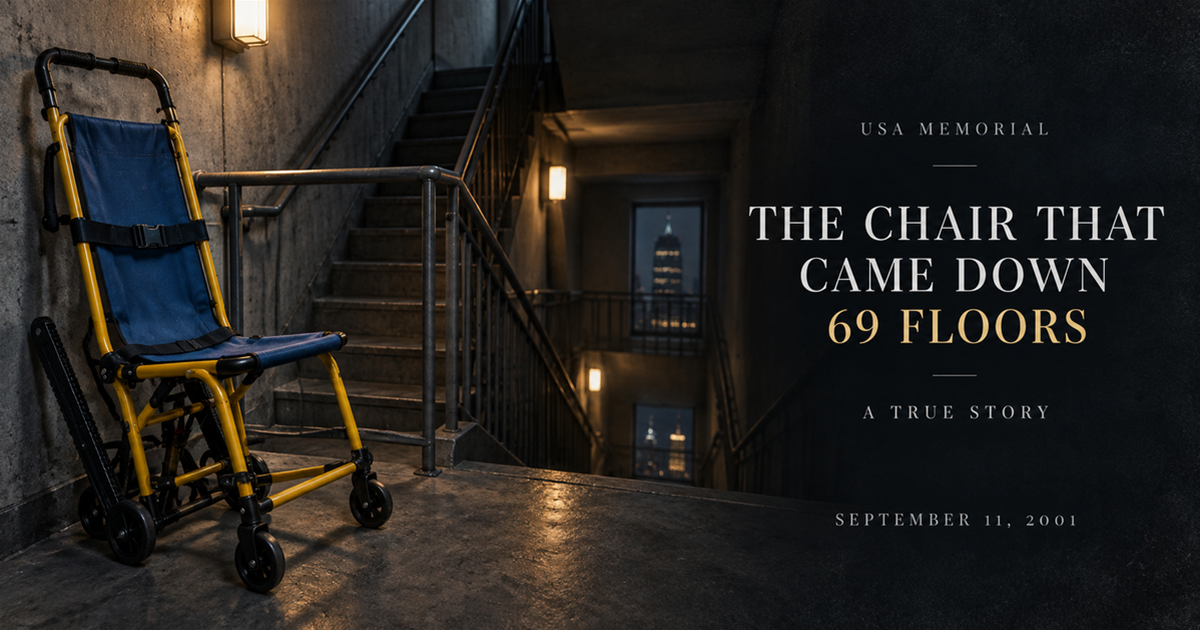
"THE CHAIR THAT CAME DOWN 69 FLOORS" Chapter 3 — The 69th Floor
John Abruzzo was at his computer when Flight 11 hit the North Tower.
The aircraft struck between the 93rd and 99th floors, well above the Port Authority offices on the 69th floor. Everyone at and above the impact zone was trapped, but the stairways below remained a possible escape route for thousands of people.
Abruzzo later described the impact in physical terms. The building seemed to have been punched. Paper fell outside his windows. He noticed the tower sway.
Those observations mattered because no one on the 69th floor had a complete view of what had happened. They did not have the later television replays, official timelines, or structural investigations. They had movement, sound, falling paper, and the behavior of the people around them.
Most occupants began leaving.
Abruzzo maneuvered his power chair into the hallway. By his account, only ten coworkers remained nearby. The rest of the office had already joined the evacuation.
The group found the EVAC+CHAIR.
Its presence was not accidental. It belonged to the safety improvements adopted after the 1993 bombing. Abruzzo’s earlier six-hour evacuation was precisely the kind of experience that had demonstrated why the building needed a lighter alternative to a power wheelchair.
It resembled a narrow folding seat attached to a lightweight metal frame. Wheels allowed it to move across a level surface. Tracks along the back could rest against stair edges and help control a descent.
Getting Abruzzo into it was only the beginning.
Transferring him meant leaving behind the wheelchair customized for his daily independence. There was no realistic way to bring that heavy chair down with them. The group had to trust a much smaller device designed for a single purpose: descent.
He later explained that the chair might have been demonstrated as a device one person could operate. On September 11, the group used two people in front and two behind. Others rotated into those positions as the work continued.
One member of the group could not help with the physical lifting and instead moved ahead to inspect conditions. That role became important when smoke blocked part of their planned route around the 40th floor. The group crossed the building and entered another stairwell.
Every change of direction demanded coordination.
At each landing, the chair had to be turned. The handlers shifted their grip, dragged or guided the frame around the tight corner, and lined it up with the next flight. The people behind them could not simply move at their normal pace. The people below had to make room.
The group did not race down all 69 floors in a single burst. They alternated positions and paused when necessary. Abruzzo and Michael Curci later recalled that they did not fully understand the scale of the attack during the early descent.
The lack of full information protected no one, but it shaped their pace and memory. They knew the tower had been hit and that leaving was necessary. They did not know the structure would collapse. They could not calculate how many minutes were safe to spend resting, changing handlers, or waiting for traffic in the stairwell.
Their StoryCorps conversation contains an unexpectedly ordinary detail: at one point, they stopped near a Snapple machine.
That detail does not make the emergency smaller. It shows how incomplete their information was.
The building was damaged, and they knew they had to leave. But they did not yet know that another aircraft would strike the South Tower at 9:03 a.m. They could not see that the two most recognizable buildings in Lower Manhattan were entering their final hour.
Inside the stairwell, the disaster was measured differently.
One flight.
One landing.
One turn.
Then another.
Firefighters were climbing upward as civilians moved down. Abruzzo later remembered seeing them carry axes, hoses, and hundreds of pounds of equipment. They were already exhausted.
Every encounter required the descending civilians to make space. The firefighters’ upward movement also told them that the emergency was still unfolding above. The two groups passed each other with opposite destinations and the same narrowing supply of time.
His coworkers continued in the opposite direction with the blue and yellow chair between them.
Above, the floors they had left were filling with smoke and confusion.
Below, the lobby was still far away.
The group could not know whether the chair would hold, whether the stairway would remain open, or whether their strength would last.
They only knew the next flight was in front of them.
Below the 69th floor, each completed flight reduced the physical distance to safety. It did not necessarily reduce the danger. Smoke, congestion, falling debris, and the condition of the lobby remained unknown until the group reached them.
ADVERTISEMENT
You May Also Like
-
CompletedChapter 9

THE BOY WHO WOULDN'T KNEEL
When two armed men storm a supermarket, everyone gets down. Ten-year-old Noah Bennett stays standing. “You’ve got thirty seconds to leave.” The gunman laughs—until the security shutter starts to fall. Then he finds the scar behind Noah’s ear and recognizes whose son he is. Six months ago, Noah buried his father. Tonight, someone is watching through the supermarket cameras. Someone who knows the gunman’s name. As the exits close, Noah realizes this was never a robbery gone wrong. And he may be the reason it happened.Human Nature|Survival|Dark Secrets8.9k words5 42 -
SerialChapter 31
With Nothing Left, I Had Two Shifter Stepbrothers to Feed
Avery transmigrates into another world—and finds herself selling her own stepbrother to a slave trader. She looks at the arrogant buyer before her, then at the stepbrother behind her, his face empty of hope. She pushes away the beast crystals being offered. “I’m not selling him.” But after taking him home, she discovers they have nothing but bare walls. Without selling someone, they really might not survive. Her other stepbrother is away with the hunting party, but his share of the meat is barely enough to feed Avery alone. Three people in the household. Two going hungry. Yet both brothers work tirelessly, never complaining, too timid to stand up for themselves. What else can Avery do? She touches her own animal ears, rolls up her sleeves, and gets to work feeding her brothers. … A few world-building details: Females retain a partly animal form, while males ordinarily look human and shift into beasts when hunting. The extent of their transformations and mutations depends on their rank…Human Nature|Survival|Spirits|Glow-Up|Fake Relationship36.3k words5 128 -
CompletedChapter 11
No One Inside Is Safe
My brother was knocking on the bunker door. My brother was also sitting beside me. Eight years after the outbreak, Rowan Hale knows the infected can imitate the living. What she doesn’t know is how the thing outside learned her brother’s voice—or why the man protecting them wants her to open the door. Then she finds the medicine he refused to give her dying brother. Beside it: a transfer list bearing their names. Rowan escapes with her twin brother and her best friend, Tess, only to discover that surviving a bite can make someone worth hunting. Their last hope is Mercy Ridge, a fortified community with doctors, fresh food, and children playing behind its walls. But its medical records tell a different story. Some residents are patients. Some are prisoners. And some are wearing glasses for a reason. To protect the people she loves, Rowan must discover what the city is keeping alive—and what it is willing to take from everyone else.Survival11.7k words5 22 -
CompletedChapter 10
THE MAN NOBODY COULD NAME
Survivors of the South Tower remembered an unidentified young man in a red bandana who found a stairway, helped the injured, and repeatedly returned to the devastated 78th floor. Months later, Alison Crowther recognized the detail that revealed the rescuer as her 24-year-old son, Welles. His story connects eyewitness testimony, a family object, and one of the most enduring acts of civilian heroism from September 11.Stories Behind 9/114.8k words5 45 -
CompletedChapter 10
THE WOMAN THEY REFUSED TO LEAVE BEHIND
Josephine Harris was descending from the 73rd floor of the North Tower when an injured leg slowed her. Six firefighters from Ladder Company 6 refused to leave her and matched her pace toward the lower floors. When the tower collapsed around them, a surviving section of Stairwell B turned their decision into one of September 11’s most extraordinary—and most carefully misunderstood—survival stories.Stories Behind 9/116.8k words5 42 -
CompletedChapter 10
THE MORNING HE NEVER REACHED THE 105TH FLOOR
Howard Lutnick survived September 11 because he took his oldest son to his first day of kindergarten instead of going to Cantor Fitzgerald’s offices high in the North Tower. The company lost 658 employees, including his brother and best friend. This verified story follows what came next: controversy, a five-year profit pledge, a decade of health coverage, an open door for the children left behind, and an annual charitable tradition built from the firm’s devastating loss.Stories Behind 9/116.8k words5 49 -
CompletedChapter 10
THE GUIDE DOG WHO WENT DOWN 78 FLOORS
Michael Hingson was working on the 78th floor of the North Tower when Flight 11 struck above him. This verified account follows Michael, his guide dog Roselle and colleague David Frank through the stairwell, past firefighters climbing upward, into the street and below ground during the South Tower’s collapse. More than a heroic-dog story, it reveals how a real guide-dog partnership—and several people sharing different kinds of information—survived one of the defining events of September 11.Stories Behind 9/116.9k words5 69 -
CompletedChapter 10
The Woman Who Walked Down 87 Floors
The Woman Who Walked Down 87 Floors On the morning of September 11, 2001, Joanne “JoJo” Capestro went to work on the 87th floor of the World Trade Center's North Tower. At 8:46 a.m., everything changed. Joanne escaped by taking the stairs, passing firefighters heading upward as office workers rushed down. One of her coworkers, Harry Ramos, stopped to help a struggling stranger and never made it out. Joanne did. Minutes later, covered in dust after the collapse of the South Tower, she walked through Lower Manhattan and unknowingly crossed paths with photographer Phil Penman. He took her picture. They didn't know each other's names. Fifteen years later, the 9/11 Memorial Museum finally connected the photographer with the woman in his photograph. But their story still wasn't over.Stories Behind 9/1110.2k words5 270 -
SerialChapter 34
I Was Sacrificed to a God
Yulia Farislan woke up as the villainous princess in a world that felt like a fantasy game she once obsessed over. Her fate was already written—execution, exile, or worse. But when her “punishment” sends her straight into the Dark Temple as a sacrifice to a sleeping Black Dragon, something goes very wrong. The dragon doesn’t kill her. He silences the voices in his head. For the first time in centuries… the world goes quiet. And he decides he’s keeping her. Not as prey. Not as a sacrifice. But as something far more dangerous—his. Now trapped in the domain of Caerus, the god-slaying Black Dragon feared even by the heavens, Yulia discovers the truth: The gods are not watching. The heroes are not coming. And the monster she was sent to die to… might be the only one who ever saw her as real.Dark Humor|Healing Romance|Age Gap|Survival|Dark Secrets|Demons|Dragons|Yandere|Instant Marriage|Possessive Love|Redemption Arc|Sweet Romance|HE36.3k words5 200 -
CompletedChapter 42
The Ghost Who Forgot How to Kill
Cassian Vale was built to survive. Former black-ops weapon. Mercenary commander. The kind of man people whispered about long after the blood dried. He doesn’t sleep much. Doesn’t speak unless necessary. And absolutely does not let people touch him. Then he meets Evelyn Mercer. A reckless underground mechanic with grease on her cheeks, unpaid parking tickets stuffed in her pockets, and a terrifying lack of survival instincts. The first time Cassian sees her, she crashes an ice cream truck into the middle of his assassination. The second time, she insults his armored vehicle to his face. The third time? She stitches a bullet wound into his shoulder while threatening to poison his coffee if he twitches again. Evie thinks Cassian is emotionally constipated, vaguely homicidal, and incapable of acting like a normal human being. Unfortunately, she might be falling for him anyway. And Cassian— Cassian is beginning to realize that Evelyn Mercer is far more dangerous than any weapon he’s ever faced. Because for the first time in years… The monster is hesitating.Dark Humor|Human Nature|Healing Romance|Mutual Pining|Age Gap|Survival|Dark Secrets|Plot Twist|Sweet Romance|HE|Adventure35.8k words5 268