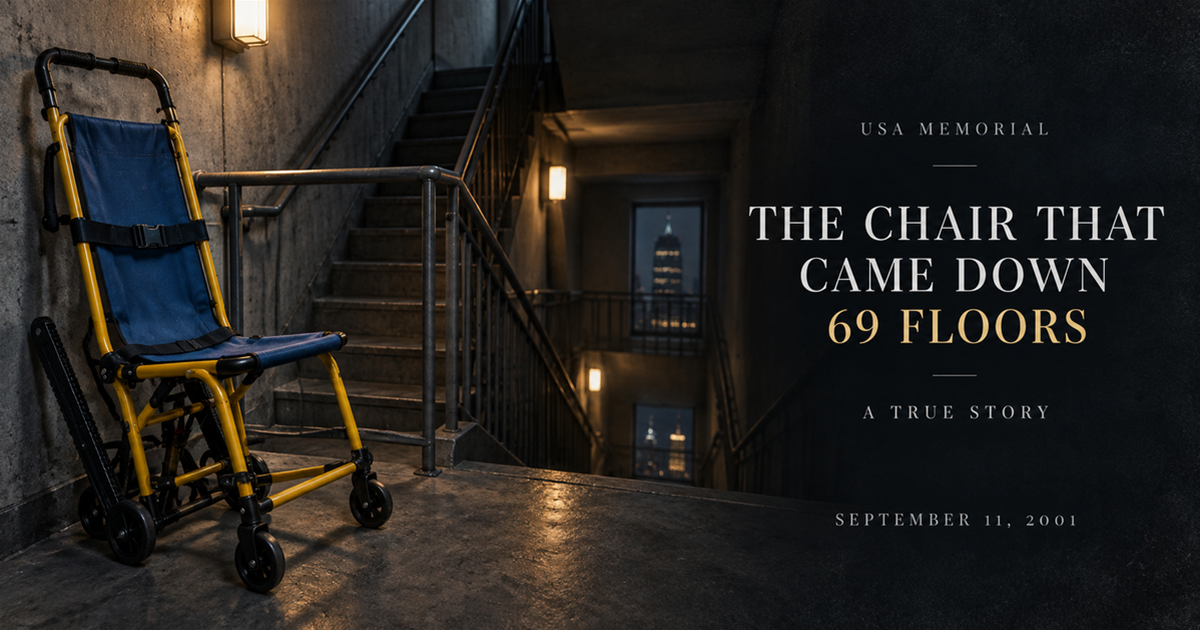
"THE CHAIR THAT CAME DOWN 69 FLOORS" Chapter 10 — The Way Out
John Abruzzo’s story is not only about a remarkable escape.
It is about who an evacuation plan imagines.
Buildings are often described through height, steel, elevators, offices, and occupancy. Emergency instructions can sound equally impersonal: use the stairs, do not use the elevators, proceed to the nearest exit.
Those instructions are written in verbs that presume bodies able to perform them. Abruzzo’s experience forced planners and later museum visitors to consider the people for whom “use the stairs” is not an independent action.
For someone who cannot walk down dozens of flights, those instructions are incomplete.
Abruzzo survived the 1993 World Trade Center bombing, but the six-hour evacuation exposed how poorly the building’s emergency system served people with limited mobility. The evacuation chair installed afterward did not erase that vulnerability. It gave coworkers a practical tool for responding to it.
On September 11, the tool worked because people used it together.
Mike Fabiano remembered Abruzzo. Someone located the chair. Ten coworkers remained. One scouted ahead. Others rotated through physically demanding positions. The group changed stairways when smoke made the route dangerous. They refused to leave Abruzzo at a temporary aid point. Firefighters helped them through the damaged lobby and later carried the chair into Stuyvesant High School.
The survival belongs to all of those actions.
It also belongs to time.
Flight 11 struck the North Tower at 8:46 a.m. The building collapsed at 10:28 a.m. Abruzzo and his coworkers escaped within that 102-minute span.
The outcome was not guaranteed by the chair’s presence. Equipment can be missing, inaccessible, poorly maintained, or unfamiliar to the people expected to use it. Plans can fail if no one knows whom they include.
The North Tower story therefore resists a simple hero narrative. Courage mattered, but courage operated through preparation: a device purchased after an earlier failure, coworkers who knew where it was, and a group willing to coordinate under pressure.
The 69-floor descent also warns against treating disability evacuation as a last-minute act of generosity. The chair existed because an earlier emergency had already shown the need. Effective inclusion had to begin before smoke entered the building.
The available evidence suggests that the most important legacy of Abruzzo’s escape is the combination of design and relationship. The chair made the route physically possible. The coworkers made the route humanly possible.
That conclusion is an inference drawn from the documented sequence, not a claim about what any one rescuer privately believed.
The words they did preserve are simpler.
At the aid point, they said John was with them.
Years later, Curci said the group shared a bond that did not need to be explained.
Abruzzo said thanks was not enough.
The chair now gives those words a physical form.
Visitors can look at it and ask practical questions. How would a person with a disability leave this office? Where is the equipment? Who is trained? Who checks the route? Who stays?
The questions are not rhetorical. They can be asked in any school, hospital, office tower, apartment building, or public venue where stairs become the only usable exit during an emergency.
Those questions extend far beyond one building and one day.
They are part of the continuing history of 9/11 because the attacks revealed not only extraordinary courage but also the consequences of decisions made long before an emergency begins.
John Abruzzo lost his customized wheelchair and his van. He inhaled smoke and was taken to a hospital. Yet he survived his second attack on the World Trade Center.
The ten coworkers survived with him.
The object that carried him survived too.
Under museum lights, the EVAC+CHAIR appears still and almost fragile. It does not show the crowds, the tight turns, the smoke near the 40th floor, the firefighters climbing upward, the broken glass in the lobby, or the cloud racing along West Street.
Those details live in the record around it.
The record has limits, and respecting them is part of remembering honestly. It cannot provide every sentence spoken on the stairs or every private thought. It provides something stronger: named witnesses, a recorded interview, contemporary reporting, a museum accession, and the surviving chair.
The chair’s power comes from what it does not have to exaggerate.
It came down 69 floors.
It carried a man out of the North Tower.
And ten people carried it all the way.
ADVERTISEMENT
You May Also Like
-
CompletedChapter 9

THE BOY WHO WOULDN'T KNEEL
When two armed men storm a supermarket, everyone gets down. Ten-year-old Noah Bennett stays standing. “You’ve got thirty seconds to leave.” The gunman laughs—until the security shutter starts to fall. Then he finds the scar behind Noah’s ear and recognizes whose son he is. Six months ago, Noah buried his father. Tonight, someone is watching through the supermarket cameras. Someone who knows the gunman’s name. As the exits close, Noah realizes this was never a robbery gone wrong. And he may be the reason it happened.Human Nature|Survival|Dark Secrets8.9k words5 42 -
SerialChapter 31
With Nothing Left, I Had Two Shifter Stepbrothers to Feed
Avery transmigrates into another world—and finds herself selling her own stepbrother to a slave trader. She looks at the arrogant buyer before her, then at the stepbrother behind her, his face empty of hope. She pushes away the beast crystals being offered. “I’m not selling him.” But after taking him home, she discovers they have nothing but bare walls. Without selling someone, they really might not survive. Her other stepbrother is away with the hunting party, but his share of the meat is barely enough to feed Avery alone. Three people in the household. Two going hungry. Yet both brothers work tirelessly, never complaining, too timid to stand up for themselves. What else can Avery do? She touches her own animal ears, rolls up her sleeves, and gets to work feeding her brothers. … A few world-building details: Females retain a partly animal form, while males ordinarily look human and shift into beasts when hunting. The extent of their transformations and mutations depends on their rank…Human Nature|Survival|Spirits|Glow-Up|Fake Relationship36.3k words5 128 -
CompletedChapter 11
No One Inside Is Safe
My brother was knocking on the bunker door. My brother was also sitting beside me. Eight years after the outbreak, Rowan Hale knows the infected can imitate the living. What she doesn’t know is how the thing outside learned her brother’s voice—or why the man protecting them wants her to open the door. Then she finds the medicine he refused to give her dying brother. Beside it: a transfer list bearing their names. Rowan escapes with her twin brother and her best friend, Tess, only to discover that surviving a bite can make someone worth hunting. Their last hope is Mercy Ridge, a fortified community with doctors, fresh food, and children playing behind its walls. But its medical records tell a different story. Some residents are patients. Some are prisoners. And some are wearing glasses for a reason. To protect the people she loves, Rowan must discover what the city is keeping alive—and what it is willing to take from everyone else.Survival11.7k words5 22 -
CompletedChapter 10
THE MAN NOBODY COULD NAME
Survivors of the South Tower remembered an unidentified young man in a red bandana who found a stairway, helped the injured, and repeatedly returned to the devastated 78th floor. Months later, Alison Crowther recognized the detail that revealed the rescuer as her 24-year-old son, Welles. His story connects eyewitness testimony, a family object, and one of the most enduring acts of civilian heroism from September 11.Stories Behind 9/114.8k words5 45 -
CompletedChapter 10
THE WOMAN THEY REFUSED TO LEAVE BEHIND
Josephine Harris was descending from the 73rd floor of the North Tower when an injured leg slowed her. Six firefighters from Ladder Company 6 refused to leave her and matched her pace toward the lower floors. When the tower collapsed around them, a surviving section of Stairwell B turned their decision into one of September 11’s most extraordinary—and most carefully misunderstood—survival stories.Stories Behind 9/116.8k words5 42 -
CompletedChapter 10
THE MORNING HE NEVER REACHED THE 105TH FLOOR
Howard Lutnick survived September 11 because he took his oldest son to his first day of kindergarten instead of going to Cantor Fitzgerald’s offices high in the North Tower. The company lost 658 employees, including his brother and best friend. This verified story follows what came next: controversy, a five-year profit pledge, a decade of health coverage, an open door for the children left behind, and an annual charitable tradition built from the firm’s devastating loss.Stories Behind 9/116.8k words5 49 -
CompletedChapter 10
THE GUIDE DOG WHO WENT DOWN 78 FLOORS
Michael Hingson was working on the 78th floor of the North Tower when Flight 11 struck above him. This verified account follows Michael, his guide dog Roselle and colleague David Frank through the stairwell, past firefighters climbing upward, into the street and below ground during the South Tower’s collapse. More than a heroic-dog story, it reveals how a real guide-dog partnership—and several people sharing different kinds of information—survived one of the defining events of September 11.Stories Behind 9/116.9k words5 69 -
CompletedChapter 10
The Woman Who Walked Down 87 Floors
The Woman Who Walked Down 87 Floors On the morning of September 11, 2001, Joanne “JoJo” Capestro went to work on the 87th floor of the World Trade Center's North Tower. At 8:46 a.m., everything changed. Joanne escaped by taking the stairs, passing firefighters heading upward as office workers rushed down. One of her coworkers, Harry Ramos, stopped to help a struggling stranger and never made it out. Joanne did. Minutes later, covered in dust after the collapse of the South Tower, she walked through Lower Manhattan and unknowingly crossed paths with photographer Phil Penman. He took her picture. They didn't know each other's names. Fifteen years later, the 9/11 Memorial Museum finally connected the photographer with the woman in his photograph. But their story still wasn't over.Stories Behind 9/1110.2k words5 270 -
SerialChapter 34
I Was Sacrificed to a God
Yulia Farislan woke up as the villainous princess in a world that felt like a fantasy game she once obsessed over. Her fate was already written—execution, exile, or worse. But when her “punishment” sends her straight into the Dark Temple as a sacrifice to a sleeping Black Dragon, something goes very wrong. The dragon doesn’t kill her. He silences the voices in his head. For the first time in centuries… the world goes quiet. And he decides he’s keeping her. Not as prey. Not as a sacrifice. But as something far more dangerous—his. Now trapped in the domain of Caerus, the god-slaying Black Dragon feared even by the heavens, Yulia discovers the truth: The gods are not watching. The heroes are not coming. And the monster she was sent to die to… might be the only one who ever saw her as real.Dark Humor|Healing Romance|Age Gap|Survival|Dark Secrets|Demons|Dragons|Yandere|Instant Marriage|Possessive Love|Redemption Arc|Sweet Romance|HE36.3k words5 200 -
CompletedChapter 42
The Ghost Who Forgot How to Kill
Cassian Vale was built to survive. Former black-ops weapon. Mercenary commander. The kind of man people whispered about long after the blood dried. He doesn’t sleep much. Doesn’t speak unless necessary. And absolutely does not let people touch him. Then he meets Evelyn Mercer. A reckless underground mechanic with grease on her cheeks, unpaid parking tickets stuffed in her pockets, and a terrifying lack of survival instincts. The first time Cassian sees her, she crashes an ice cream truck into the middle of his assassination. The second time, she insults his armored vehicle to his face. The third time? She stitches a bullet wound into his shoulder while threatening to poison his coffee if he twitches again. Evie thinks Cassian is emotionally constipated, vaguely homicidal, and incapable of acting like a normal human being. Unfortunately, she might be falling for him anyway. And Cassian— Cassian is beginning to realize that Evelyn Mercer is far more dangerous than any weapon he’s ever faced. Because for the first time in years… The monster is hesitating.Dark Humor|Human Nature|Healing Romance|Mutual Pining|Age Gap|Survival|Dark Secrets|Plot Twist|Sweet Romance|HE|Adventure35.8k words5 268