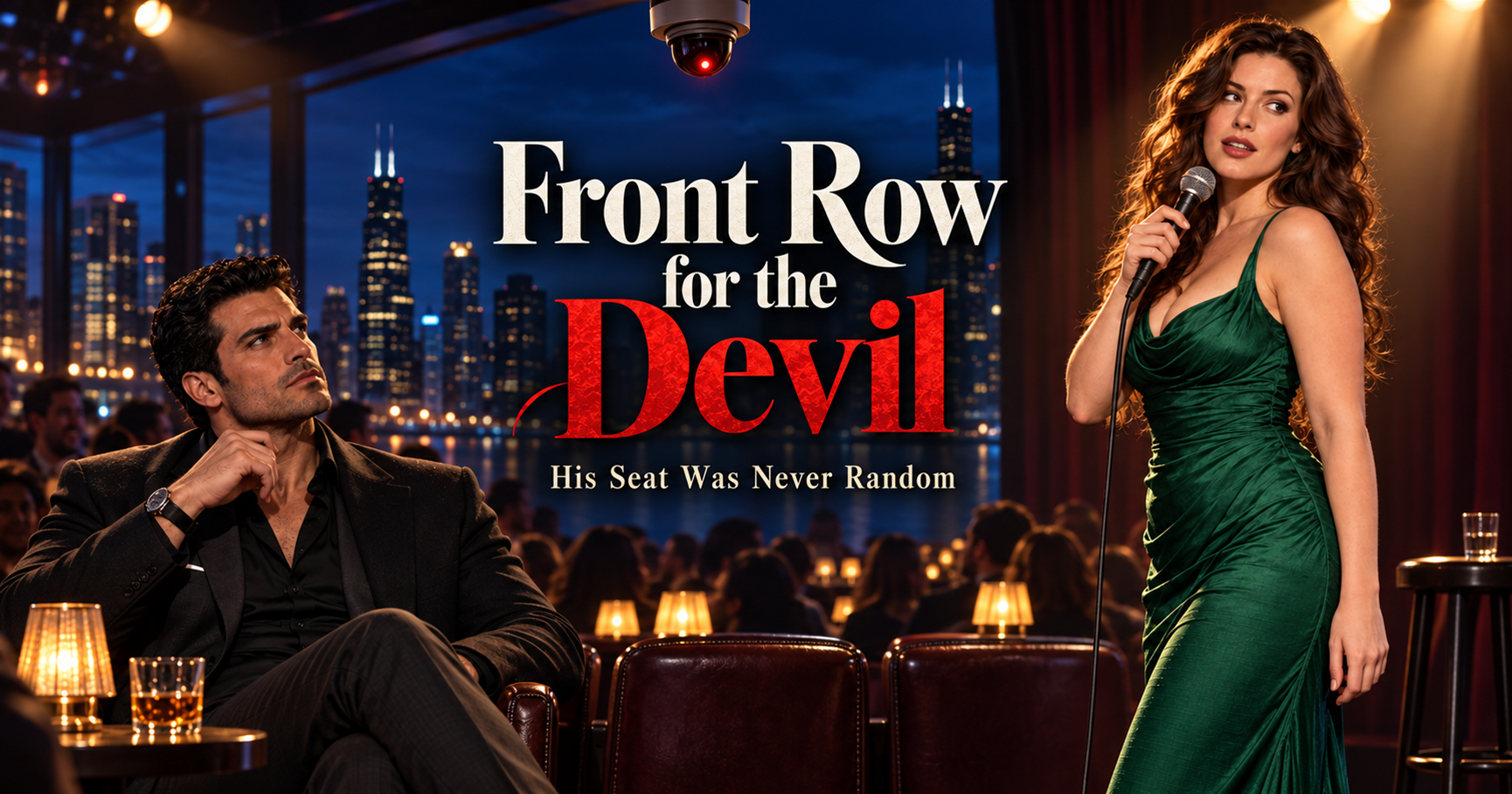
"Front Row for the Devil" Chapter 1 — The Most Dangerous Seat in Comedy
Chapter 1 — The Most Dangerous Seat in Comedy
For six years, Natalie Hayes had paid her rent by humiliating strangers under flattering stage lights.
The arrangement was simple. If you sat in the front row at The Lantern, you had accepted the possibility that your shirt, your date, your drink order, and every poor decision that had brought you there might become public property.
Most people understood the risk. The man in the center seat on Thursday night apparently believed risks happened to other people.
He wore a charcoal suit that probably cost more than Natalie’s car. Broad shoulders filled the jacket without straining it. His dark hair was neat, his watch was discreet, and his expression suggested happiness had violated a court order by coming within five hundred feet of him.
Natalie shaded her eyes against the spotlight.
“Sir, you look like a tax audit learned how to bench-press.”
The room broke open.
The man did not smile.
Beside him, a man with a broken nose lowered his head to hide a smile.
The silent man lifted his glass of sparkling water.
“Of course,” Natalie said. “Have you ever ordered sparkling water without making the waiter fear for his pension?”
The bodyguard’s shoulders moved once.
That was blood in the water.
For twelve glorious minutes, Natalie returned to the stranger whenever the room needed a fresh jolt. He gave her almost nothing beyond his name—Enzo—and a low, unexpectedly dry voice. The audience loved him for answering. Natalie loved him for making her work.
When she finally left the stage, damp with sweat and bright with the familiar chemical rush of a good set, Marcus Bell was waiting outside her dressing room.
Her manager had the waxy expression of a man trying to decide whether to call a lawyer or a priest.
“How attached are you to living in Chicago?” he asked.
Natalie wiped eyeliner from beneath one eye. “The winters are hostile and my landlord thinks insulation is a personality flaw. Why?”
Marcus shut the door.
“The man in front.”
“The human funeral announcement?”
“Enzo Caruso.”
She waited.
Marcus stared at her.
The name landed a second later.
Caruso controlled clubs, freight routes, construction contracts, and—depending on which newspaper one believed—half the people who claimed he controlled nothing at all. He had never been convicted of anything serious. Men who testified against him tended to reconsider, relocate, or develop a sudden devotion to silence.
Natalie looked at the thin dressing-room wall.
“His bodyguard laughed.”
“That is not the comforting detail you think it is.”
She slept for forty-three minutes. By Friday evening, she planned to perform, avoid the center section, and leave through the kitchen.
Then she peeked through the curtain.
Enzo sat in the same front-row seat.
Center table. Perfect view of the stage. Perfect view from the fixed camera mounted above the bar.
He had arrived twenty minutes early.
ADVERTISEMENT
The broken-nosed bodyguard sat one table back tonight, which somehow made the arrangement worse.
Her name boomed through the speakers.
Natalie walked into the light.
Applause rose. She smiled, thanked the host, adjusted the microphone, and looked directly at Enzo.
Their eyes met.
His mouth moved almost imperceptibly.
Go ahead.
So she did.
“Ladies and gentlemen, apparently Yelp reviews weren’t enough. My kidnapping has become a subscription service.”
The room howled.
Enzo laughed.
It was not polite. It was brief and real, changing his face in a way Natalie found considerably more alarming than his stare.
She leaned toward him. “You bought front row after yesterday?”
“Yes.”
“You enjoy suffering?”
“Apparently.”
“Therapy would be cheaper.”
“Not in Chicago.”
Natalie laughed first. For half a second she lost the next line, and the audience laughed harder because they had seen her lose it.
Then a man two seats behind Enzo called out.
“Ask him about Warehouse Nine.”
The room shifted. A few people kept laughing. Others waited.
Enzo’s amusement vanished.
Natalie looked at the heckler. Mid-thirties, blond hair clipped close at the sides, blue sport coat, no drink in front of him. He wore the eager grin of someone pretending an interruption had occurred to him spontaneously.
“Warehouse Nine?” Natalie said. “Is that where Chicago stores men who say they’re six feet tall on dating apps?”
The room came back to her.
The heckler laughed too loudly.
Natalie moved on, but five minutes later a woman near the aisle shouted, “Tell the Madison Street story!”
Enzo turned his head.
Not toward the woman.
Toward the camera above the bar.
Natalie felt the first clean edge of fear.
She abandoned the sequence Marcus had taped beside her mirror and improvised for the rest of the set. She pulled a couple celebrating an anniversary into an argument about air fryers. She made the bodyguard admit he owned a tiny dog named Princess. She kept the audience laughing while watching the blond man check his phone three times.
At 10:46, he left.
After the show, Enzo waited near the backstage hallway.
His bodyguard stood at the far end, close enough to intervene and far enough to hear nothing.
“No bodyguards in my dressing room,” Natalie said.
“He stays outside.”
“No threatening comedians.”
“I came to ask you a question.”
“Disappointingly civilized.”
Inside, Enzo did not sit. He took out his phone and placed it on her makeup table.
Four videos waited on the screen.
In the first, Natalie teased a banker for wearing a fitness tracker while ordering loaded fries. In the second, she convinced a nightclub owner to admit he hated dancing. Then came a freight executive who had lied about being on a first date and a city contractor who kept touching his wedding ring.
Different nights. Different jokes. Different supposedly random people.
Enzo tapped the timestamps.
“These clips were submitted in four separate investigations,” he said.
ADVERTISEMENT
“Submitted by whom?”
“Attorneys. Insurers. One city ethics board.”
“As what?”
“Proof that each person was here at a specific time.”
Natalie looked from one smiling face to the next.
“Alibis.”
“Yes.”
Her skin tightened.
“You think I helped them?”
“I think you remembered all four without needing to replay them.”
She had. The banker had tipped nothing. The nightclub owner had smelled like cedar cologne. The freight executive’s date had cried in the bathroom afterward. The contractor had waited for someone near the sound booth to nod before raising his hand.
“Why come back?” she asked.
“Because last night you changed your set.”
“I improvise.”
“You went sixteen minutes off schedule after you started talking to me.”
Enzo selected a still image from Thursday. The blond man stood near the exit, watching his phone.
“He left when it became clear you would not reach your planned crowd segment on time.”
Natalie thought of the printed sequence taped beside her mirror. Marcus called it structure. Sponsors liked predictable breaks. The club’s social team liked knowing when to isolate clips.
“Warehouse Nine,” she said.
“The phrase matters.”
“To you?”
“To whoever paid him to say it.”
Natalie opened The Lantern’s social archive and searched faces instead of names.
Four months earlier, she found the blond man at a table near the stage. His hair had been dark then. He wore glasses and sat beside a woman who had introduced him as Daniel from Milwaukee.
Natalie enlarged the image.
A plastic badge showed inside his folded lapel.
LANTERN EVENTS STAFF.
“He isn’t an audience member,” she said.
“No.”
Footsteps pounded in the hallway.
Marcus entered without knocking, carrying the printed seating manifest.
“Natalie, you need to see this.”
Every front-row ticket showed a purchaser, payment type, and reservation number.
Except the center seat.
COMPLIMENTARY — ARTIST REQUEST.
Natalie looked up. “I never requested his seat.”
Enzo’s gaze sharpened. “I paid cash for it.”
Marcus turned the page. “The original purchaser was refunded seven minutes before he arrived. Someone reopened that exact chair.”
Beside the internal entry was a note.
CARUSO MUST BE VISIBLE ON CAMERA.
Enzo became utterly still.
Natalie looked toward the dark stage. For the first time, the room where she felt most powerful seemed built to point at her.
“They didn’t expect you to come back,” she whispered.
“No.”
Enzo picked up his phone.
“They needed me to.”