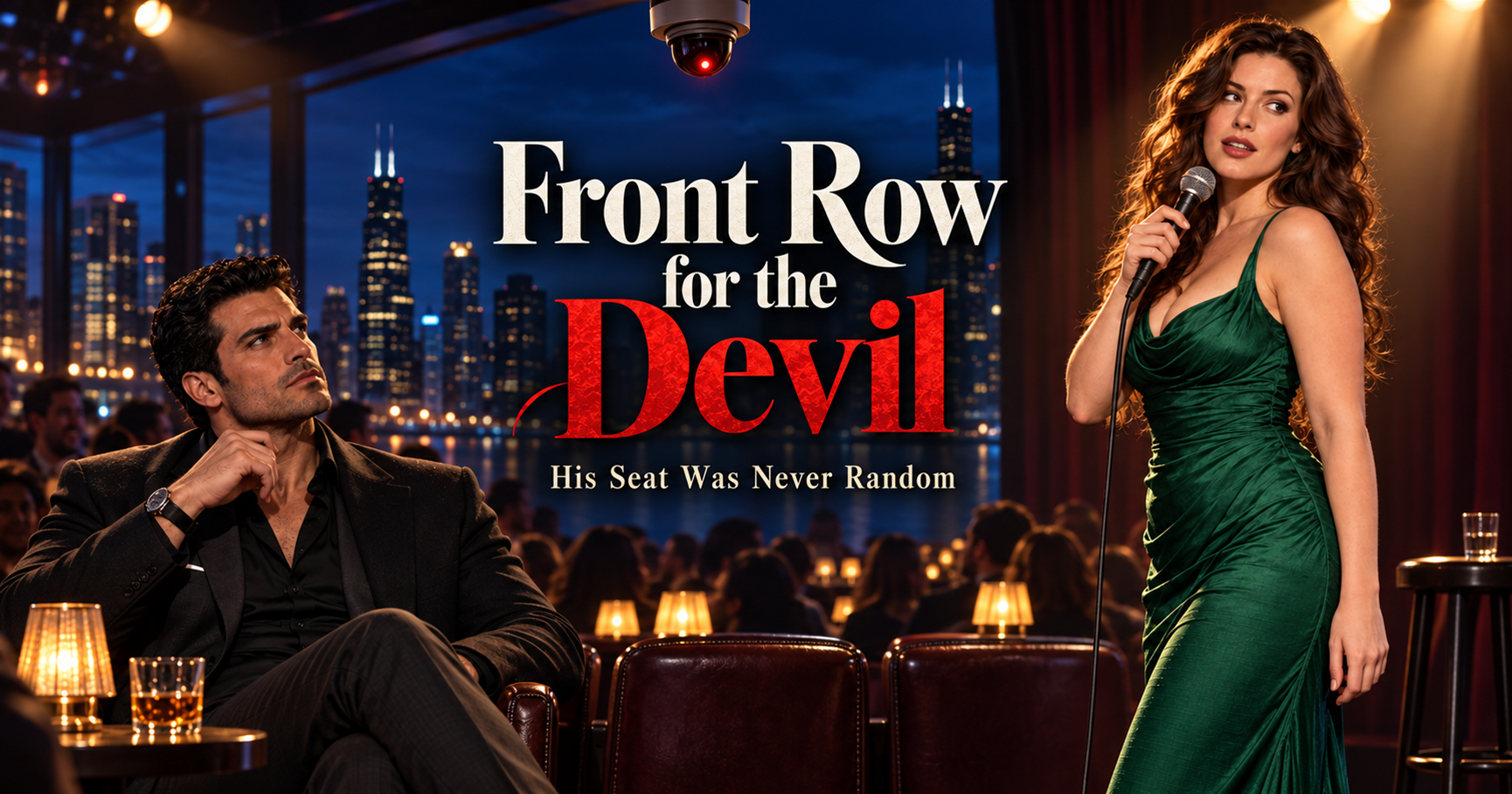
"Front Row for the Devil" Chapter 3 — Every Laugh Has a Timestamp
Chapter 3 — Every Laugh Has a Timestamp
By nine Saturday morning, Natalie had acquired three new professional titles.
Mob Mistress.
Comedy Courier.
The woman who joked while Owen Price died.
The Lantern canceled her weekend shows “out of respect for the ongoing investigation.” Two corporate bookings vanished before breakfast. Her agent in Los Angeles sent a message saying everyone should pause until the optics became less radioactive.
Marcus called six times.
She ignored him and called Priya Shah.
“How quickly can you get into the club?” Natalie asked.
“Marcus told everyone to stay home.”
“That wasn’t my question.”
Priya was silent for a moment. “Twenty minutes.”
Natalie entered The Lantern through the kitchen at 9:34. Enzo’s men remained outside, exactly as agreed. She disliked seeing them and disliked even more how relieved she felt when one nodded from across the alley.
Inside, Priya had tied her black hair into a knot and surrounded herself with cables, two laptops, and the grim concentration of a surgeon whose patient had been backed up incorrectly.
“The main archive was accessed remotely,” Priya said. “Admin credentials. They wiped the multiview cache and most of the temporary audio.”
“Most?”
Priya glanced at her. “Video systems are hoarders. They never delete as cleanly as people think.”
She opened a hidden proxy directory used by the editing software to generate low-resolution previews. Four silent windows appeared, one for each camera.
The files skipped and froze, but the missing angles existed.
On camera three, the blond heckler raised his hand to his right ear seconds before shouting about Warehouse Nine.
On camera four, a man near the sound booth watched him and touched his own cuff.
Natalie sat forward. “Go back.”
Priya replayed it.
Ear. Cuff. Shout.
Not random. Not spontaneous.
“Can you recover audio?”
“Maybe fragments. The separate tracks were overwritten, but the proxies reference waveform files. Give me time.”
Natalie walked onto the empty stage.
From beneath the switched-off spotlight, the tables looked smaller than they did during a show. She pictured the banker, the nightclub owner, the freight executive, and the city contractor.
Four strangers who had seemed nervous in four different ways.
She found a marker and began writing on the back of an old drink-special board.
Banker: fries joke. Checked watch before raising hand.
Nightclub owner: woman at booth nodded first.
Freight executive: asked to use restroom, returned before interaction.
City contractor: touched wedding ring, watched sound booth.
Priya joined her. “You remember all that?”
“I remember when a room feels wrong.”
They pulled the posted clips and compared timestamps. The banker’s interaction began at 9:29. The nightclub owner’s at 10:01. The freight executive’s at 9:59. The contractor’s at 10:30.
All four occurred within sixty seconds of a half-hour or hour mark.
“They weren’t buying jokes,” Natalie said. “They were buying clocks.”
The kitchen door opened.
Enzo entered alone, carrying coffee in a cardboard tray.
ADVERTISEMENT
“Bribery?” Natalie asked.
“Hospitality.”
“From a man accused of murder.”
“The line was shorter.”
Priya accepted a cup immediately. Natalie waited three seconds on principle before taking hers.
Enzo placed a thin folder on the stage.
“The four people in those older clips share one connection,” he said. “Their companies held contracts that required Voss Civic Strategies for security review, surveillance access, or event production.”
Natalie opened the folder. Corporate records, city award notices, photographs from fundraising dinners.
Julian Voss appeared in several of them: silver at his temples, easy smile, one hand resting on shoulders as if every room already belonged to him.
“So he sells alibis to clients?” Priya asked.
“Or leverage,” Enzo said. “An alibi is useful. Proof that an alibi is false may be worth more.”
Natalie watched him instead of the photographs.
“You recognized the company last night.”
“Yes.”
“Not just the name.”
Enzo did not answer quickly enough.
She put down the folder.
“How have you done business with Voss?”
Priya looked between them, then picked up her coffee and retreated toward the booth with excellent instincts.
Enzo remained at the edge of the stage.
“Years ago, his company provided access to traffic-camera blind spots and municipal inspection schedules.”
“Provided how?”
“For money.”
“You bought city surveillance information.”
“Yes.”
The blunt admission angered her more than a denial might have.
“When were you planning to tell me?”
“When I knew whether it was connected.”
“You knew enough to be surprised by the domain.”
“Surprise is not evidence.”
“No, but apparently my face is.”
She stepped down from the stage.
“You let me chase your frame job while withholding the reason the man framing you might already have access to your movements.”
“I was verifying it.”
“You were controlling it.”
His jaw tightened. “Information given too early can put a person in danger.”
“So can information given too late.”
Natalie pulled on her coat.
Enzo did not block her path.
He took a black phone from his pocket, unlocked it, and set it on the nearest table.
“That contains everything Luca confirmed this morning. The four clients, Voss’s contract network, the vehicle outside last night, and my past purchases from him.”
“Why give it to me now?”
“Because you were right.”
She waited for an excuse. None came.
“Keep it or leave it,” he said. “I won’t follow you inside your home. I won’t tell you to trust me. But I will not lie to you about what is on that phone.”
Natalie hated how much more effective that was than an apology polished for effect.
She picked up the phone.
“This does not mean we’re partners.”
“No.”
“It means I’m taking your evidence.”
“I understood the distinction.”
She left him standing beneath the stage where she had mocked him.
At noon, Natalie called Jenna Morales, a former Lantern server who now worked at a hotel near O’Hare.
She did not mention murder, Voss, or Enzo.
Instead, she said she was assembling a touring comedy show and needed experienced event staff who understood livestream setups.
“You remember the temp crew we used for the sponsored nights?” Natalie asked. “There was a blond guy. Good with timing. I’m trying to find his name.”
Jenna laughed. “Good with timing? He made us hold drink service whenever you reached certain audience sections. Said the cameras needed clean audio.”
Natalie’s grip tightened around the phone.
“Do you still have the schedules?”
“Maybe in my old payroll folder.”
“I’ll buy dinner for a month.”
“Two weeks. You’re not that famous.”
An hour later, Jenna sent photographs of four staffing sheets.
The same temporary technician appeared on every relevant night.
Caleb Rusk.
Natalie searched the name. The first result was an obituary.
Caleb Rusk, thirty-four, had died in a single-car accident three months earlier.
She called Priya.
“Check last night’s access log for Caleb Rusk.”
Keys clicked over the line.
Priya stopped breathing.
“Natalie.”
“What?”
“His badge wasn’t just used last night.”
A new alert sounded on Enzo’s black phone.
The Lantern security system had registered an employee entrance at 1:17 p.m.
Credential: RUSK, CALEB.
Location: BACKSTAGE DOOR.
Natalie looked at the time.
1:18.
Somewhere inside the empty club, a door closed.