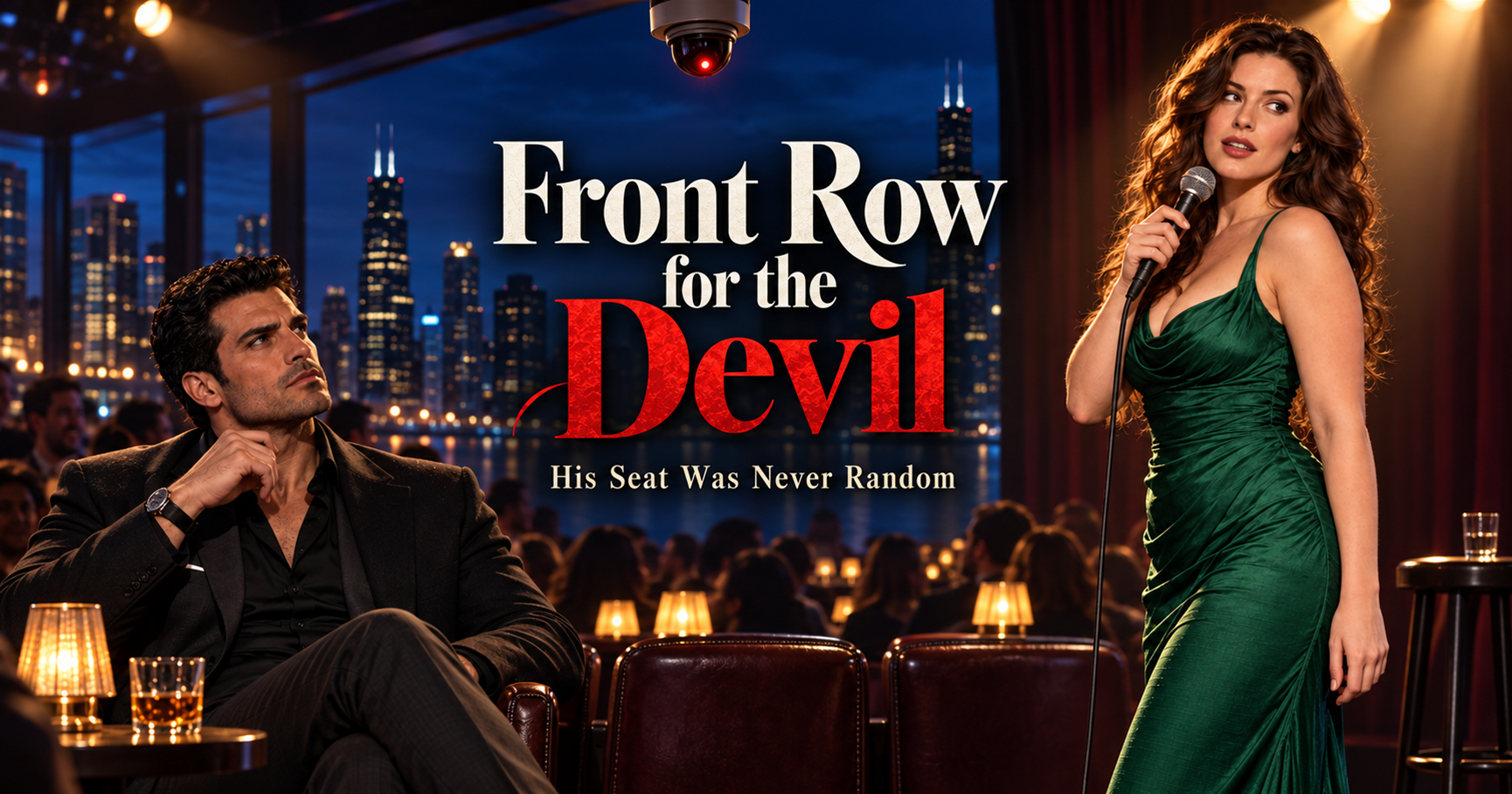
"Front Row for the Devil" Chapter 5 — The Manager Who Sold the Front Row
Chapter 5 — The Manager Who Sold the Front Row
Marcus chose a twenty-four-hour laundromat in Avondale because its cameras pointed toward every entrance and its dryers made private conversation almost impossible to record cleanly.
Natalie chose not to come alone.
Enzo waited across the street with Luca, out of Marcus’s sight. That had been Natalie’s condition. Enzo had objected once, then handed her a small transmitter and said, “If you ask for me, I enter. Not before.”
Marcus sat between two humming dryers, gray-faced and unshaven.
Natalie remained standing.
“How much?” she asked.
“It didn’t start like this.”
“That is not a number.”
“Five hundred per placement. Then a thousand. Sponsored tables, controlled interactions, nothing illegal.”
“You sold my set list.”
“I sold timing. Brands do it constantly.”
“Brands don’t usually murder city auditors.”
Marcus looked toward the window.
“I thought the clients wanted proof they attended public events. A divorce case. Insurance disputes. Contract meetings. They gave me a name, a seat, and a minute. I made sure you reached that section near the right time.”
“And when I improvised?”
“I signaled the plant to interrupt.”
Natalie remembered all the times Marcus had praised her for recovering from a difficult audience. How often he had hugged her backstage while someone else carried away a purchased timestamp.
“Why me?”
“Because people share you. Because your crowd work looks spontaneous. A security-camera image can be challenged. A viral clip reposted by ten thousand strangers becomes public memory.”
He slid a prepaid debit card across the folding table. The transaction list showed deposits routed through an event-production vendor owned by Voss Civic Strategies.
“This proves they paid you,” Natalie said. “Not why.”
Marcus placed an old phone beside it.
“They sent instructions through voice messages that deleted after playback. I recorded one with another device.”
He pressed play.
A distorted voice filled the space between the machines.
“Caruso must be visible. Center frame. The Warehouse Nine prompt must produce a reaction. If Hayes deviates, use Madison Street to recover the sequence.”
The message ended with a soft electronic chime.
Natalie played it again.
The voice had been altered. The phone number was disposable. But she knew that chime.
“That was in the club Friday afternoon,” she said. “During sound check.”
Marcus nodded. “Priya tested a sponsor cue that never played during the show.”
“So the message was recorded near our system.”
“Or using a copy of the cue.”
Natalie sat at last.
“When did you know?”
“That it was bigger than fake appearances? Thursday. After you derailed the set, they called me before you left the stage. They knew the delay to the second. Friday morning, they ordered Enzo’s seat.”
“You still let me walk onstage.”
Marcus’s face collapsed inward. “I thought they were trapping him. Not you.”
“That is supposed to help?”
“No.”
For once, he did not offer an excuse.
ADVERTISEMENT
“Why give me this now?”
“Owen Price is dead. Caleb is dead. I think Caleb tried to keep a copy of something from them. That accident—”
“Was not an accident?”
“I don’t know. I only know they kept using his badge because a dead employee never disputes a log.”
The dryers turned behind Marcus, carrying strangers’ clothes through circles of heat.
Natalie collected the card and phone.
“You’re going to a lawyer. Then the police.”
“Not yet.”
“That was not a suggestion.”
“They monitor my daughter.”
Marcus unlocked his phone and showed her a photograph received four minutes earlier.
His twelve-year-old daughter, Sophie, stood outside her school beside her mother. Across the street, a man read a newspaper in a parked car.
The caption said: You still have something that belongs to us.
Natalie’s anger changed shape.
She tapped the transmitter. “Enzo.”
He entered thirty seconds later. Marcus recoiled.
“You brought him?”
“I brought someone who knows the difference between protection and ownership. I’m testing whether he remembers it.”
Enzo stopped several feet away. His injured shoulder was hidden beneath a black coat, but Natalie noticed he avoided moving the arm.
She showed him the photograph.
“Can you move Sophie without making her disappear into your world?”
“Yes. Through an attorney who has handled protected witnesses. Her mother consents, the police know the destination, and every transfer is documented.”
Marcus stared. “You would do that for me?”
“For your daughter,” Enzo said. “Do not confuse the two.”
Enzo listened to the recording. His face revealed nothing until the electronic chime sounded.
“Voss uses that cue at contract presentations,” he said. “It marks a synchronized data push.”
“Can this clear you?” Natalie asked.
“No. A competent attorney will call it fabricated.”
“Can it hurt him?”
“If we connect the device, the cue, or the instruction to his system.”
Marcus looked from Enzo to Natalie. “And if we don’t?”
“Then you still confess,” Natalie said.
“Nat—”
“You do not get immunity because you became frightened after someone died. Sophie deserves protection. You deserve a lawyer. The people you sold into those seats deserve the truth.”
Marcus lowered his eyes. “I will give a statement. All of it.”
Natalie believed his fear. She did not yet believe his courage.
Natalie looked through the laundromat window at three different reflections of herself.
“Then we don’t hand him evidence to explain away. We make him use his system again.”
Marcus went pale. “How?”
“A live show. No delay. No predictable crowd work.”
Enzo understood first. “You give him a timeline he cannot trust.”
“I give him one he thinks he controls. Then I change it in public.”
She turned to him.
“If I do this, the evidence is mine. You don’t erase anything that embarrasses you. You don’t remove footage because it helps your people. You don’t decide the truth is too dangerous for me after I collect it.”
“Agreed.”
“Even if it does not clear you.”
Enzo held her gaze. “Even then.”
Something passed between them—too warm to be trust, too serious to be attraction alone.
Enzo reached for the prepaid card, then stopped before touching it.
“Your evidence,” he said.
It was a small thing. Natalie had spent two days learning how much destruction could hide inside small things.
She slid the card into an envelope herself.
Marcus’s phone buzzed.
A second photograph showed Sophie entering a car with her mother.
The message beneath it contained no words.
Only a countdown beginning at forty-eight hours.
Marcus looked at Natalie. “If we give everything to the police now, maybe they can protect her.”
“Maybe,” Natalie said.
The debit card and distorted recording were real, but neither proved Julian Voss had ordered a murder. If they moved too early, Voss could deny the voice, sacrifice Marcus, and wipe every remaining system before a warrant reached it.
If they waited, they might catch him reaching for the machinery.
They might also give him another chance to hurt someone.
Natalie closed her hand around the old phone.
“First we get Sophie into a protection chain no one can call kidnapping. Then I announce the show.”
Enzo watched her carefully. “And if the transfer fails?”
“We stop.”
Marcus swallowed. “And if it works?”
Natalie looked at the message counting down on his screen.
“Then for once, Voss performs on my schedule.”