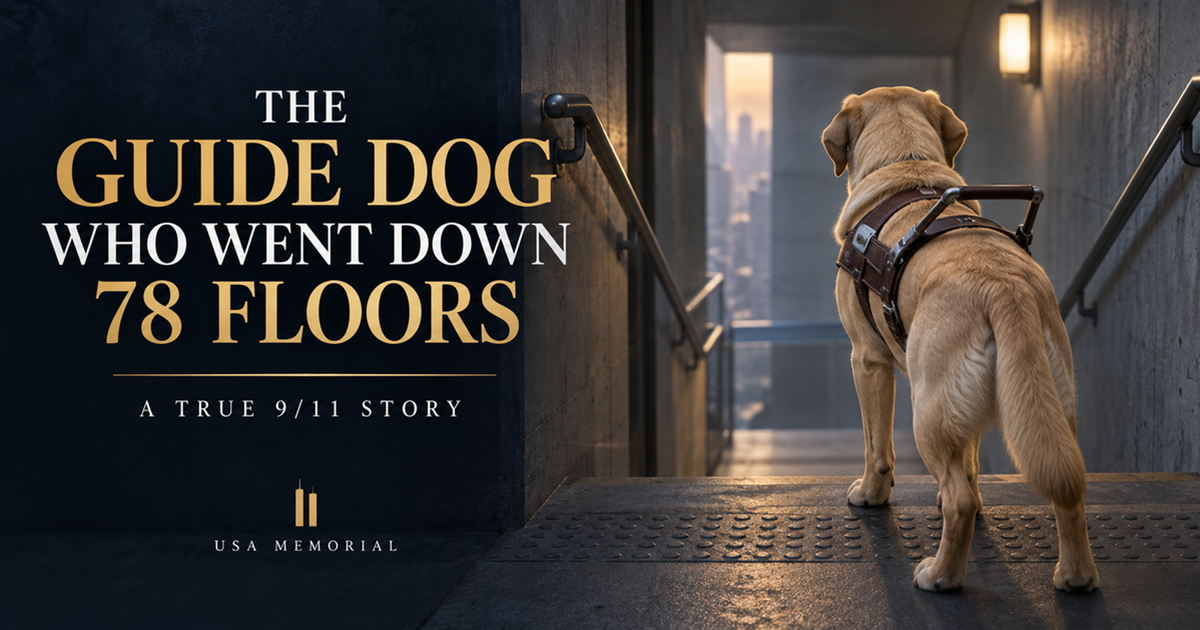
"THE GUIDE DOG WHO WENT DOWN 78 FLOORS" Chapter 2 — A Partnership Before the Emergency
Long before Roselle entered the North Tower, Michael Hingson had learned that blindness was not the same thing as helplessness.
He had been blind since birth. By September 2001, he was 51 years old, married, working in technology sales and traveling for business. The office on the 78th floor was not an unfamiliar maze. It was his workplace. He knew its layout, knew how to reach the exits and had participated in emergency preparation.
Roselle was his fifth guide dog. They had been matched by Guide Dogs for the Blind in 1999. By the time they went to work on September 11, their partnership had already been built through thousands of smaller decisions: curbs, doors, platforms, hallways, streets and elevators. Trust was not something they invented during the attack. It was something they had practiced before anyone knew it would be tested there.
A guide-dog team works through communication. The handler gives a direction. The dog chooses a safe route and identifies obstacles. If a command would create an immediate hazard, the dog may disobey it. That skill is often called intelligent disobedience, but it does not make the dog an independent navigator with a map inside her head. The work remains shared.
That distinction matters because popular versions of Roselle’s story sometimes erase Michael’s competence. They describe him as being pulled from the tower by a heroic animal. The record shows something different: a trained dog and an experienced blind man working together while sighted people around them were also trying to understand what had happened.
Michael’s blindness did not prevent him from reading the scene. He listened to the sounds of the building and to David’s descriptions. He noticed Roselle’s behavior. She was not panicking or refusing to work. Her steadiness told him something useful: whatever had happened, there was still a navigable environment immediately around them.
Michael also knew that fear could travel between handler and dog. As they began moving, he kept speaking to Roselle, praising her and reinforcing the familiar pattern of work. In a later interview, he said he wanted her to understand that he was all right even while she sensed the fear around them.
“Good dog, Roselle,” he repeatedly told her. “You’re doing a great job.”
Those words are not invented dialogue. Michael has recalled them publicly. They reveal the practical rhythm beneath the larger story. He was not delivering a speech. He was maintaining contact with his dog.
David Frank was also part of that working team. He could report what he saw. Michael could keep their decisions focused. Roselle could help Michael move safely when space allowed. Each had abilities the others needed.
Their situation was still unclear. They did not yet possess the aerial images that would soon be broadcast around the world. They had no complete account of Flight 11, no knowledge that a second plane would strike the South Tower and no way to know that both buildings would collapse.
The absence of a complete picture shaped their behavior. Michael could not pause to solve the whole event before acting. He could only test whether the next route remained usable. That is also how a guide-dog team ordinarily moves through a city. The destination may be known, but the work happens at the next doorway, curb or obstruction.
Roselle had been matched with Michael in 1999, and the pair had moved through years of ordinary travel. None of those journeys looked historic. That was precisely why they mattered. Repetition had made the harness familiar in Michael’s hand and his voice familiar to Roselle. The emergency did not create their system. It revealed what the system could withstand.
David’s presence corrected the simple picture of a man and dog alone. He was a coworker, a witness and soon an essential source of visual information. When his own fear rose later in the descent, the roles would change again. The person helping could need help; the person who could not see could restore focus.
They had only the next action.
They left the office and joined the flow toward the stairs.
Behind them was the desk where Roselle had been sleeping. Ahead of them was a descent longer than any ordinary workday could have prepared them to imagine.
And inside the stairwell, the partnership would have to change shape.
ADVERTISEMENT
You May Also Like
-
CompletedChapter 10

THE MAN NOBODY COULD NAME
Survivors of the South Tower remembered an unidentified young man in a red bandana who found a stairway, helped the injured, and repeatedly returned to the devastated 78th floor. Months later, Alison Crowther recognized the detail that revealed the rescuer as her 24-year-old son, Welles. His story connects eyewitness testimony, a family object, and one of the most enduring acts of civilian heroism from September 11.Stories Behind 9/114.8k words5 33 -
CompletedChapter 10
THE WOMAN THEY REFUSED TO LEAVE BEHIND
Josephine Harris was descending from the 73rd floor of the North Tower when an injured leg slowed her. Six firefighters from Ladder Company 6 refused to leave her and matched her pace toward the lower floors. When the tower collapsed around them, a surviving section of Stairwell B turned their decision into one of September 11’s most extraordinary—and most carefully misunderstood—survival stories.Stories Behind 9/116.8k words5 31 -
CompletedChapter 10
THE MORNING HE NEVER REACHED THE 105TH FLOOR
Howard Lutnick survived September 11 because he took his oldest son to his first day of kindergarten instead of going to Cantor Fitzgerald’s offices high in the North Tower. The company lost 658 employees, including his brother and best friend. This verified story follows what came next: controversy, a five-year profit pledge, a decade of health coverage, an open door for the children left behind, and an annual charitable tradition built from the firm’s devastating loss.Stories Behind 9/116.8k words5 33 -
CompletedChapter 10
THE CHAIR THAT CAME DOWN 69 FLOORS
When Flight 11 struck the North Tower, Port Authority accountant John Abruzzo could not evacuate by stairs. Ten coworkers placed him in an emergency chair installed after the 1993 bombing and carried him down 69 floors. Their documented escape—and the chair now preserved by the 9/11 Museum—reveals how preparation, disability inclusion, and an extraordinary decision made before the tower fell changed eleven lives.Stories Behind 9/11|Survival7.1k words5 253 -
CompletedChapter 10
The Woman Who Walked Down 87 Floors
The Woman Who Walked Down 87 Floors On the morning of September 11, 2001, Joanne “JoJo” Capestro went to work on the 87th floor of the World Trade Center's North Tower. At 8:46 a.m., everything changed. Joanne escaped by taking the stairs, passing firefighters heading upward as office workers rushed down. One of her coworkers, Harry Ramos, stopped to help a struggling stranger and never made it out. Joanne did. Minutes later, covered in dust after the collapse of the South Tower, she walked through Lower Manhattan and unknowingly crossed paths with photographer Phil Penman. He took her picture. They didn't know each other's names. Fifteen years later, the 9/11 Memorial Museum finally connected the photographer with the woman in his photograph. But their story still wasn't over.Stories Behind 9/1110.2k words5 251