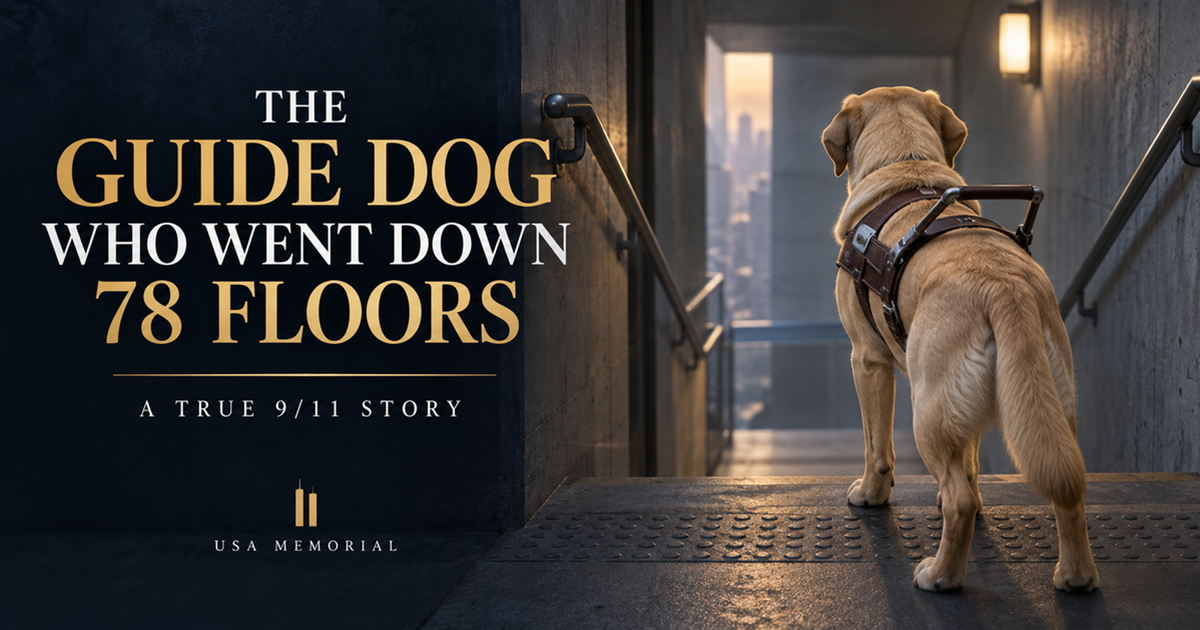
"THE GUIDE DOG WHO WENT DOWN 78 FLOORS" Chapter 4 — The Men Going Up
They met firefighters in the stairwell.
Michael later estimated that about 50 passed during the descent. The precise count was his recollection, but the direction of their movement is beyond dispute: office workers were moving down while firefighters carrying equipment climbed upward.
The contrast has become one of the enduring images of September 11. It is also easy to turn it into a polished line and forget what it meant physically. Firefighters wore heavy protective clothing and carried tools and air cylinders. They climbed flight after flight as hundreds of civilians pressed toward the street. Every landing narrowed the exchange.
Some evacuees offered to help. Michael recalled first responders telling them that their job was to keep going down and get out. The firefighters would handle what was above.
Michael could hear the equipment and the exertion as they passed. He could not see the faces that David and others saw. The names of the individual firefighters who crossed their path have not been established in the accounts used for this story, and they should not be invented. What is known is the terrible larger fact: 343 members of the New York City Fire Department were killed that day.
Roselle continued at Michael’s side or heel, depending on the space. She did not bark or bolt. Michael continued using the rail and continued giving praise. David continued to provide information from ahead.
Their progress was steady rather than fast. An evacuation from the 78th floor could not be reduced to a single dramatic sprint. It required one landing, one turn and one flight at a time. The rhythm itself became protection. Stop looking at the impossible total. Complete the section directly in front of you.
The smell and conditions changed as they descended. Later accounts describe smoke and the odor associated with the impact, but the exact intensity at each floor cannot be reconstructed. The most reliable narrative anchor is behavior: the stairwell remained passable, the crowd continued downward and the firefighters continued upward.
Michael has spent years correcting assumptions about that journey. Sighted interviewers often imagine that blindness must have made the stairs uniquely terrifying. His answer has been that blindness was an ordinary part of his life. He did not suddenly become less capable because other people could see the disaster and he could not. In some ways, his practiced attention to nonvisual information helped him remain focused.
There is no need to turn that focus into fearlessness. Michael has spoken openly about fear as information. What distinguished his behavior was the refusal to let fear become the only information. Roselle’s steadiness, David’s reports, the railing and the downward flow all supplied additional facts.
The firefighters supplied another. Their upward movement showed that organized response was underway even though no one in the stairwell could see the whole emergency. For the evacuees, each passing company created a narrow exchange: make room, continue down, allow the equipment to pass. Later knowledge gives those encounters a tragic weight the survivors could not yet fully possess.
The names and final movements of those particular responders cannot responsibly be assigned. The encounter must remain collective, respectful and exact about the limits of what is known.
That does not mean he knew they would survive. It means he concentrated on what he could control: his voice, his commands, the rail, Roselle’s movements and the information David gave him.
They kept descending until the stairwell opened into the lower part of the complex. The lobby was not a return to normal life. It was another altered environment, and they still did not have a full picture of what was happening outside.
An FBI agent directed Michael and David out of the complex.
Roselle crossed with them toward Broadway.
After dozens of floors inside concrete walls, they were finally in open air.
Then a police officer shouted that something was coming down.
For the first time since leaving the office, the safest direction was no longer simply down.
The encounter remained with Michael, as it did with many survivors who remembered responders climbing toward danger. On that morning, however, there was no time to turn it into history. The landing cleared, the two streams separated, and the descent continued.
ADVERTISEMENT
You May Also Like
-
CompletedChapter 10

THE MAN NOBODY COULD NAME
Survivors of the South Tower remembered an unidentified young man in a red bandana who found a stairway, helped the injured, and repeatedly returned to the devastated 78th floor. Months later, Alison Crowther recognized the detail that revealed the rescuer as her 24-year-old son, Welles. His story connects eyewitness testimony, a family object, and one of the most enduring acts of civilian heroism from September 11.Stories Behind 9/114.8k words5 33 -
CompletedChapter 10
THE WOMAN THEY REFUSED TO LEAVE BEHIND
Josephine Harris was descending from the 73rd floor of the North Tower when an injured leg slowed her. Six firefighters from Ladder Company 6 refused to leave her and matched her pace toward the lower floors. When the tower collapsed around them, a surviving section of Stairwell B turned their decision into one of September 11’s most extraordinary—and most carefully misunderstood—survival stories.Stories Behind 9/116.8k words5 31 -
CompletedChapter 10
THE MORNING HE NEVER REACHED THE 105TH FLOOR
Howard Lutnick survived September 11 because he took his oldest son to his first day of kindergarten instead of going to Cantor Fitzgerald’s offices high in the North Tower. The company lost 658 employees, including his brother and best friend. This verified story follows what came next: controversy, a five-year profit pledge, a decade of health coverage, an open door for the children left behind, and an annual charitable tradition built from the firm’s devastating loss.Stories Behind 9/116.8k words5 33 -
CompletedChapter 10
THE CHAIR THAT CAME DOWN 69 FLOORS
When Flight 11 struck the North Tower, Port Authority accountant John Abruzzo could not evacuate by stairs. Ten coworkers placed him in an emergency chair installed after the 1993 bombing and carried him down 69 floors. Their documented escape—and the chair now preserved by the 9/11 Museum—reveals how preparation, disability inclusion, and an extraordinary decision made before the tower fell changed eleven lives.Stories Behind 9/11|Survival7.1k words5 253 -
CompletedChapter 10
The Woman Who Walked Down 87 Floors
The Woman Who Walked Down 87 Floors On the morning of September 11, 2001, Joanne “JoJo” Capestro went to work on the 87th floor of the World Trade Center's North Tower. At 8:46 a.m., everything changed. Joanne escaped by taking the stairs, passing firefighters heading upward as office workers rushed down. One of her coworkers, Harry Ramos, stopped to help a struggling stranger and never made it out. Joanne did. Minutes later, covered in dust after the collapse of the South Tower, she walked through Lower Manhattan and unknowingly crossed paths with photographer Phil Penman. He took her picture. They didn't know each other's names. Fifteen years later, the 9/11 Memorial Museum finally connected the photographer with the woman in his photograph. But their story still wasn't over.Stories Behind 9/1110.2k words5 251