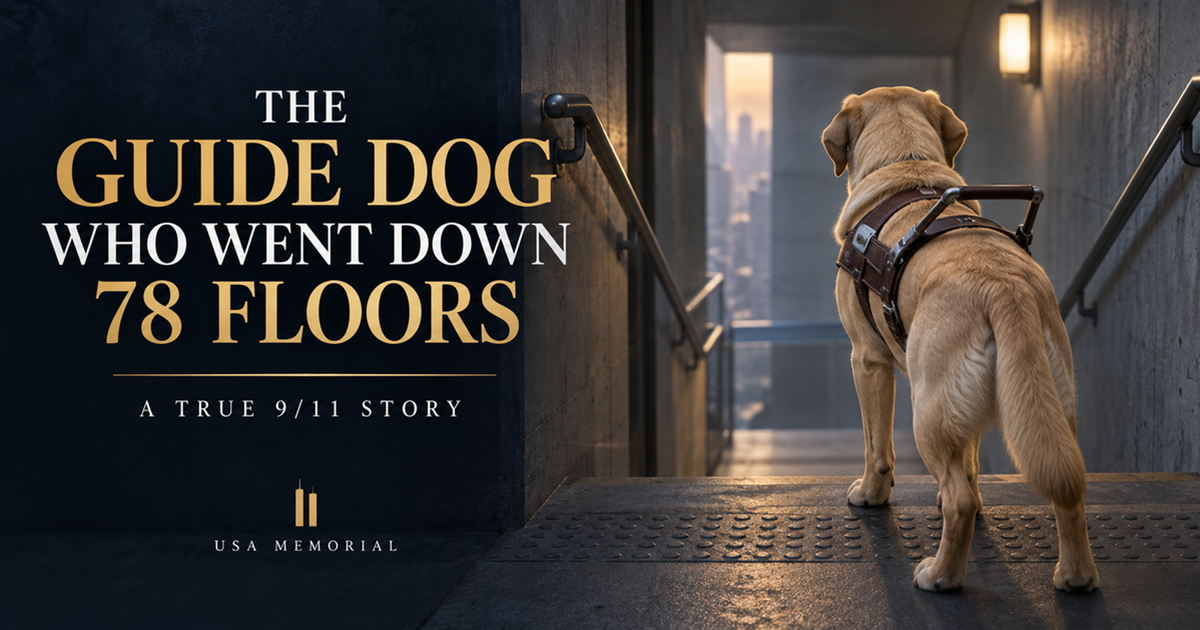
"THE GUIDE DOG WHO WENT DOWN 78 FLOORS" Chapter 5 — The Sound Across Broadway
Reaching the street did not end the evacuation.
Michael, Roselle and David had crossed Broadway when a police officer yelled for people to run. The South Tower, struck after the North Tower, was beginning to collapse.
Michael could not see it. He heard it.
He has described the sound in different interviews as a vast combination of a freight train and a waterfall—metal, concrete and debris becoming one continuous roar. Around him, people turned and ran. The information that mattered was no longer a floor number or a stairwell landing. It was the movement of the crowd and the sound growing behind them.
Michael ran with Roselle.
His later account includes an explicitly remembered thought: he could not believe they had escaped one building only to face collapse outside. He then focused on the instruction that had carried them through the stairs—do not spend the critical moment on what cannot be controlled. Run with Roselle.
This is the point at which the story is often told as if the dog selected a fully mapped escape route through Lower Manhattan. Michael’s recollection is more grounded. Roselle worked in the immediate environment. She responded to his movement, avoided obstacles and stopped when the route changed.
At the top of a flight of subway stairs, Roselle stopped.
A sudden stop is part of a guide dog’s vocabulary. It tells the handler that the ground or route ahead requires a decision. Michael recognized the stairs. Roselle then helped him move below street level, where the subway entrance offered shelter from the debris cloud above.
David remained with them. Other people also entered the station. No camera recorded Roselle’s exact path, and later reconstructions should never pretend that a particular generated frame is an original photograph. The verified action is enough: after guiding Michael down from the 78th floor, she helped him negotiate another unfamiliar set of stairs beneath the street.
Above them, Lower Manhattan was being transformed.
The South Tower had collapsed at 9:59 a.m. The North Tower—the building they had just left—was still standing. The team had no dependable way to calculate how much time remained. The popular statement that the North Tower fell “about half an hour after they got out” depends on what moment is treated as their exit and how long they sheltered underground. In a recent interview, Michael said the North Tower fell about 10 minutes after they returned from the subway to street level.
Both descriptions can be repeated carelessly as if they refer to the same instant. They do not. The responsible account preserves the sequence instead of forcing false precision: they exited the North Tower, ran during the South Tower’s collapse, sheltered underground, came back up, and soon afterward the North Tower collapsed.
The subway entrance is important because it shows Roselle performing the kind of task for which she had been trained amid conditions no training course could reproduce. She stopped at a change in elevation. Michael interpreted the stop and made the next decision. Then they descended. The dog did not predict the collapse or select a bunker from a city map. She communicated the obstacle immediately in front of them.
Underground, sound replaced the skyline once again. Dust and debris were outside; concrete and tile enclosed the people inside. They had survived the tower, but they still needed instructions about when to emerge. The police officer’s guidance became another link in the chain of shared information.
That chain—dog, handler, colleague, strangers and responders—is the true mechanism behind the story’s most dramatic minutes.
In the station, the immediate roar diminished. A police officer eventually said it was safe to emerge.
Michael, Roselle and David climbed back toward the street.
David looked toward the place where the South Tower had stood. What he described was not a damaged building but columns of smoke. The tower was gone.
The three survivors were standing outside the remaining tower when another sound began.
This time, it was their own workplace coming down.
Nothing in Roselle’s training could explain that sound. Her task was smaller and more urgent: remain with Michael through it.
The officer’s warning changed the scale of the problem. The team had escaped a building, but now the street itself had become part of the emergency. Roselle and Michael had to work while everyone around them was running.
ADVERTISEMENT
You May Also Like
-
CompletedChapter 10

THE MAN NOBODY COULD NAME
Survivors of the South Tower remembered an unidentified young man in a red bandana who found a stairway, helped the injured, and repeatedly returned to the devastated 78th floor. Months later, Alison Crowther recognized the detail that revealed the rescuer as her 24-year-old son, Welles. His story connects eyewitness testimony, a family object, and one of the most enduring acts of civilian heroism from September 11.Stories Behind 9/114.8k words5 33 -
CompletedChapter 10
THE WOMAN THEY REFUSED TO LEAVE BEHIND
Josephine Harris was descending from the 73rd floor of the North Tower when an injured leg slowed her. Six firefighters from Ladder Company 6 refused to leave her and matched her pace toward the lower floors. When the tower collapsed around them, a surviving section of Stairwell B turned their decision into one of September 11’s most extraordinary—and most carefully misunderstood—survival stories.Stories Behind 9/116.8k words5 31 -
CompletedChapter 10
THE MORNING HE NEVER REACHED THE 105TH FLOOR
Howard Lutnick survived September 11 because he took his oldest son to his first day of kindergarten instead of going to Cantor Fitzgerald’s offices high in the North Tower. The company lost 658 employees, including his brother and best friend. This verified story follows what came next: controversy, a five-year profit pledge, a decade of health coverage, an open door for the children left behind, and an annual charitable tradition built from the firm’s devastating loss.Stories Behind 9/116.8k words5 33 -
CompletedChapter 10
THE CHAIR THAT CAME DOWN 69 FLOORS
When Flight 11 struck the North Tower, Port Authority accountant John Abruzzo could not evacuate by stairs. Ten coworkers placed him in an emergency chair installed after the 1993 bombing and carried him down 69 floors. Their documented escape—and the chair now preserved by the 9/11 Museum—reveals how preparation, disability inclusion, and an extraordinary decision made before the tower fell changed eleven lives.Stories Behind 9/11|Survival7.1k words5 253 -
CompletedChapter 10
The Woman Who Walked Down 87 Floors
The Woman Who Walked Down 87 Floors On the morning of September 11, 2001, Joanne “JoJo” Capestro went to work on the 87th floor of the World Trade Center's North Tower. At 8:46 a.m., everything changed. Joanne escaped by taking the stairs, passing firefighters heading upward as office workers rushed down. One of her coworkers, Harry Ramos, stopped to help a struggling stranger and never made it out. Joanne did. Minutes later, covered in dust after the collapse of the South Tower, she walked through Lower Manhattan and unknowingly crossed paths with photographer Phil Penman. He took her picture. They didn't know each other's names. Fifteen years later, the 9/11 Memorial Museum finally connected the photographer with the woman in his photograph. But their story still wasn't over.Stories Behind 9/1110.2k words5 251