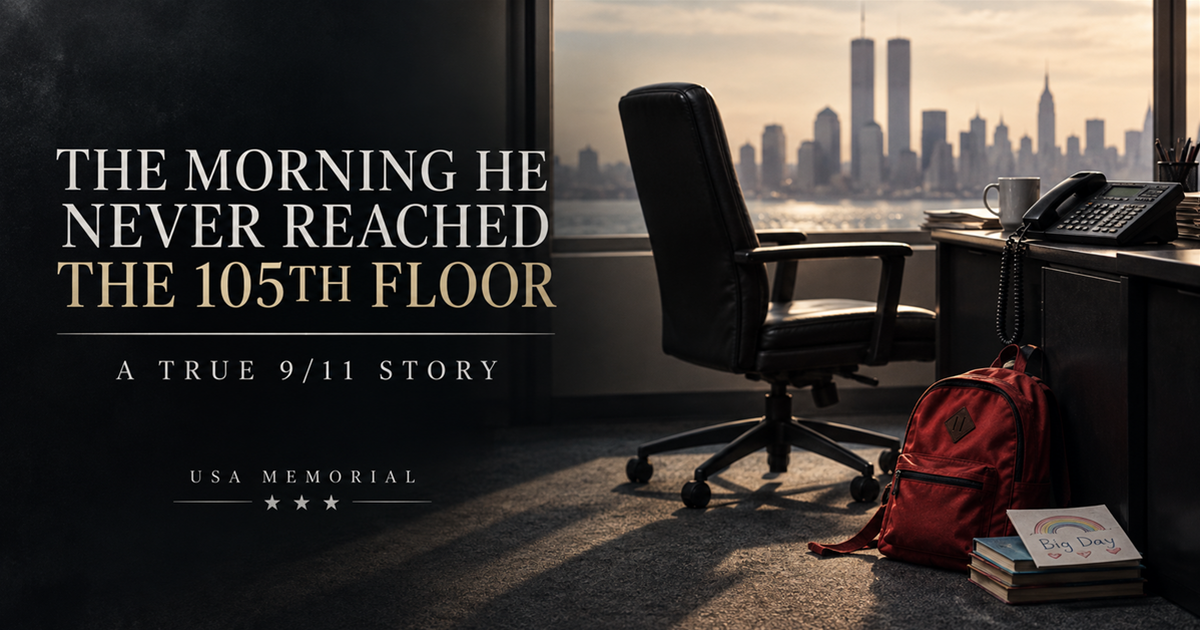
"THE MORNING HE NEVER REACHED THE 105TH FLOOR" Chapter 1 — The Backpack
On the morning of September 11, 2001, the object that changed Howard Lutnick’s life was not on a trading desk.
It was a child’s school backpack.
Howard was the chairman and chief executive of Cantor Fitzgerald, a bond-trading firm whose New York headquarters filled the 101st through 105th floors of the World Trade Center’s North Tower. His own office was on the 105th floor. On an ordinary Tuesday morning, that was where people expected him to be.
But this was not an ordinary morning for his family. His oldest son was beginning kindergarten. Howard went with his wife to take him to school.
There was no warning hidden in that decision. No one standing at the school entrance could have known that a family milestone was separating Howard from nearly everyone he worked with. It was simply the kind of choice parents make: work could wait for a little while; the first day of school would happen only once.
At 8:46 a.m., American Airlines Flight 11 struck the North Tower.
The airplane tore into the building from roughly the 93rd through the 99th floors. Cantor Fitzgerald’s offices were above the impact zone. The elevators and stairways that connected those floors to the ground were cut off.
In the space of seconds, the offices Howard had been expected to enter became unreachable.
News traveled across the city in fragments. A plane had hit the World Trade Center. Smoke was pouring from one of the towers. People turned toward televisions, windows and radios, trying to understand whether what they were seeing was an accident.
For Howard, the question was immediately personal. His company was up there. His younger brother, Gary, worked there. His best friend, Douglas Gardner, worked there. Hundreds of colleagues had arrived for what they believed would be a normal business day.
Howard headed downtown.
He later wrote that he grabbed people coming away from the disaster and asked whether they were from Cantor. The questions reflected the first desperate hope of that morning: perhaps some had escaped before the way down was lost. Perhaps someone had been late. Perhaps the people he knew were somewhere in the crowd.
But Cantor’s location made the reality especially cruel. Its employees were not simply near the impact. They were above it.
The North Tower remained standing for 102 minutes after it was struck. During that time, families called, messages were left, and people below watched the upper floors through smoke. Then, at 10:28 a.m., the building collapsed.
Howard had survived because he had not gone to work.
That sentence would follow every account of his life afterward. It sounds simple when reduced to a line: a father took his son to school, and the decision saved him. But survival did not deliver him to safety in any ordinary sense. It placed him outside the tower while almost an entire office disappeared inside it.
The school morning and the trading floor would remain connected forever: a small backpack, an empty chair, a father alive, and hundreds of families waiting for people who would not return.
The surviving photographs from that day cannot show this entire contrast in one frame. Images of smoke record the public disaster. Family photographs record the people as they were before it. A picture from a school morning, if properly sourced, would record only a parent and child at an ordinary threshold. The meaning comes from the timeline connecting them, not from altering any photograph or asking it to prove more than it can.
That is why the first day of school is not sentimental decoration. It establishes the interruption in Howard’s normal schedule. Cantor’s business operated early, and its senior leader would ordinarily have been with his employees. For a brief family obligation, he was not. History turned that absence into survival before he could understand what had happened.
By the end of the day, Howard still did not know the full number.
Soon, he would.
The number would force every ordinary detail of that school morning to be remembered differently for the rest of his life.
It would also become the beginning of a promise extending far beyond one survivor and one family.
That promise came next.
ADVERTISEMENT
You May Also Like
-
CompletedChapter 10

THE MAN NOBODY COULD NAME
Survivors of the South Tower remembered an unidentified young man in a red bandana who found a stairway, helped the injured, and repeatedly returned to the devastated 78th floor. Months later, Alison Crowther recognized the detail that revealed the rescuer as her 24-year-old son, Welles. His story connects eyewitness testimony, a family object, and one of the most enduring acts of civilian heroism from September 11.Stories Behind 9/114.8k words5 33 -
CompletedChapter 10
THE WOMAN THEY REFUSED TO LEAVE BEHIND
Josephine Harris was descending from the 73rd floor of the North Tower when an injured leg slowed her. Six firefighters from Ladder Company 6 refused to leave her and matched her pace toward the lower floors. When the tower collapsed around them, a surviving section of Stairwell B turned their decision into one of September 11’s most extraordinary—and most carefully misunderstood—survival stories.Stories Behind 9/116.8k words5 31 -
CompletedChapter 10
THE GUIDE DOG WHO WENT DOWN 78 FLOORS
Michael Hingson was working on the 78th floor of the North Tower when Flight 11 struck above him. This verified account follows Michael, his guide dog Roselle and colleague David Frank through the stairwell, past firefighters climbing upward, into the street and below ground during the South Tower’s collapse. More than a heroic-dog story, it reveals how a real guide-dog partnership—and several people sharing different kinds of information—survived one of the defining events of September 11.Stories Behind 9/116.9k words5 59 -
CompletedChapter 10
THE CHAIR THAT CAME DOWN 69 FLOORS
When Flight 11 struck the North Tower, Port Authority accountant John Abruzzo could not evacuate by stairs. Ten coworkers placed him in an emergency chair installed after the 1993 bombing and carried him down 69 floors. Their documented escape—and the chair now preserved by the 9/11 Museum—reveals how preparation, disability inclusion, and an extraordinary decision made before the tower fell changed eleven lives.Stories Behind 9/11|Survival7.1k words5 253 -
CompletedChapter 10
The Woman Who Walked Down 87 Floors
The Woman Who Walked Down 87 Floors On the morning of September 11, 2001, Joanne “JoJo” Capestro went to work on the 87th floor of the World Trade Center's North Tower. At 8:46 a.m., everything changed. Joanne escaped by taking the stairs, passing firefighters heading upward as office workers rushed down. One of her coworkers, Harry Ramos, stopped to help a struggling stranger and never made it out. Joanne did. Minutes later, covered in dust after the collapse of the South Tower, she walked through Lower Manhattan and unknowingly crossed paths with photographer Phil Penman. He took her picture. They didn't know each other's names. Fifteen years later, the 9/11 Memorial Museum finally connected the photographer with the woman in his photograph. But their story still wasn't over.Stories Behind 9/1110.2k words5 251