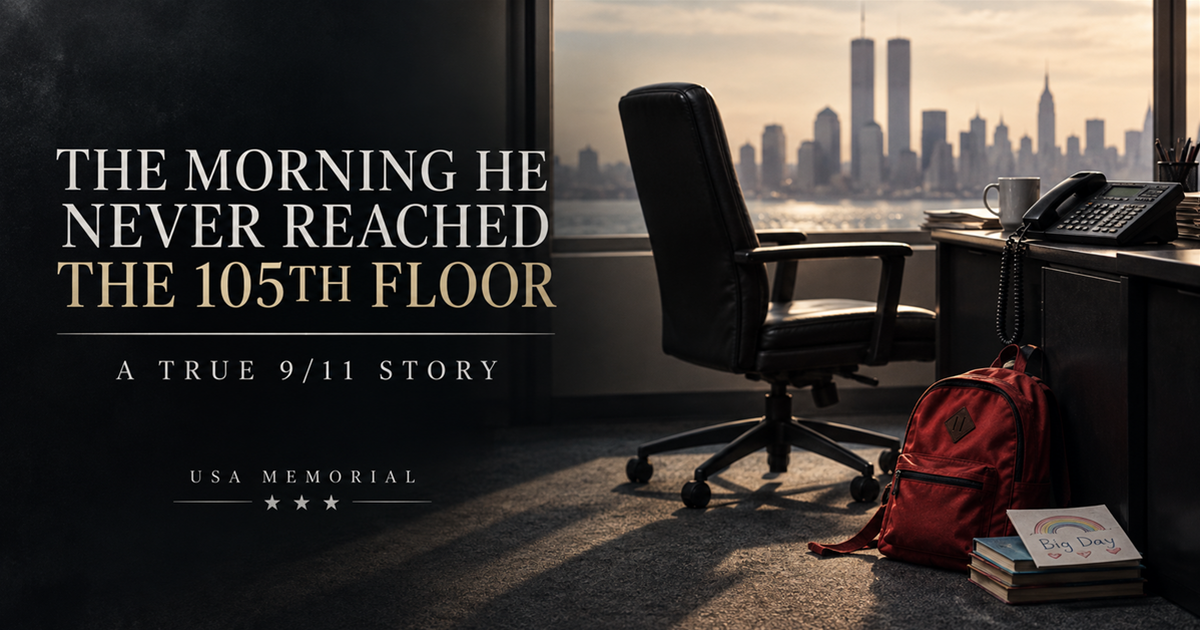
"THE MORNING HE NEVER REACHED THE 105TH FLOOR" Chapter 3 — 8:46 A.M.
At 8:46 a.m., clocks across New York continued moving.
The markets had not yet opened. Commuters were still arriving. Parents were leaving schools after first-day drop-offs. In Lower Manhattan, the day was only beginning.
Then Flight 11 struck the North Tower.
For Cantor Fitzgerald, there was an immediate before and after. Before the impact, its New York employees were preparing for business. After it, the company’s headquarters were stranded above the crash zone.
The public history of September 11 contains vast numbers: four hijacked aircraft, two towers, thousands killed. But inside each institution, the catastrophe arrived through names. A brother. A friend. A desk partner. A manager. A receptionist. Someone who had called home only minutes earlier.
Howard’s two most personal names were Gary and Doug.
Gary Lutnick was Howard’s younger brother. Douglas Gardner was his best friend and a senior figure at Cantor. Both were in the North Tower. Neither survived.
The deaths were part of a company total that would eventually be fixed at 658 employees.
That number is repeated so often that it can begin to look like a statistic. It was not. It represented 658 separate lives and an even larger circle of spouses, parents, children, siblings and friends. It represented empty places at dinner tables and unanswered telephones in hundreds of homes.
Howard’s position made his grief unusually public. He was a bereaved brother and friend. He was also the chief executive of a firm whose surviving employees were trying to determine whether the company could continue to exist.
Those roles could not be separated.
The physical business had been concentrated in the tower. Trading systems, records, equipment and office space were lost. More devastatingly, the human knowledge of the firm had been torn away. Teams had disappeared together. Survivors were not returning to a workplace where they could slowly resume normal operations. Their workplace no longer existed.
Yet financial obligations did not pause. Families needed information. Employees elsewhere needed direction. Markets would reopen. The company faced practical decisions immediately, even while the scale of death was still becoming clear.
No responsible telling of this story should turn those decisions into a simple legend.
In the days after the attack, Cantor’s handling of payroll for the missing employees produced anger and public criticism. Families were grieving, and reports that paychecks had stopped felt brutal. Howard later explained the company was fighting to preserve enough cash to survive and support the families over time. The controversy became part of the record, and it should not be erased.
What happened next also belongs in the record.
The firm established a relief fund. It committed a quarter of its profits for five years to the families of the employees it had lost. It arranged health-care coverage for ten years. Over time, the assistance distributed to those families exceeded $180 million.
Those actions did not reverse the first days. They did not return a single person. They did create a long structure of support that outlasted the immediate attention surrounding the attacks.
The company’s future would therefore be measured in two ways at once: by whether it could rebuild its business, and by whether it would keep its promises to the families of the dead.
In those first days, certainty was scarce. Official identifications would take time, and many families initially used the language of missing people because hope had not yet surrendered to confirmation. Company leaders had to work while their own colleagues and relatives remained among those names. Every operational discussion existed beside grief, and every public statement was heard by people desperate for information.
The markets eventually reopened, but reopening did not restore the human network Cantor had lost. Surviving offices and employees outside New York helped carry the business. Competitors, clients and recruits became part of the rebuilding. The firm’s ability to operate again would determine whether its promises could become something more than declarations made in shock.
At 8:46 a.m., Howard had still been a father completing a school morning.
By the time the North Tower fell, he had become the surviving leader of a company missing 658 people.
The next chapter of Cantor Fitzgerald would not begin on a trading floor.
It would begin with a list of names.
ADVERTISEMENT
You May Also Like
-
CompletedChapter 10

THE MAN NOBODY COULD NAME
Survivors of the South Tower remembered an unidentified young man in a red bandana who found a stairway, helped the injured, and repeatedly returned to the devastated 78th floor. Months later, Alison Crowther recognized the detail that revealed the rescuer as her 24-year-old son, Welles. His story connects eyewitness testimony, a family object, and one of the most enduring acts of civilian heroism from September 11.Stories Behind 9/114.8k words5 33 -
CompletedChapter 10
THE WOMAN THEY REFUSED TO LEAVE BEHIND
Josephine Harris was descending from the 73rd floor of the North Tower when an injured leg slowed her. Six firefighters from Ladder Company 6 refused to leave her and matched her pace toward the lower floors. When the tower collapsed around them, a surviving section of Stairwell B turned their decision into one of September 11’s most extraordinary—and most carefully misunderstood—survival stories.Stories Behind 9/116.8k words5 31 -
CompletedChapter 10
THE GUIDE DOG WHO WENT DOWN 78 FLOORS
Michael Hingson was working on the 78th floor of the North Tower when Flight 11 struck above him. This verified account follows Michael, his guide dog Roselle and colleague David Frank through the stairwell, past firefighters climbing upward, into the street and below ground during the South Tower’s collapse. More than a heroic-dog story, it reveals how a real guide-dog partnership—and several people sharing different kinds of information—survived one of the defining events of September 11.Stories Behind 9/116.9k words5 59 -
CompletedChapter 10
THE CHAIR THAT CAME DOWN 69 FLOORS
When Flight 11 struck the North Tower, Port Authority accountant John Abruzzo could not evacuate by stairs. Ten coworkers placed him in an emergency chair installed after the 1993 bombing and carried him down 69 floors. Their documented escape—and the chair now preserved by the 9/11 Museum—reveals how preparation, disability inclusion, and an extraordinary decision made before the tower fell changed eleven lives.Stories Behind 9/11|Survival7.1k words5 253 -
CompletedChapter 10
The Woman Who Walked Down 87 Floors
The Woman Who Walked Down 87 Floors On the morning of September 11, 2001, Joanne “JoJo” Capestro went to work on the 87th floor of the World Trade Center's North Tower. At 8:46 a.m., everything changed. Joanne escaped by taking the stairs, passing firefighters heading upward as office workers rushed down. One of her coworkers, Harry Ramos, stopped to help a struggling stranger and never made it out. Joanne did. Minutes later, covered in dust after the collapse of the South Tower, she walked through Lower Manhattan and unknowingly crossed paths with photographer Phil Penman. He took her picture. They didn't know each other's names. Fifteen years later, the 9/11 Memorial Museum finally connected the photographer with the woman in his photograph. But their story still wasn't over.Stories Behind 9/1110.2k words5 251