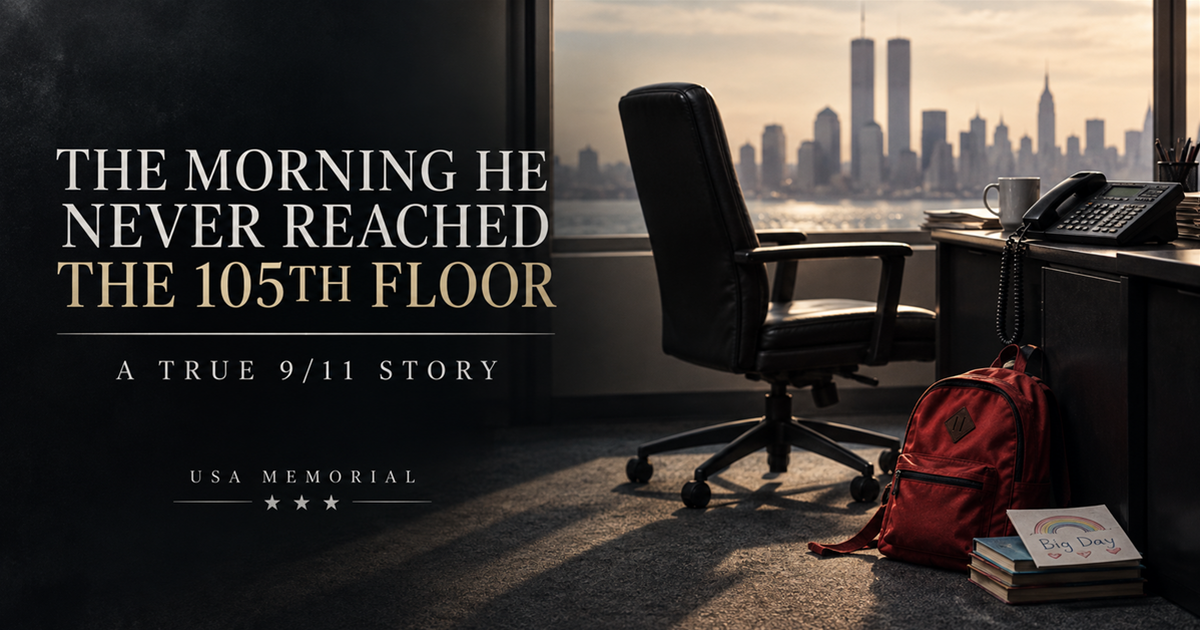
"THE MORNING HE NEVER REACHED THE 105TH FLOOR" Chapter 4 — The Number 658
There is no gentle way to say what 658 meant to Cantor Fitzgerald.
It meant that more than two out of every three members of the firm’s New York workforce were gone.
It meant that the company suffered the largest loss of life experienced by any single business in the September 11 attacks.
It meant that survival was no longer an individual story about Howard Lutnick missing a morning at the office. Survival had become an obligation shared by everyone from Cantor who remained.
In the first public accounts, the company’s loss was often described through the image of its location high in the North Tower. That image was accurate, but incomplete. Buildings explain where people were. They do not explain who those people were.
The 658 came from different communities, backgrounds and jobs. Some worked directly on trading desks. Others supported the systems and operations that allowed the business to function. They had spouses and partners, young children and adult children, parents who expected to grow old before them, and friends who knew them outside finance entirely.
The company’s memorial responsibility could not be contained by a single ceremony.
Families needed health coverage. They needed financial support while households adjusted to lost incomes. Children would reach milestones their parents would never see. Anniversaries would return. The news cameras would eventually move away, but the consequences would continue.
Cantor created the Cantor Fitzgerald Relief Fund in the immediate aftermath. The organization became a channel for assistance to the families of those killed. The firm’s central financial pledge—25 percent of profits for five years—linked the company’s rebuilding directly to the people it had lost.
The structure mattered.
It meant that recovery was not defined only by revenue or market share. If the surviving business earned money, a share would go to the families. The company’s future performance would carry a debt to its past.
The ten-year health-care commitment extended that logic. Medical coverage is not a dramatic symbol. It is a practical promise involving forms, bills, eligibility and continuity. That ordinariness is precisely why it mattered. Grief does not suspend the need for doctors, prescriptions or treatment.
Across five years, the profit-sharing pledge accumulated. Across a decade, the health-care commitment continued. Together, the support distributed to the families surpassed $180 million.
The number is substantial, but it should not be mistaken for a price placed on 658 lives. No sum could perform that function. The money addressed living needs among the people left behind.
Howard became the public face of those decisions. He was praised by some and criticized by others. His own losses were frequently mentioned, yet they did not make every choice beyond dispute. The documented story is stronger when both realities remain visible: the first chaotic decisions caused pain, and the long-term commitments delivered extensive help.
That complexity separates history from advertising.
It also changes the meaning of the word company. A company is often described through buildings, legal documents or financial results. After September 11, Cantor’s most important boundary extended beyond its new offices. It included bereaved households, children growing up without a parent and surviving employees who had lost entire teams. The institution could relocate its desks; it could not relocate itself away from those relationships.
The relief effort therefore required administration as well as empathy. Records had to be maintained, benefits coordinated and distributions made over years. None of that produces a single iconic photograph. Yet repeated, unglamorous work is what turns a memorial pledge into material help. A promise becomes real when it survives the calendar.
The firm rebuilt. It hired. It returned to trading. But inside Cantor, the 658 were not treated as a closed chapter belonging only to 2001. Their names continued to define how the company spoke about itself and why its charitable programs existed.
For Howard, two names stood close to the center of that number.
One belonged to the younger brother he had grown up with.
The other belonged to the friend who had helped build the company beside him.
To understand why Cantor’s promises lasted for years, the story has to move from the total back to those two men.
Their names made the scale intimate, but they also pointed back toward every family whose private grief was contained inside the same public number.
ADVERTISEMENT
You May Also Like
-
CompletedChapter 10

THE MAN NOBODY COULD NAME
Survivors of the South Tower remembered an unidentified young man in a red bandana who found a stairway, helped the injured, and repeatedly returned to the devastated 78th floor. Months later, Alison Crowther recognized the detail that revealed the rescuer as her 24-year-old son, Welles. His story connects eyewitness testimony, a family object, and one of the most enduring acts of civilian heroism from September 11.Stories Behind 9/114.8k words5 33 -
CompletedChapter 10
THE WOMAN THEY REFUSED TO LEAVE BEHIND
Josephine Harris was descending from the 73rd floor of the North Tower when an injured leg slowed her. Six firefighters from Ladder Company 6 refused to leave her and matched her pace toward the lower floors. When the tower collapsed around them, a surviving section of Stairwell B turned their decision into one of September 11’s most extraordinary—and most carefully misunderstood—survival stories.Stories Behind 9/116.8k words5 31 -
CompletedChapter 10
THE GUIDE DOG WHO WENT DOWN 78 FLOORS
Michael Hingson was working on the 78th floor of the North Tower when Flight 11 struck above him. This verified account follows Michael, his guide dog Roselle and colleague David Frank through the stairwell, past firefighters climbing upward, into the street and below ground during the South Tower’s collapse. More than a heroic-dog story, it reveals how a real guide-dog partnership—and several people sharing different kinds of information—survived one of the defining events of September 11.Stories Behind 9/116.9k words5 59 -
CompletedChapter 10
THE CHAIR THAT CAME DOWN 69 FLOORS
When Flight 11 struck the North Tower, Port Authority accountant John Abruzzo could not evacuate by stairs. Ten coworkers placed him in an emergency chair installed after the 1993 bombing and carried him down 69 floors. Their documented escape—and the chair now preserved by the 9/11 Museum—reveals how preparation, disability inclusion, and an extraordinary decision made before the tower fell changed eleven lives.Stories Behind 9/11|Survival7.1k words5 253 -
CompletedChapter 10
The Woman Who Walked Down 87 Floors
The Woman Who Walked Down 87 Floors On the morning of September 11, 2001, Joanne “JoJo” Capestro went to work on the 87th floor of the World Trade Center's North Tower. At 8:46 a.m., everything changed. Joanne escaped by taking the stairs, passing firefighters heading upward as office workers rushed down. One of her coworkers, Harry Ramos, stopped to help a struggling stranger and never made it out. Joanne did. Minutes later, covered in dust after the collapse of the South Tower, she walked through Lower Manhattan and unknowingly crossed paths with photographer Phil Penman. He took her picture. They didn't know each other's names. Fifteen years later, the 9/11 Memorial Museum finally connected the photographer with the woman in his photograph. But their story still wasn't over.Stories Behind 9/1110.2k words5 251