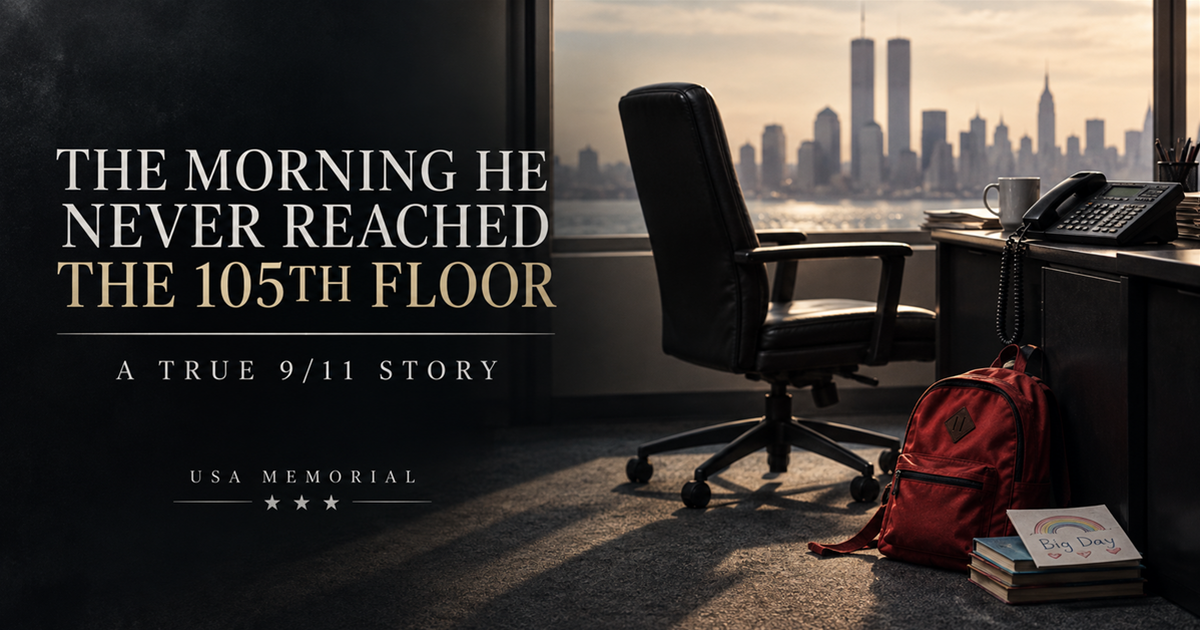
"THE MORNING HE NEVER REACHED THE 105TH FLOOR" Chapter 5 — Gary and Doug
Howard Lutnick did not lose 658 employees at a distance.
Among them was his younger brother, Gary.
Among them was his best friend, Douglas Gardner, known as Doug.
Their deaths placed the company’s catastrophe inside Howard’s own family and closest circle. Every discussion about Cantor’s losses included people whose absence followed him home.
Gary was 36. Howard has continued to name him publicly in remembrances decades later. Doug was 39 and had become a leading figure at the company. In Howard’s later account, the two appear not as symbols but as part of the personal sentence he uses to describe September 11: his brother, his best friend, and 656 other colleagues and friends.
That phrasing matters because it refuses to separate the famous names from the larger group.
The public knew Howard because he survived and because he led the company afterward. Gary and Doug became known largely through their relationship to him. But their lives were their own, just as every one of the 658 lives was its own.
There is a temptation in stories about mass tragedy to invent a final conversation or a meaningful last gesture. None is needed here. The verified facts already hold the emotional weight.
Howard went to his son’s first day of school.
Gary and Doug went to work.
The offices were above the impact.
Howard lived. They did not.
That difference was not the result of a moral choice. It was a difference in morning schedules.
For survivors, chance can become a lifelong companion. A delayed train, a doctor’s appointment, a child’s event or a missed elevator may separate one life from another. Outsiders often call such circumstances miraculous. The survivor may also have to carry the knowledge of everyone who made the ordinary choice to be where they were expected to be.
Howard’s public work after September 11 can be read against that background. He did not simply try to restore a firm that had suffered an operational disaster. He tried to build a future for an institution whose identity was now inseparable from its dead.
The families watched what Cantor did. The financial world watched. Reporters asked whether the company could survive. Each decision had business consequences and moral meaning.
The profit pledge gave the company a measurable obligation. For five years, one quarter of its profits would be directed to the families. The health-care promise extended for ten. These were long enough periods to test whether words spoken in the aftermath would become sustained action.
They did.
The firm’s survival allowed the commitments to be funded. At the same time, the commitments gave survival a purpose larger than restoring a balance sheet.
Howard’s later retellings preserve the blunt arithmetic of his loss, but arithmetic cannot describe the overlapping roles Gary and Doug held in his life. One was tied to childhood and family. The other was tied to friendship and the building of the firm. Losing both on the same morning meant there was no separate private place where the company’s catastrophe could be left behind.
The same overlap existed for many others. Cantor employees attended one another’s weddings, knew one another’s families and built careers side by side. When so many members of one organization died together, grief traveled through both home and workplace. Rebuilding teams meant working in the presence of those connections, not starting from an empty corporate chart.
Nothing in that arrangement removed grief. Howard still entered every anniversary knowing why he had been absent and why Gary and Doug had been present. The company could distribute money, maintain insurance and create jobs, but it could not recreate the five floors as they had existed before 8:46.
The most honest version of the story therefore contains no perfect closure.
It contains continuity.
Gary’s name continued to be spoken. Doug’s name continued to be spoken. The other 656 names remained part of the company’s memorial life. Children grew older. Some eventually entered the same firm where their parents had worked.
And each year, the trading activity that once defined an ordinary business day was transformed, for one day, into something else.
It became a way to give the day’s revenue away.
That future tradition would grow from loss, but it would never be presented as a replacement for the people whose absence created it.
ADVERTISEMENT
You May Also Like
-
CompletedChapter 10

THE MAN NOBODY COULD NAME
Survivors of the South Tower remembered an unidentified young man in a red bandana who found a stairway, helped the injured, and repeatedly returned to the devastated 78th floor. Months later, Alison Crowther recognized the detail that revealed the rescuer as her 24-year-old son, Welles. His story connects eyewitness testimony, a family object, and one of the most enduring acts of civilian heroism from September 11.Stories Behind 9/114.8k words5 33 -
CompletedChapter 10
THE WOMAN THEY REFUSED TO LEAVE BEHIND
Josephine Harris was descending from the 73rd floor of the North Tower when an injured leg slowed her. Six firefighters from Ladder Company 6 refused to leave her and matched her pace toward the lower floors. When the tower collapsed around them, a surviving section of Stairwell B turned their decision into one of September 11’s most extraordinary—and most carefully misunderstood—survival stories.Stories Behind 9/116.8k words5 31 -
CompletedChapter 10
THE GUIDE DOG WHO WENT DOWN 78 FLOORS
Michael Hingson was working on the 78th floor of the North Tower when Flight 11 struck above him. This verified account follows Michael, his guide dog Roselle and colleague David Frank through the stairwell, past firefighters climbing upward, into the street and below ground during the South Tower’s collapse. More than a heroic-dog story, it reveals how a real guide-dog partnership—and several people sharing different kinds of information—survived one of the defining events of September 11.Stories Behind 9/116.9k words5 59 -
CompletedChapter 10
THE CHAIR THAT CAME DOWN 69 FLOORS
When Flight 11 struck the North Tower, Port Authority accountant John Abruzzo could not evacuate by stairs. Ten coworkers placed him in an emergency chair installed after the 1993 bombing and carried him down 69 floors. Their documented escape—and the chair now preserved by the 9/11 Museum—reveals how preparation, disability inclusion, and an extraordinary decision made before the tower fell changed eleven lives.Stories Behind 9/11|Survival7.1k words5 253 -
CompletedChapter 10
The Woman Who Walked Down 87 Floors
The Woman Who Walked Down 87 Floors On the morning of September 11, 2001, Joanne “JoJo” Capestro went to work on the 87th floor of the World Trade Center's North Tower. At 8:46 a.m., everything changed. Joanne escaped by taking the stairs, passing firefighters heading upward as office workers rushed down. One of her coworkers, Harry Ramos, stopped to help a struggling stranger and never made it out. Joanne did. Minutes later, covered in dust after the collapse of the South Tower, she walked through Lower Manhattan and unknowingly crossed paths with photographer Phil Penman. He took her picture. They didn't know each other's names. Fifteen years later, the 9/11 Memorial Museum finally connected the photographer with the woman in his photograph. But their story still wasn't over.Stories Behind 9/1110.2k words5 251