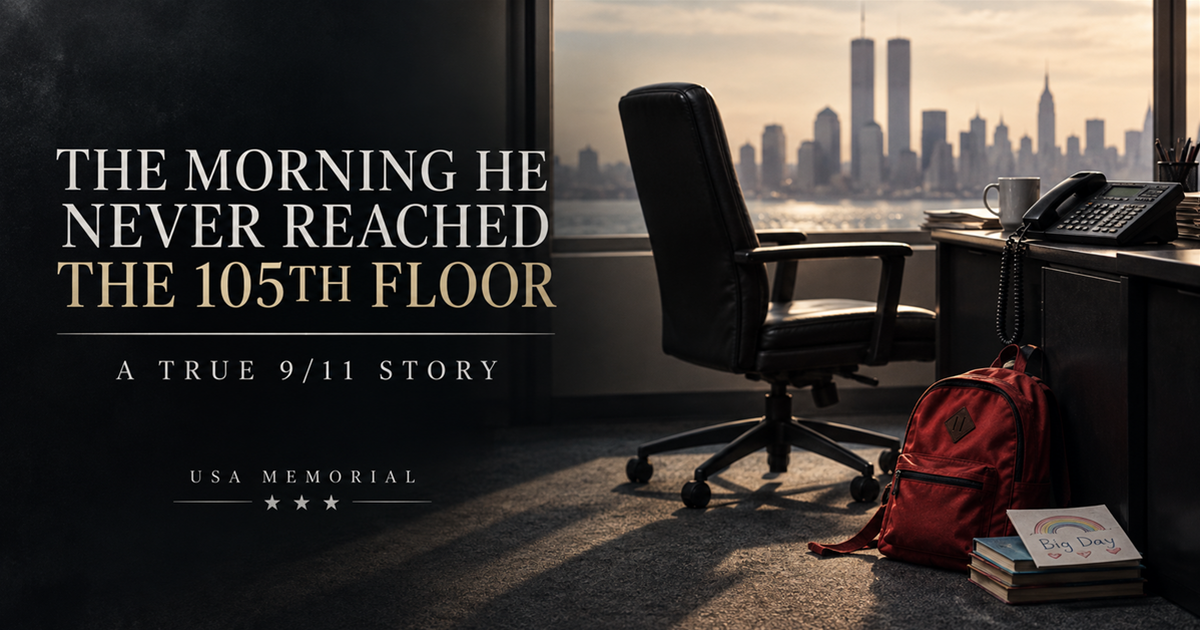
"THE MORNING HE NEVER REACHED THE 105TH FLOOR" Chapter 7 — The Children Left Behind
On September 11, many children of Cantor Fitzgerald employees were too young to understand why a parent had not come home.
Some would remember the last morning clearly. Others would know it through photographs and family stories. As they grew older, the date would remain both national history and private biography.
The company’s long commitments followed them through those years.
Health-care coverage for a decade meant that the support did not disappear after the first anniversary. Profit distributions over five years provided assistance during a period when households were rebuilding their financial lives. The relief fund created a continuing relationship between Cantor and the families whose losses had made the firm’s survival so complicated.
The employment promise carried a different meaning.
It did not offer to replace a parent or to erase what had happened. It offered a route into the institution where that parent had worked. For some children, that possibility may have held no appeal. For others, it offered a connection to people and a place that were part of the family story.
Accounts from the company describe many children of the 658 eventually working at Cantor. By the time they were old enough to enter the workforce, the firm they joined was not the firm their parents had known. It operated in different offices, with new technologies and new colleagues. Yet the names of those lost remained central to its identity.
Imagine the weight of arriving for a first day in that environment.
The comparison with Howard’s own first-day story is unavoidable. His child’s school morning kept him out of the tower. The children of his employees lost parents who had gone into it. Years later, some of those children walked into Cantor offices as adults.
That circle is powerful without invented scenes. We do not need to imagine precise conversations at reception desks or private thoughts in elevators. The documented movement through time is enough: children left behind, years passing, an open employment offer, and members of the next generation joining the company.
Their presence changed the meaning of the workplace.
An office could no longer be only the site of future deals. It also held family history. A surname might belong to a new employee and to a name read at a memorial. A colleague could remember the parent. A photograph could connect a young adult to a morning they understood mostly through other people’s accounts.
This is one reason the Cantor story cannot be reduced to Howard Lutnick’s lucky absence.
His survival is the hook because it contains an extraordinary accident of timing. The deeper story is what followed: whether a surviving leader and company would remain connected to hundreds of families after the cameras left.
The answer was expressed through years rather than a single dramatic moment.
Not every child would choose the same relationship with the company. Some might want proximity to a parent’s colleagues and history. Others might prefer an entirely different path. The importance of an offer lies partly in leaving that choice with the child. It created an option rather than an obligation and allowed each family to decide what connection, if any, felt right.
For those who did join, their employment did not make them representatives of all the families. Each arrived with an individual education, ability and ambition. The historical connection was real, but it should not erase their adult identities. They were people building careers while carrying a family history that colleagues understood.
Five years of profit sharing.
Ten years of health coverage.
An employment opportunity that did not expire when childhood ended.
Then, beginning in 2004, an annual event that converted the work of trading into money for charity.
On Charity Day, public figures and celebrities joined employees on the trading floor. The attention helped generate donations for a wide range of causes. But beneath the spectacle was an origin that remained fixed: the 658 Cantor employees killed on September 11.
The children had grown.
The company had rebuilt.
The date had not changed.
Every year, the phones would ring again—not from the lost offices high in the North Tower, but in a living workplace carrying their memory forward.
For a new generation, that sound would connect ordinary work to a history that began before many of them were old enough to remember.
ADVERTISEMENT
You May Also Like
-
CompletedChapter 10

THE MAN NOBODY COULD NAME
Survivors of the South Tower remembered an unidentified young man in a red bandana who found a stairway, helped the injured, and repeatedly returned to the devastated 78th floor. Months later, Alison Crowther recognized the detail that revealed the rescuer as her 24-year-old son, Welles. His story connects eyewitness testimony, a family object, and one of the most enduring acts of civilian heroism from September 11.Stories Behind 9/114.8k words5 33 -
CompletedChapter 10
THE WOMAN THEY REFUSED TO LEAVE BEHIND
Josephine Harris was descending from the 73rd floor of the North Tower when an injured leg slowed her. Six firefighters from Ladder Company 6 refused to leave her and matched her pace toward the lower floors. When the tower collapsed around them, a surviving section of Stairwell B turned their decision into one of September 11’s most extraordinary—and most carefully misunderstood—survival stories.Stories Behind 9/116.8k words5 31 -
CompletedChapter 10
THE GUIDE DOG WHO WENT DOWN 78 FLOORS
Michael Hingson was working on the 78th floor of the North Tower when Flight 11 struck above him. This verified account follows Michael, his guide dog Roselle and colleague David Frank through the stairwell, past firefighters climbing upward, into the street and below ground during the South Tower’s collapse. More than a heroic-dog story, it reveals how a real guide-dog partnership—and several people sharing different kinds of information—survived one of the defining events of September 11.Stories Behind 9/116.9k words5 59 -
CompletedChapter 10
THE CHAIR THAT CAME DOWN 69 FLOORS
When Flight 11 struck the North Tower, Port Authority accountant John Abruzzo could not evacuate by stairs. Ten coworkers placed him in an emergency chair installed after the 1993 bombing and carried him down 69 floors. Their documented escape—and the chair now preserved by the 9/11 Museum—reveals how preparation, disability inclusion, and an extraordinary decision made before the tower fell changed eleven lives.Stories Behind 9/11|Survival7.1k words5 253 -
CompletedChapter 10
The Woman Who Walked Down 87 Floors
The Woman Who Walked Down 87 Floors On the morning of September 11, 2001, Joanne “JoJo” Capestro went to work on the 87th floor of the World Trade Center's North Tower. At 8:46 a.m., everything changed. Joanne escaped by taking the stairs, passing firefighters heading upward as office workers rushed down. One of her coworkers, Harry Ramos, stopped to help a struggling stranger and never made it out. Joanne did. Minutes later, covered in dust after the collapse of the South Tower, she walked through Lower Manhattan and unknowingly crossed paths with photographer Phil Penman. He took her picture. They didn't know each other's names. Fifteen years later, the 9/11 Memorial Museum finally connected the photographer with the woman in his photograph. But their story still wasn't over.Stories Behind 9/1110.2k words5 251