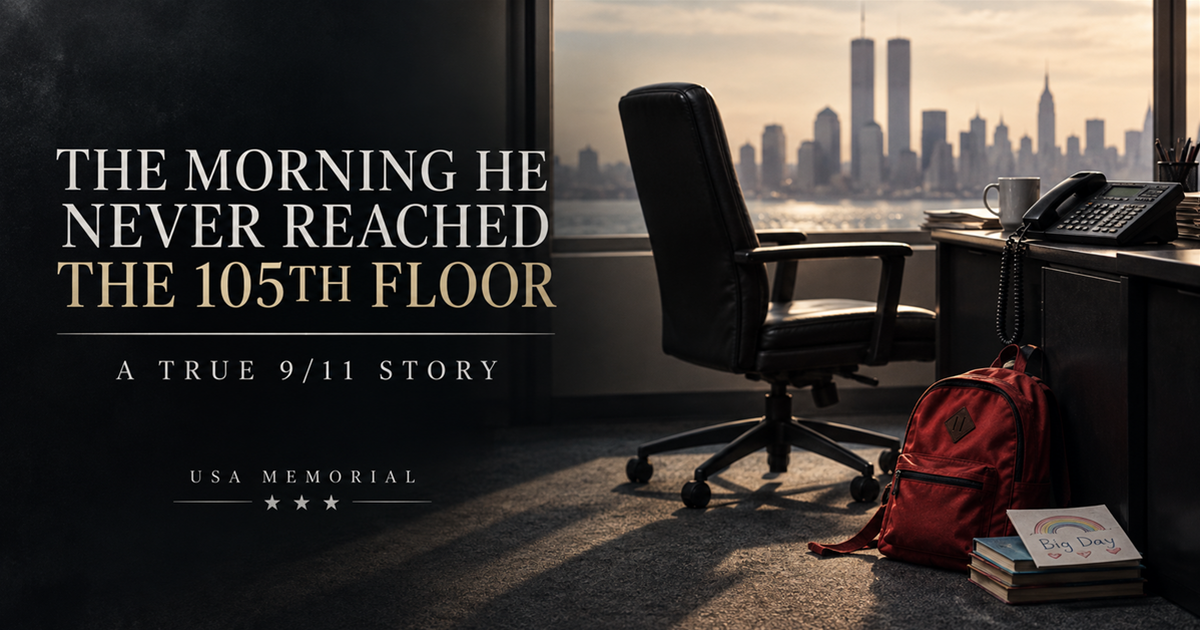
"THE MORNING HE NEVER REACHED THE 105TH FLOOR" Chapter 8 — One Day’s Revenue
In 2004, Cantor Fitzgerald began an annual tradition called Charity Day.
The idea used the company’s ordinary machinery for a different purpose. Employees traded. Guests helped attract attention. The day’s revenue was donated to charitable organizations.
Trading floors are usually built around speed, competition and profit. On Charity Day, those same qualities were redirected toward giving.
The event grew. Athletes, entertainers and public figures participated. Cameras captured them taking calls beside traders. Beneficiary organizations changed from year to year, expanding the impact beyond the families directly connected to Cantor.
By 2024, Charity Day had raised more than $200 million for charitable causes. Later totals continued to rise. The precise figure depends on the date of the report, which is why any published version should attach a year to the amount rather than present it as permanent.
The event’s connection to September 11 is not decorative.
It began because Cantor had lost 658 people. The firm could have marked the anniversary only with speeches and moments of silence. Those acts matter, but Charity Day added work. It asked the company to perform the business it knew, then give away the result.
The format also carried a quiet reversal.
On September 11, 2001, Cantor’s telephones and screens were stranded above the impact zone. The trading floor disappeared. On Charity Day, phones and screens became tools for raising money in the names of those who were gone.
This does not transform disaster into triumph. No charitable total balances 658 deaths. The meaning lies in continuity: the company refused to let its remembrance remain passive.
Howard’s role remained visible. So did the controversies and debates surrounding his public life. Historical subjects do not become flawless because they experience loss or organize generosity. A verified story can acknowledge that without losing sight of what was accomplished.
The family assistance was real.
The health coverage was real.
The profit pledge was fulfilled.
The annual charitable tradition continued for more than two decades.
These facts are stronger than a simplified portrait of a perfect hero.
Charity Day also demonstrates why totals require dates. A fundraising figure accurate in one anniversary article becomes outdated as new events add to it. Responsible storytelling should say when the total was reported and avoid presenting a changing amount as final. This is especially important on Facebook, where old graphics can circulate for years after their captions have lost context.
The same caution applies to photographs of celebrity participants. Such pictures may be authentic images from a particular Charity Day, but authenticity does not equal permission for commercial reuse. The photographer or agency may still own the copyright. A memorial page should identify both what a photograph shows and whether it is licensed to be republished.
They show a person and an institution making decisions under pressure, facing criticism, and then building commitments that could be measured over time.
They also show how memorials can take forms other than stone.
The National September 11 Memorial records names in bronze. Family albums preserve faces. Stories preserve details. Charity Day preserves memory through repeated action: a calendar date, a working floor, revenue moving outward to people in need.
For younger employees, the event may be their most direct encounter with colleagues they never met. For families, it is evidence that the company still names the origin of the tradition. For the public, the visible guests may provide the attraction, but the absent employees provide the reason.
The story that began with a school backpack had now traveled far beyond one family.
A father missed the office.
A company lost most of its New York workforce.
Survivors rebuilt.
Profits supported families.
One workday each year became a fundraiser.
Yet the most important objects in the story remained ordinary: a backpack, an office chair and a telephone.
One had taken Howard away from the tower.
One was left empty.
And one kept ringing in the years that followed.
The ringing telephone was not closure. It was evidence that remembrance could remain active, measurable and connected to the work the company still knew how to do.
That distinction kept the annual event grounded in service rather than spectacle, even as famous guests drew public attention.
The origin remained unchanged.
ADVERTISEMENT
You May Also Like
-
CompletedChapter 10

THE MAN NOBODY COULD NAME
Survivors of the South Tower remembered an unidentified young man in a red bandana who found a stairway, helped the injured, and repeatedly returned to the devastated 78th floor. Months later, Alison Crowther recognized the detail that revealed the rescuer as her 24-year-old son, Welles. His story connects eyewitness testimony, a family object, and one of the most enduring acts of civilian heroism from September 11.Stories Behind 9/114.8k words5 33 -
CompletedChapter 10
THE WOMAN THEY REFUSED TO LEAVE BEHIND
Josephine Harris was descending from the 73rd floor of the North Tower when an injured leg slowed her. Six firefighters from Ladder Company 6 refused to leave her and matched her pace toward the lower floors. When the tower collapsed around them, a surviving section of Stairwell B turned their decision into one of September 11’s most extraordinary—and most carefully misunderstood—survival stories.Stories Behind 9/116.8k words5 31 -
CompletedChapter 10
THE GUIDE DOG WHO WENT DOWN 78 FLOORS
Michael Hingson was working on the 78th floor of the North Tower when Flight 11 struck above him. This verified account follows Michael, his guide dog Roselle and colleague David Frank through the stairwell, past firefighters climbing upward, into the street and below ground during the South Tower’s collapse. More than a heroic-dog story, it reveals how a real guide-dog partnership—and several people sharing different kinds of information—survived one of the defining events of September 11.Stories Behind 9/116.9k words5 59 -
CompletedChapter 10
THE CHAIR THAT CAME DOWN 69 FLOORS
When Flight 11 struck the North Tower, Port Authority accountant John Abruzzo could not evacuate by stairs. Ten coworkers placed him in an emergency chair installed after the 1993 bombing and carried him down 69 floors. Their documented escape—and the chair now preserved by the 9/11 Museum—reveals how preparation, disability inclusion, and an extraordinary decision made before the tower fell changed eleven lives.Stories Behind 9/11|Survival7.1k words5 253 -
CompletedChapter 10
The Woman Who Walked Down 87 Floors
The Woman Who Walked Down 87 Floors On the morning of September 11, 2001, Joanne “JoJo” Capestro went to work on the 87th floor of the World Trade Center's North Tower. At 8:46 a.m., everything changed. Joanne escaped by taking the stairs, passing firefighters heading upward as office workers rushed down. One of her coworkers, Harry Ramos, stopped to help a struggling stranger and never made it out. Joanne did. Minutes later, covered in dust after the collapse of the South Tower, she walked through Lower Manhattan and unknowingly crossed paths with photographer Phil Penman. He took her picture. They didn't know each other's names. Fifteen years later, the 9/11 Memorial Museum finally connected the photographer with the woman in his photograph. But their story still wasn't over.Stories Behind 9/1110.2k words5 251