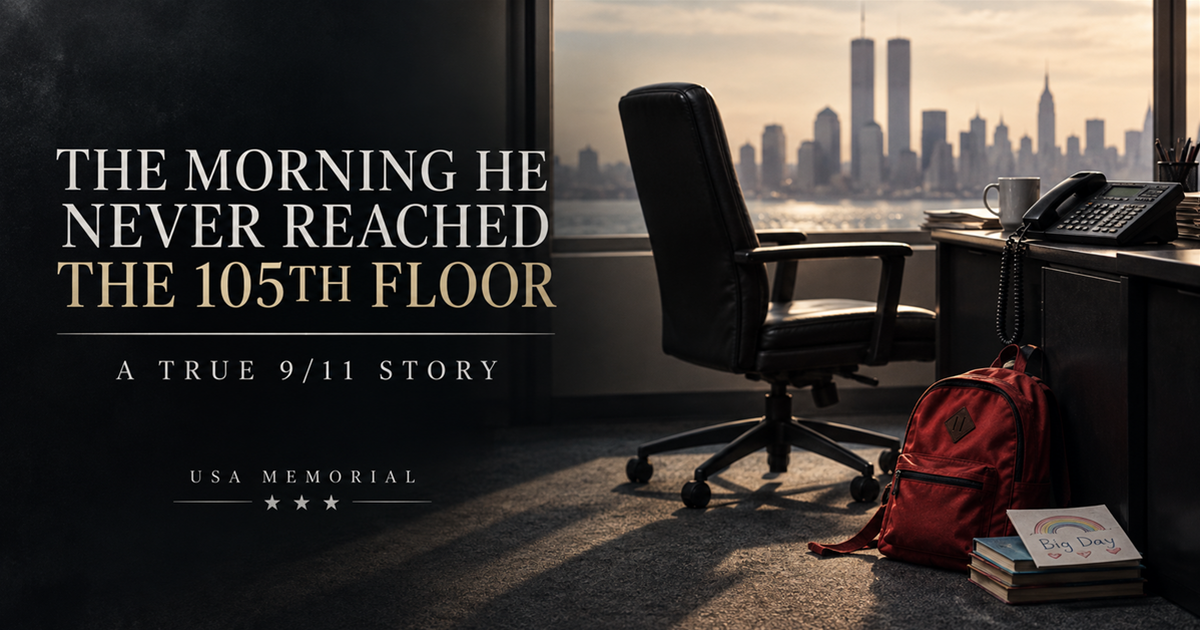
"THE MORNING HE NEVER REACHED THE 105TH FLOOR" Chapter 9 — The Empty Chair
An empty office chair can mean almost nothing.
Someone may be late. Someone may be in a meeting. Someone may have stepped away for coffee.
On September 11, the empty chair that would have been Howard Lutnick’s carried a different meaning. He was alive because he had gone to a school instead of the 105th floor.
Around him were hundreds of chairs whose occupants had arrived at work and never returned home.
That contrast explains why the story continues to circulate. It compresses chance into one image: the chief executive absent, most of his New York employees present. The reason was not a secret warning or a last-minute business decision. It was a child’s first day of kindergarten.
Viral versions often sharpen the story until it becomes too smooth. They may place Howard on the 101st floor even though Cantor occupied floors 101 through 105 and his office was reported on the 105th. They may repeat an exact number of employees’ children hired by a certain year without showing where the number originated. They may combine family-support payments with Charity Day fundraising as if they were one fund.
The corrections do not make the story less remarkable.
They make it trustworthy.
Howard would ordinarily have gone to offices above the impact zone.
His child’s first school day kept him away.
Cantor lost 658 employees, including Gary Lutnick and Doug Gardner.
The firm committed 25 percent of profits for five years and health coverage for ten.
More than $180 million went to the families.
The company maintained an employment path for children of those killed.
Charity Day became a separate, continuing tradition that raised hundreds of millions for broader causes.
Each fact can stand without enhancement.
That method also protects the audience. People encounter September 11 stories amid recycled images, cropped captions and confident but unsourced claims. Once one detail is shown to be wrong, readers may begin to doubt the documented parts as well. A claim audit is therefore not merely an editorial exercise; it preserves the credibility of the memorial itself.
The strongest storytelling decision is often restraint. Instead of inventing what Howard said to his son, show the verified schedule change. Instead of imagining the final minutes upstairs, establish the location of the offices and the destroyed escape routes. Instead of giving an unsupported hiring total, explain the standing offer and what later reporting confirms. Facts arranged carefully create their own suspense.
The supplied social-media image of Howard beside a child may capture attention, but it is a derivative graphic with overlaid claims, not an identified original-source photograph. It should not be treated as proof of every sentence printed on it. Before commercial reuse, its photographer and license would need to be established.
That distinction matters especially for a memorial page. Accuracy is not an obstacle to emotion. It is a form of respect.
The 658 deserve a story that does not use uncertain details to make their deaths more dramatic. Their actual circumstances were already devastating. The families deserve clear separation between documented assistance and promotional exaggeration. Howard’s survival deserves to be told without turning his child into a fictional character or inventing a conversation at the school door.
What remains is an image no camera needed to capture.
Morning light entered an office high above Manhattan.
The chief executive’s chair was empty.
His brother’s was not.
His best friend’s was not.
Hundreds of other employees had taken their places for the day.
At 8:46, the meaning of every chair changed.
Years later, new offices filled with new employees. Some carried the surnames of people killed in the tower. Trading phones rang on Charity Day. Money moved toward families and organizations that needed it. The company continued, but continuation did not mean forgetting.
The chair had been empty because of a backpack.
The rest of the story was about what the survivor chose to do after he understood why he was still alive.
Those choices remain open to examination. They can be documented, criticized and measured without turning the survivor into a flawless character or the tragedy into a corporate slogan.
That is the version worthy of the people whose names the company continues to carry.
Their record requires it.
ADVERTISEMENT
You May Also Like
-
CompletedChapter 10

THE MAN NOBODY COULD NAME
Survivors of the South Tower remembered an unidentified young man in a red bandana who found a stairway, helped the injured, and repeatedly returned to the devastated 78th floor. Months later, Alison Crowther recognized the detail that revealed the rescuer as her 24-year-old son, Welles. His story connects eyewitness testimony, a family object, and one of the most enduring acts of civilian heroism from September 11.Stories Behind 9/114.8k words5 33 -
CompletedChapter 10
THE WOMAN THEY REFUSED TO LEAVE BEHIND
Josephine Harris was descending from the 73rd floor of the North Tower when an injured leg slowed her. Six firefighters from Ladder Company 6 refused to leave her and matched her pace toward the lower floors. When the tower collapsed around them, a surviving section of Stairwell B turned their decision into one of September 11’s most extraordinary—and most carefully misunderstood—survival stories.Stories Behind 9/116.8k words5 31 -
CompletedChapter 10
THE GUIDE DOG WHO WENT DOWN 78 FLOORS
Michael Hingson was working on the 78th floor of the North Tower when Flight 11 struck above him. This verified account follows Michael, his guide dog Roselle and colleague David Frank through the stairwell, past firefighters climbing upward, into the street and below ground during the South Tower’s collapse. More than a heroic-dog story, it reveals how a real guide-dog partnership—and several people sharing different kinds of information—survived one of the defining events of September 11.Stories Behind 9/116.9k words5 59 -
CompletedChapter 10
THE CHAIR THAT CAME DOWN 69 FLOORS
When Flight 11 struck the North Tower, Port Authority accountant John Abruzzo could not evacuate by stairs. Ten coworkers placed him in an emergency chair installed after the 1993 bombing and carried him down 69 floors. Their documented escape—and the chair now preserved by the 9/11 Museum—reveals how preparation, disability inclusion, and an extraordinary decision made before the tower fell changed eleven lives.Stories Behind 9/11|Survival7.1k words5 253 -
CompletedChapter 10
The Woman Who Walked Down 87 Floors
The Woman Who Walked Down 87 Floors On the morning of September 11, 2001, Joanne “JoJo” Capestro went to work on the 87th floor of the World Trade Center's North Tower. At 8:46 a.m., everything changed. Joanne escaped by taking the stairs, passing firefighters heading upward as office workers rushed down. One of her coworkers, Harry Ramos, stopped to help a struggling stranger and never made it out. Joanne did. Minutes later, covered in dust after the collapse of the South Tower, she walked through Lower Manhattan and unknowingly crossed paths with photographer Phil Penman. He took her picture. They didn't know each other's names. Fifteen years later, the 9/11 Memorial Museum finally connected the photographer with the woman in his photograph. But their story still wasn't over.Stories Behind 9/1110.2k words5 251