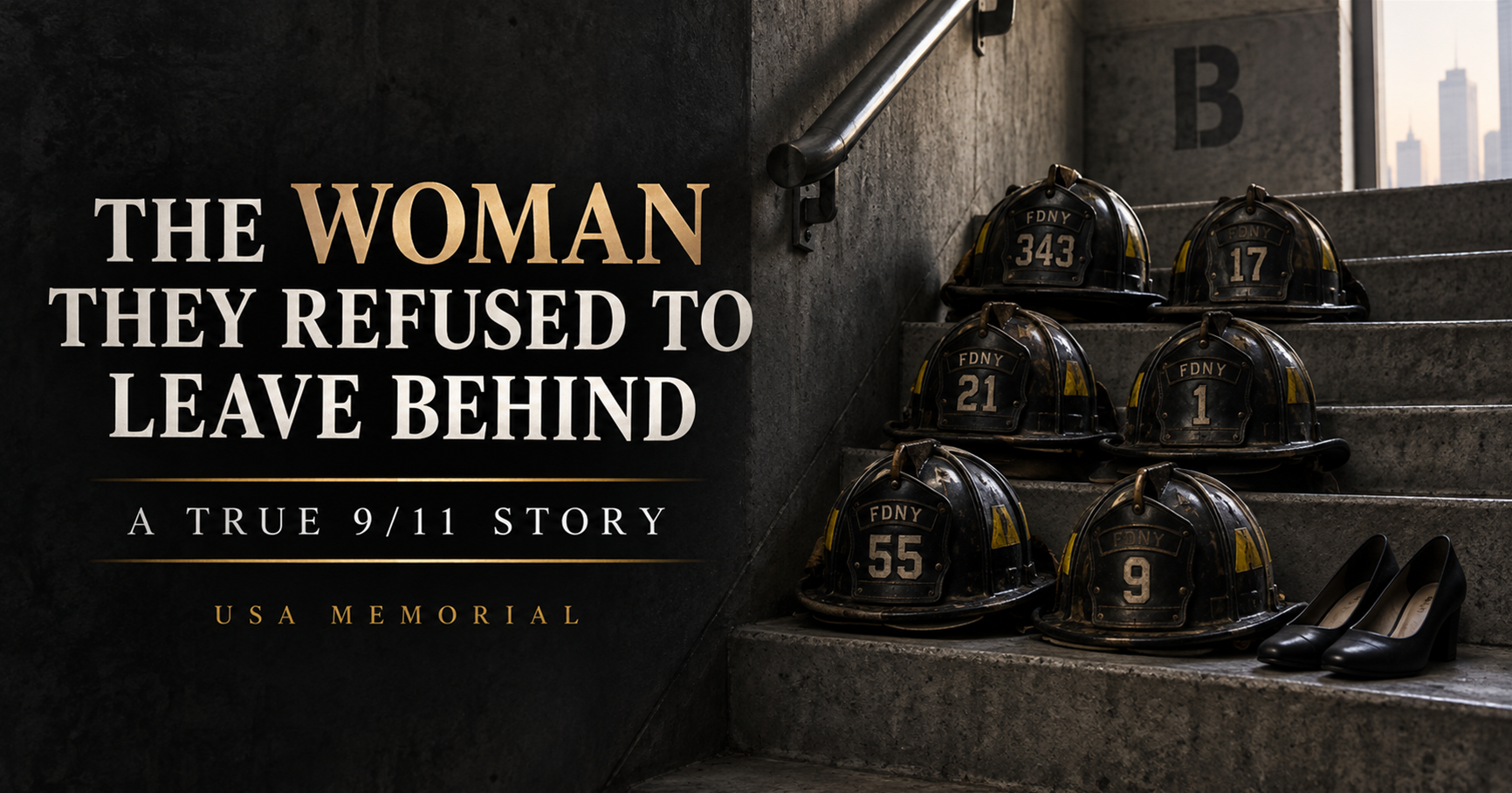
"THE WOMAN THEY REFUSED TO LEAVE BEHIND" Chapter 1
The Woman on the Stairs
The meeting joined two journeys already measured in exhaustion. Josephine had descended more than fifty floors with a painful leg. The firefighters had climbed to the 27th floor wearing heavy equipment, then turned back after the South Tower fell. Neither side arrived fresh. Their bodies carried everything that had happened before the twentieth-floor landing.
Later, people would look backward from the ending and see a perfect intersection. Inside the tower, there was no visible pattern. There was only a narrow concrete passage, a civilian falling behind, and responders attempting to leave a building whose condition was rapidly worsening. To stop resisted the pressure of the stairwell, which existed to keep people moving downward.
That is precisely why the choice matters. Rescue ethics are tested when speed and responsibility point in different directions. The firefighters did not know that helping Josephine might alter their location at the moment of collapse. They knew only that moving at their own pace would mean separating from someone who needed help.
On the twentieth floor of the North Tower, six firefighters found a woman who could no longer keep pace with the evacuation.
Her name was Josephine Harris.
She worked for the Port Authority and had begun the morning high in the tower. By the time the firefighters of FDNY Ladder Company 6 encountered her, she had already come down dozens of floors. An injured leg had made every remaining flight slower.
The firefighters were going down too.
They had entered the World Trade Center to climb toward people who needed help. Then the South Tower collapsed at 9:59 a.m. The force shook the North Tower. Captain John “Jay” Jonas and the members of Ladder 6 understood that conditions had changed. Their mission became getting out.
Speed should have mattered more than almost anything.
Then they met Josephine.
The viral version of this story is often reduced to one sentence: the woman who slowed the firefighters down saved their lives. That sentence contains the shape of the ending, but it turns a complicated survival into a certainty the evidence cannot prove.
What can be established is stronger than a slogan.
Ladder 6 stayed with her.
They adjusted their descent to the pace of a woman whose leg was failing after a long journey down the tower.
They reached the lower floors together.
The North Tower collapsed around them at 10:28 a.m.
And the part of Stairwell B where they were gathered did not vanish completely.
Most people inside the tower when it fell were killed. Josephine, the six members of Ladder 6, and Port Authority Police Lieutenant David Lim were among a small group who survived inside a protected section of the stairwell.
The physical reason involved the tower’s structure, the location of Stairwell B, and the way debris fell around that area. Their exact path and timing also mattered. But no responsible account can demonstrate what would have happened if the firefighters had passed Josephine or moved faster.
Jonas and other survivors later reflected that stopping for her may have placed them in the surviving pocket at the critical moment. That is a survivor’s interpretation, not a laboratory proof.
The distinction does not reduce the power of their decision.
Six firefighters descending from a doomed tower found one person who could not move quickly. They did not calculate whether helping her would improve their odds. They simply refused to leave her alone.
The image that opens this story is not a photograph. There is no authenticated frame showing the precise second they met. The surviving evidence comes from testimony, official records, documentaries, interviews, and the physical remains of the building.
Yet the scene is easy to understand without invention.
A concrete stairwell.
A woman gripping a handrail.
Firefighters carrying equipment after climbing upward.
A decision made while the building above and below them had already been transformed.
At that moment, none of them could see the ending.
They only knew Josephine was still on the stairs.
And the tower had twenty-eight minutes left.
No one on that landing possessed the information that would make those twenty-eight minutes look like destiny. Their task remained immediate: take the next steps together and keep moving toward the ground.
ADVERTISEMENT
You May Also Like
-
CompletedChapter 10

THE MAN NOBODY COULD NAME
Survivors of the South Tower remembered an unidentified young man in a red bandana who found a stairway, helped the injured, and repeatedly returned to the devastated 78th floor. Months later, Alison Crowther recognized the detail that revealed the rescuer as her 24-year-old son, Welles. His story connects eyewitness testimony, a family object, and one of the most enduring acts of civilian heroism from September 11.Stories Behind 9/114.8k words5 33 -
CompletedChapter 10
THE MORNING HE NEVER REACHED THE 105TH FLOOR
Howard Lutnick survived September 11 because he took his oldest son to his first day of kindergarten instead of going to Cantor Fitzgerald’s offices high in the North Tower. The company lost 658 employees, including his brother and best friend. This verified story follows what came next: controversy, a five-year profit pledge, a decade of health coverage, an open door for the children left behind, and an annual charitable tradition built from the firm’s devastating loss.Stories Behind 9/116.8k words5 33 -
CompletedChapter 10
THE GUIDE DOG WHO WENT DOWN 78 FLOORS
Michael Hingson was working on the 78th floor of the North Tower when Flight 11 struck above him. This verified account follows Michael, his guide dog Roselle and colleague David Frank through the stairwell, past firefighters climbing upward, into the street and below ground during the South Tower’s collapse. More than a heroic-dog story, it reveals how a real guide-dog partnership—and several people sharing different kinds of information—survived one of the defining events of September 11.Stories Behind 9/116.9k words5 59 -
CompletedChapter 10
THE CHAIR THAT CAME DOWN 69 FLOORS
When Flight 11 struck the North Tower, Port Authority accountant John Abruzzo could not evacuate by stairs. Ten coworkers placed him in an emergency chair installed after the 1993 bombing and carried him down 69 floors. Their documented escape—and the chair now preserved by the 9/11 Museum—reveals how preparation, disability inclusion, and an extraordinary decision made before the tower fell changed eleven lives.Stories Behind 9/11|Survival7.1k words5 253 -
CompletedChapter 10
The Woman Who Walked Down 87 Floors
The Woman Who Walked Down 87 Floors On the morning of September 11, 2001, Joanne “JoJo” Capestro went to work on the 87th floor of the World Trade Center's North Tower. At 8:46 a.m., everything changed. Joanne escaped by taking the stairs, passing firefighters heading upward as office workers rushed down. One of her coworkers, Harry Ramos, stopped to help a struggling stranger and never made it out. Joanne did. Minutes later, covered in dust after the collapse of the South Tower, she walked through Lower Manhattan and unknowingly crossed paths with photographer Phil Penman. He took her picture. They didn't know each other's names. Fifteen years later, the 9/11 Memorial Museum finally connected the photographer with the woman in his photograph. But their story still wasn't over.Stories Behind 9/1110.2k words5 251