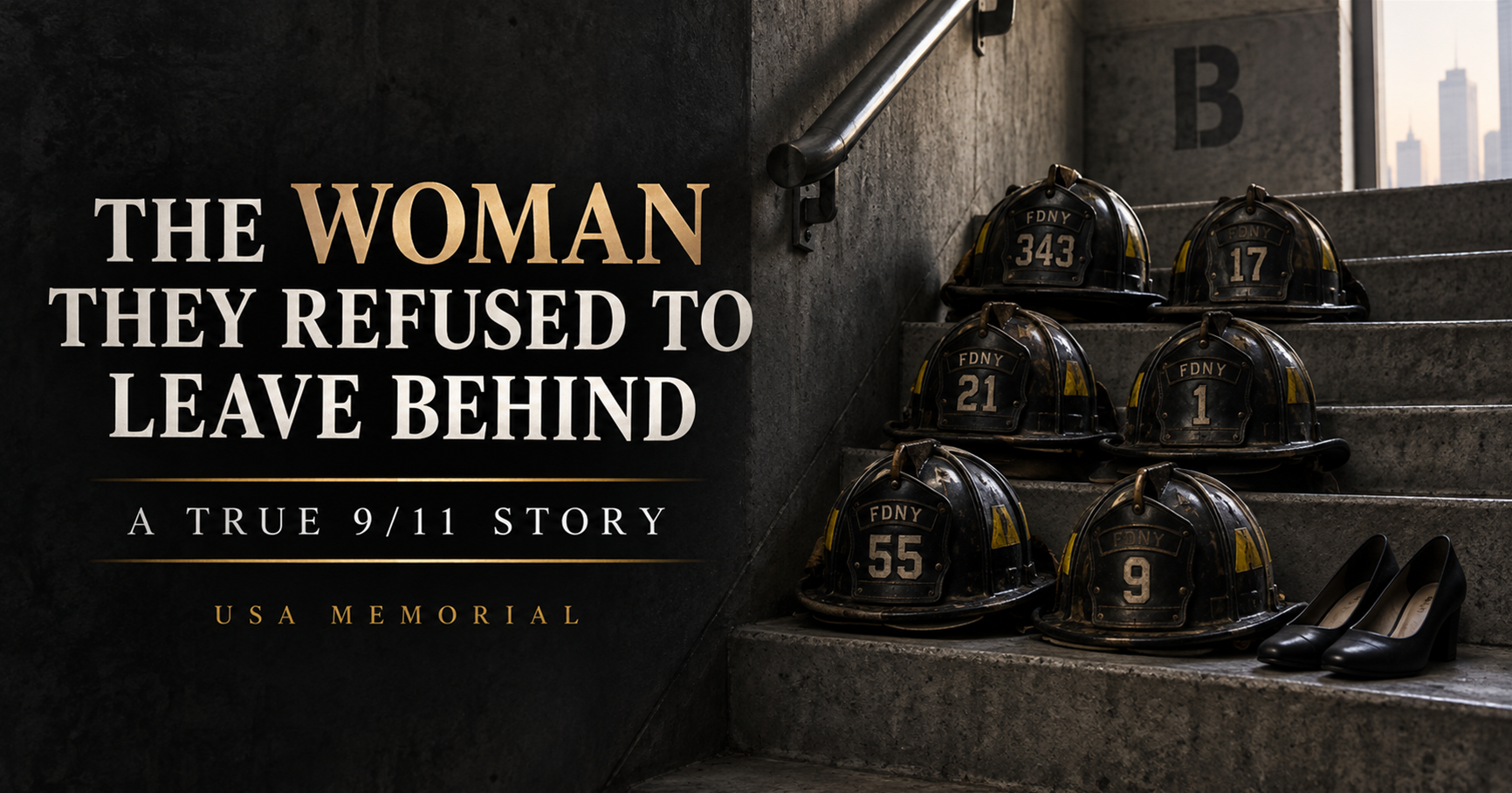
"THE WOMAN THEY REFUSED TO LEAVE BEHIND" Chapter 2
Seventy-Three Floors Above the Street
The Port Authority was not merely Josephine’s employer. It operated the World Trade Center, and its employees experienced the complex as a workplace rather than the distant symbol shown in skyline photographs. Elevators, corridors, office doors, and security procedures belonged to the rhythm of an ordinary morning until the impact turned architecture into a survival problem.
Once Josephine entered the stairwell, height became physical labor. An elevator can erase dozens of floors in seconds. A stairwell makes the body account for each one. Descending from the 73rd floor to approximately the twentieth meant hundreds of steps, repeated turns, crowded landings, and the accumulated strain of staying upright while thousands of other people were also seeking a way out.
The injury changed the journey without ending it. Josephine continued far beyond the point at which most readers imagine a painful leg would force a person to stop. By the time Ladder 6 met her, she had already completed most of the vertical distance to the street. What remained was shorter on paper but increasingly difficult in her body.
Josephine Harris began September 11 as an employee inside the headquarters complex of the Port Authority of New York and New Jersey.
Her workplace was on the 73rd floor of the North Tower.
At 8:46 a.m., American Airlines Flight 11 struck the building between approximately the 93rd and 99th floors. Josephine was below the impact zone, which meant a route downward remained possible. The elevators could not be relied upon. The stairs became the way out.
Thousands of people began descending.
The stairwells were narrow compared with the population they had to carry. Office workers entered in business clothes and practical shoes, carrying bags or leaving belongings behind. Firefighters and other responders moved in the opposite direction, hauling protective equipment upward while civilians moved toward the street.
Josephine joined that downward current.
No reliable account requires a fictional conversation at her desk. The geography supplies the urgency. She was more than seventy floors above ground in a building that had just been struck by an airliner. Smoke and damage were above her. Safety was far below.
Her descent also belonged to a larger history of the towers.
Eight years earlier, terrorists had detonated a truck bomb beneath the World Trade Center. The 1993 attack exposed weaknesses in evacuation, lighting, communication, and planning. Improvements made afterward helped many people in 2001. Emergency procedures, drills, illuminated markings, and greater awareness influenced how occupants responded.
But preparation could not remove the physical demand of walking down floor after floor.
For Josephine, that demand became increasingly severe. Accounts describe an injured or painful leg that slowed her as she descended. The exact medical description varies in retellings, so the verified narrative should remain narrow: her leg was hurting, her mobility declined, and she could not maintain the pace of other evacuees.
She continued anyway.
The distance between the 73rd floor and the street is not merely a number. In a stairwell, each floor arrives as another landing, another turn, and another set of steps. The body measures height differently from an elevator. It measures it through knees, lungs, balance, and time.
Above Josephine, Ladder 6 was entering the same vertical world from the opposite direction.
The company came from Chinatown. Captain Jonas led firefighters Salvatore D’Agostino, Bill Butler, Thomas Falco, Matthew Komorowski, and Michael Meldrum into the North Tower. Their assignment took them upward with gear while evacuees streamed down.
They did not yet know Josephine existed.
She did not know their names.
Their paths were being shaped by separate duties: one woman trying to reach the ground and six firefighters climbing toward danger.
Then, at 9:03 a.m., a second airplane struck the South Tower.
The attack was no longer mistaken for an accident.
Emergency operations continued inside the North Tower. Firefighters climbed, rested, received fragments of information, and worked within a communications environment later documented as deeply difficult. Outside, the world watched both buildings burn.
Inside, Josephine kept descending.
By the time she reached the lower third of the tower, her leg was determining her speed. Others could move past. She could not simply make her body go faster because the danger had become greater.
Then the South Tower began to fall.
Its collapse would turn Ladder 6 around.
And bring six firefighters directly toward the woman on the stairs.
ADVERTISEMENT
You May Also Like
-
CompletedChapter 10

THE MAN NOBODY COULD NAME
Survivors of the South Tower remembered an unidentified young man in a red bandana who found a stairway, helped the injured, and repeatedly returned to the devastated 78th floor. Months later, Alison Crowther recognized the detail that revealed the rescuer as her 24-year-old son, Welles. His story connects eyewitness testimony, a family object, and one of the most enduring acts of civilian heroism from September 11.Stories Behind 9/114.8k words5 33 -
CompletedChapter 10
THE MORNING HE NEVER REACHED THE 105TH FLOOR
Howard Lutnick survived September 11 because he took his oldest son to his first day of kindergarten instead of going to Cantor Fitzgerald’s offices high in the North Tower. The company lost 658 employees, including his brother and best friend. This verified story follows what came next: controversy, a five-year profit pledge, a decade of health coverage, an open door for the children left behind, and an annual charitable tradition built from the firm’s devastating loss.Stories Behind 9/116.8k words5 33 -
CompletedChapter 10
THE GUIDE DOG WHO WENT DOWN 78 FLOORS
Michael Hingson was working on the 78th floor of the North Tower when Flight 11 struck above him. This verified account follows Michael, his guide dog Roselle and colleague David Frank through the stairwell, past firefighters climbing upward, into the street and below ground during the South Tower’s collapse. More than a heroic-dog story, it reveals how a real guide-dog partnership—and several people sharing different kinds of information—survived one of the defining events of September 11.Stories Behind 9/116.9k words5 59 -
CompletedChapter 10
THE CHAIR THAT CAME DOWN 69 FLOORS
When Flight 11 struck the North Tower, Port Authority accountant John Abruzzo could not evacuate by stairs. Ten coworkers placed him in an emergency chair installed after the 1993 bombing and carried him down 69 floors. Their documented escape—and the chair now preserved by the 9/11 Museum—reveals how preparation, disability inclusion, and an extraordinary decision made before the tower fell changed eleven lives.Stories Behind 9/11|Survival7.1k words5 253 -
CompletedChapter 10
The Woman Who Walked Down 87 Floors
The Woman Who Walked Down 87 Floors On the morning of September 11, 2001, Joanne “JoJo” Capestro went to work on the 87th floor of the World Trade Center's North Tower. At 8:46 a.m., everything changed. Joanne escaped by taking the stairs, passing firefighters heading upward as office workers rushed down. One of her coworkers, Harry Ramos, stopped to help a struggling stranger and never made it out. Joanne did. Minutes later, covered in dust after the collapse of the South Tower, she walked through Lower Manhattan and unknowingly crossed paths with photographer Phil Penman. He took her picture. They didn't know each other's names. Fifteen years later, the 9/11 Memorial Museum finally connected the photographer with the woman in his photograph. But their story still wasn't over.Stories Behind 9/1110.2k words5 251