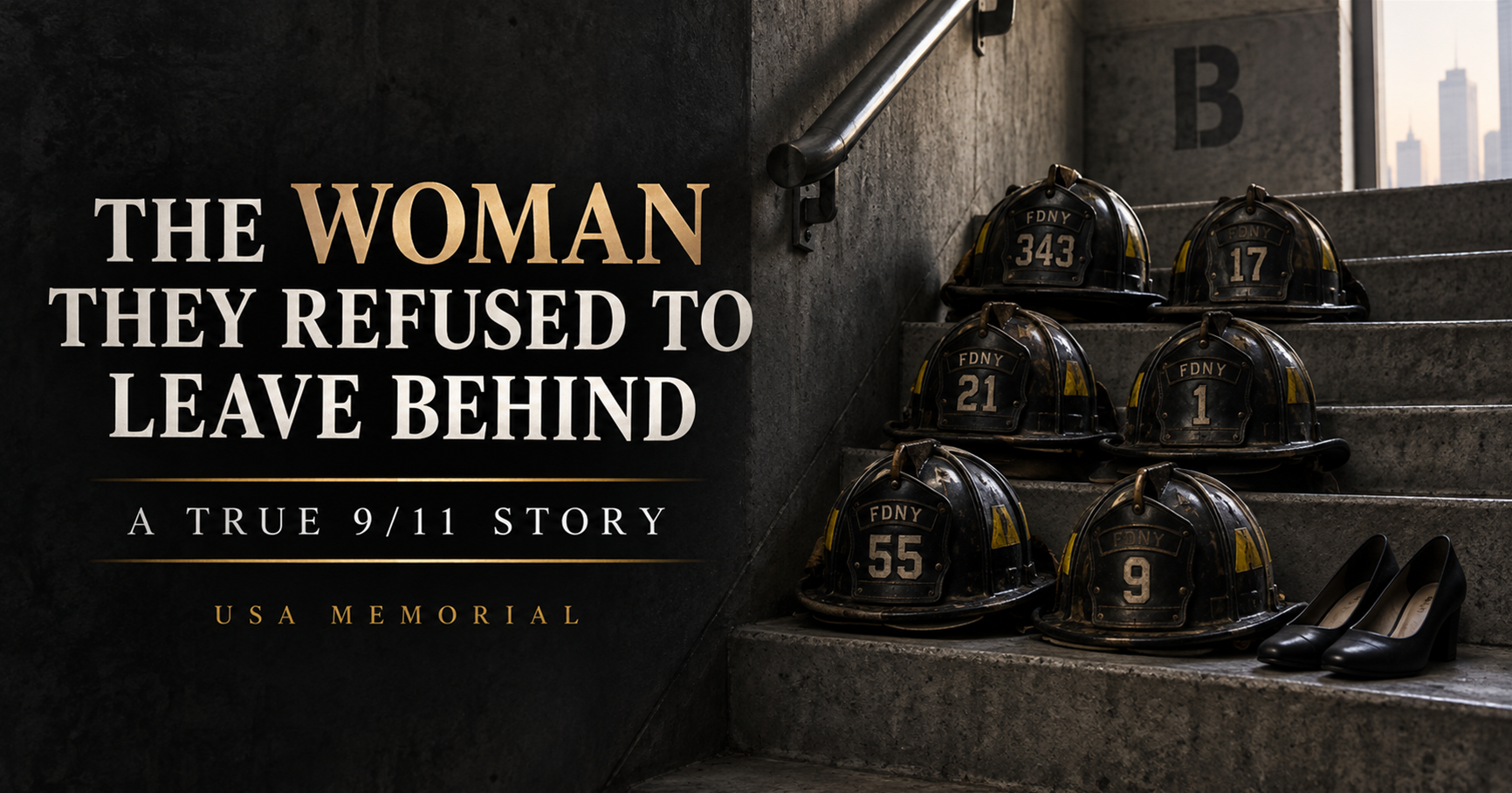
"THE WOMAN THEY REFUSED TO LEAVE BEHIND" Chapter 6
The Name They Gave Her
Calling Josephine a guardian angel gave the firefighters a language for a debt they could not calculate. They had helped her because rescue was their responsibility. Afterward, they could see her presence as something that may have been given back to them. The affectionate phrase transformed a one-directional rescue into a relationship of mutual survival.
Josephine’s own experience must remain visible behind that name. She had lost colleagues, survived the destruction of her workplace, and emerged from a collapsed tower after a punishing descent. Being celebrated by firefighters did not erase injury, trauma, or grief. A memorial story can preserve the name they gave her without turning the real woman into a supernatural device.
The phrase also illustrates how survivor testimony should be handled. When a firefighter says Josephine may have saved the company, the statement records how he understands the event. It does not prove an alternate timeline. Attribution protects both the emotion and the evidence, allowing gratitude to remain powerful without being mislabeled as certainty.
After September 11, members of Ladder 6 remained connected to Josephine Harris.
Their shared survival was too unusual to become an ordinary memory.
The firefighters had encountered her during the descent, stayed with her, and reached Stairwell B’s lower section before the collapse. In later interviews, they reflected on how the delay may have changed their position at 10:28 a.m.
Some called Josephine their guardian angel.
The phrase is emotionally powerful, but it should be understood as a survivor’s expression of gratitude and wonder. It does not mean Josephine predicted the collapse or intentionally delayed the group. She was trying to get out. Her leg hurt. The firefighters helped her because she needed help.
The meaning came afterward.
Human beings revisit survival by looking for the moments on which it turned. A different stairwell, a faster descent, a pause on another landing, or a decision to separate can become central in memory. On September 11, tiny differences in location and time produced radically different outcomes.
For Ladder 6, Josephine became one of those turning points.
The relationship also reversed the usual language of rescue.
Firefighters saved civilians. That is the expected direction of the story. Ladder 6 did save Josephine by refusing to abandon her inside the tower.
But in the firefighters’ later interpretation, Josephine’s presence may also have kept them from moving beyond the section that survived.
Rescuer and rescued no longer fit into separate boxes.
They had become one group.
That is why the story has lasted.
It does not celebrate slowness as a magical force. It shows what can happen when trained responders refuse to treat the slowest person as expendable. Their decision was ethically right before anyone knew the outcome. The outcome made it unforgettable.
Josephine did not become famous in the manner of a public official or celebrity. Her identity remained tied to the stairs, the firefighters, and the survival pocket. Interviews and documentaries brought her account to audiences. Photographs taken after the attacks showed the real people whose faces no reconstruction should imitate.
Those photographs must be handled carefully.
An authentic image of Josephine with Ladder 6 may document their later reunion or relationship. It does not depict the exact moment inside the tower. A news-agency photograph may be historically valuable while remaining copyrighted. A museum page may preserve a photograph without granting commercial permission to reproduce it.
Authenticity and usage rights are different questions.
The surviving stairwell itself became another form of evidence. Photographs of the ruins showed recognizable stairs within devastation. Testimony connected that space to the people who survived there. Together, object, place, and recollection created a record stronger than any invented dialogue.
The story’s most viral sentence would always be tempting:
The woman who slowed them down saved them.
The verified sentence is more precise:
The firefighters stayed with a woman who could not move faster, and their shared pace placed them in a surviving section of Stairwell B when the North Tower collapsed.
That sentence contains uncertainty.
It also contains the truth.
And the truth leads to a deeper question than whether Josephine was an angel.
What kind of people stop for someone when every second appears to argue against it?
The answer was already below them.
ADVERTISEMENT
You May Also Like
-
CompletedChapter 10

THE MAN NOBODY COULD NAME
Survivors of the South Tower remembered an unidentified young man in a red bandana who found a stairway, helped the injured, and repeatedly returned to the devastated 78th floor. Months later, Alison Crowther recognized the detail that revealed the rescuer as her 24-year-old son, Welles. His story connects eyewitness testimony, a family object, and one of the most enduring acts of civilian heroism from September 11.Stories Behind 9/114.8k words5 33 -
CompletedChapter 10
THE MORNING HE NEVER REACHED THE 105TH FLOOR
Howard Lutnick survived September 11 because he took his oldest son to his first day of kindergarten instead of going to Cantor Fitzgerald’s offices high in the North Tower. The company lost 658 employees, including his brother and best friend. This verified story follows what came next: controversy, a five-year profit pledge, a decade of health coverage, an open door for the children left behind, and an annual charitable tradition built from the firm’s devastating loss.Stories Behind 9/116.8k words5 33 -
CompletedChapter 10
THE GUIDE DOG WHO WENT DOWN 78 FLOORS
Michael Hingson was working on the 78th floor of the North Tower when Flight 11 struck above him. This verified account follows Michael, his guide dog Roselle and colleague David Frank through the stairwell, past firefighters climbing upward, into the street and below ground during the South Tower’s collapse. More than a heroic-dog story, it reveals how a real guide-dog partnership—and several people sharing different kinds of information—survived one of the defining events of September 11.Stories Behind 9/116.9k words5 59 -
CompletedChapter 10
THE CHAIR THAT CAME DOWN 69 FLOORS
When Flight 11 struck the North Tower, Port Authority accountant John Abruzzo could not evacuate by stairs. Ten coworkers placed him in an emergency chair installed after the 1993 bombing and carried him down 69 floors. Their documented escape—and the chair now preserved by the 9/11 Museum—reveals how preparation, disability inclusion, and an extraordinary decision made before the tower fell changed eleven lives.Stories Behind 9/11|Survival7.1k words5 253 -
CompletedChapter 10
The Woman Who Walked Down 87 Floors
The Woman Who Walked Down 87 Floors On the morning of September 11, 2001, Joanne “JoJo” Capestro went to work on the 87th floor of the World Trade Center's North Tower. At 8:46 a.m., everything changed. Joanne escaped by taking the stairs, passing firefighters heading upward as office workers rushed down. One of her coworkers, Harry Ramos, stopped to help a struggling stranger and never made it out. Joanne did. Minutes later, covered in dust after the collapse of the South Tower, she walked through Lower Manhattan and unknowingly crossed paths with photographer Phil Penman. He took her picture. They didn't know each other's names. Fifteen years later, the 9/11 Memorial Museum finally connected the photographer with the woman in his photograph. But their story still wasn't over.Stories Behind 9/1110.2k words5 251