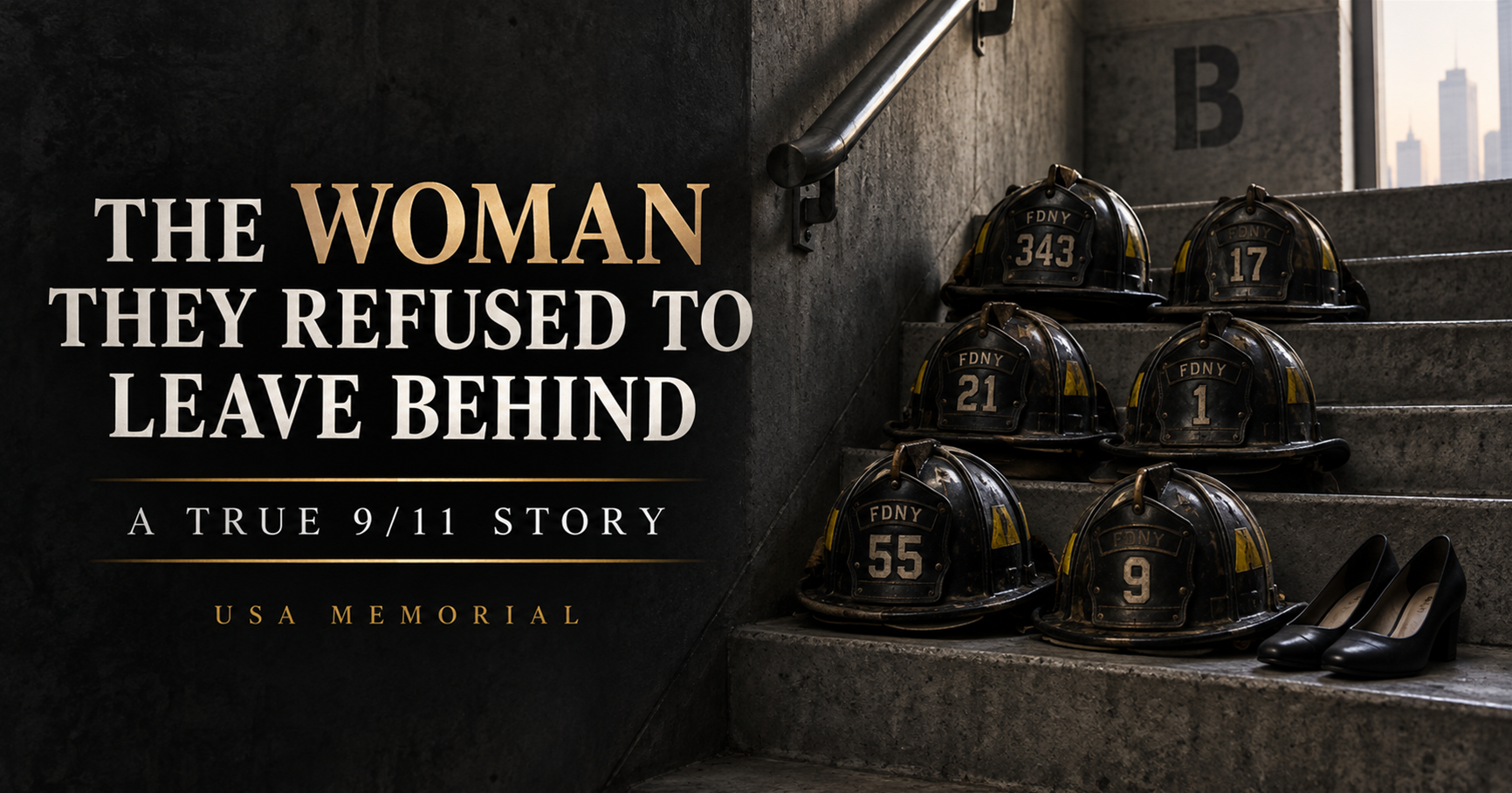
"THE WOMAN THEY REFUSED TO LEAVE BEHIND" Chapter 7
Stairwell B
Official investigations showed that stairwell performance, structural damage, communication, and evacuation conditions varied dramatically throughout the World Trade Center. Stairwell B’s result cannot be generalized into a promise about any other building or location. Its historical importance comes from specificity: one section of one tower occupied by a particular group at one moment.
That specificity is why the floor numbers work so well in narrative. The 73rd floor establishes Josephine’s starting distance. The 27th marks Ladder 6’s upward progress. The twentieth marks their meeting. The fourth marks how close the group had come to escape. The sequence lets readers feel movement without inventing a false second-by-second countdown.
The stairwell was both route and evidence. Before collapse, it directed people toward the street. After collapse, its partial survival explained how people could remain alive inside a destroyed tower. The same concrete steps that had seemed too slow for Josephine became the physical enclosure separating the group from fatal debris.
Stairwell B became one of the most extraordinary locations in the history of September 11.
It was not a secret escape route. Before the collapse, it was one of the North Tower’s ordinary emergency stairways, built to move people vertically through the building.
After 10:28 a.m., a lower portion remained within the debris.
The surviving section did not preserve the tower around it. It preserved a limited pocket inside catastrophic destruction. The people there were surrounded by evidence that nearly everything above them had failed.
Later investigations considered why.
The location of the stairwell, the surrounding structural system, and the distribution of debris all mattered. Simplified diagrams can make the survival appear neat. The real space was damaged, unstable, dusty, and dangerous.
For the public, Stairwell B offered a physical answer to an almost impossible question: how could anyone survive inside a collapsing 110-story tower?
The answer was not that the collapse was gentle. It was that destruction was not identical in every cubic foot of the site. A small void remained where several people happened to be.
Josephine and Ladder 6 reached that location through a sequence of documented movements.
She descended from the 73rd floor.
They climbed to the 27th.
The South Tower collapsed.
They turned back.
They met her around the 20th floor.
They stayed together.
They reached the lower levels and encountered David Lim.
The North Tower fell.
That chronology creates the narrative tension. It should not be embellished with invented clocks on every landing or precise words no recording captured.
The stairs themselves provide enough structure.
In the two earlier USA Memorial stories that performed strongly, height was also transformed into a human journey. Joanne Capestro walked down from the 87th floor. John Abruzzo’s coworkers carried an evacuation chair down from the 69th.
Josephine’s story uses the same vertical language but produces a different ending.
Joanne reached the street before collapse.
John and his coworkers escaped shortly before the North Tower fell.
Josephine and Ladder 6 were still inside.
That difference creates a new information gap for returning readers. The familiar goal—get down—appears to fail. Then the stairwell itself becomes the object that explains survival.
This is why Stairwell B should be treated as more than scenery. It is the physical evidence at the center of the story, comparable to Joanne’s shoes or John’s evacuation chair.
Photographs of the stairwell ruins are authentic historical records. Reconstruction images can help viewers understand the sequence, but they must carry a permanent label and should never be presented as newly discovered photographs.
The site later disappeared as recovery and reconstruction transformed Ground Zero. Its record survives through photographs, diagrams, testimony, official reports, and the accounts of those who emerged.
Josephine carried another kind of record in her body: the long descent before the collapse and the leg that would not let her move faster.
The firefighters carried the memory of matching her pace.
Years later, that decision would still define Ladder 6.
But Josephine would not live to see every anniversary.
Her death would give the surviving firefighters another responsibility: to keep the woman separate from the legend and to remember the person who had shared the stairwell with them.
The story had outlived the building. Now it would outlive one of its central witnesses.
ADVERTISEMENT
You May Also Like
-
CompletedChapter 10

THE MAN NOBODY COULD NAME
Survivors of the South Tower remembered an unidentified young man in a red bandana who found a stairway, helped the injured, and repeatedly returned to the devastated 78th floor. Months later, Alison Crowther recognized the detail that revealed the rescuer as her 24-year-old son, Welles. His story connects eyewitness testimony, a family object, and one of the most enduring acts of civilian heroism from September 11.Stories Behind 9/114.8k words5 33 -
CompletedChapter 10
THE MORNING HE NEVER REACHED THE 105TH FLOOR
Howard Lutnick survived September 11 because he took his oldest son to his first day of kindergarten instead of going to Cantor Fitzgerald’s offices high in the North Tower. The company lost 658 employees, including his brother and best friend. This verified story follows what came next: controversy, a five-year profit pledge, a decade of health coverage, an open door for the children left behind, and an annual charitable tradition built from the firm’s devastating loss.Stories Behind 9/116.8k words5 33 -
CompletedChapter 10
THE GUIDE DOG WHO WENT DOWN 78 FLOORS
Michael Hingson was working on the 78th floor of the North Tower when Flight 11 struck above him. This verified account follows Michael, his guide dog Roselle and colleague David Frank through the stairwell, past firefighters climbing upward, into the street and below ground during the South Tower’s collapse. More than a heroic-dog story, it reveals how a real guide-dog partnership—and several people sharing different kinds of information—survived one of the defining events of September 11.Stories Behind 9/116.9k words5 59 -
CompletedChapter 10
THE CHAIR THAT CAME DOWN 69 FLOORS
When Flight 11 struck the North Tower, Port Authority accountant John Abruzzo could not evacuate by stairs. Ten coworkers placed him in an emergency chair installed after the 1993 bombing and carried him down 69 floors. Their documented escape—and the chair now preserved by the 9/11 Museum—reveals how preparation, disability inclusion, and an extraordinary decision made before the tower fell changed eleven lives.Stories Behind 9/11|Survival7.1k words5 253 -
CompletedChapter 10
The Woman Who Walked Down 87 Floors
The Woman Who Walked Down 87 Floors On the morning of September 11, 2001, Joanne “JoJo” Capestro went to work on the 87th floor of the World Trade Center's North Tower. At 8:46 a.m., everything changed. Joanne escaped by taking the stairs, passing firefighters heading upward as office workers rushed down. One of her coworkers, Harry Ramos, stopped to help a struggling stranger and never made it out. Joanne did. Minutes later, covered in dust after the collapse of the South Tower, she walked through Lower Manhattan and unknowingly crossed paths with photographer Phil Penman. He took her picture. They didn't know each other's names. Fifteen years later, the 9/11 Memorial Museum finally connected the photographer with the woman in his photograph. But their story still wasn't over.Stories Behind 9/1110.2k words5 251