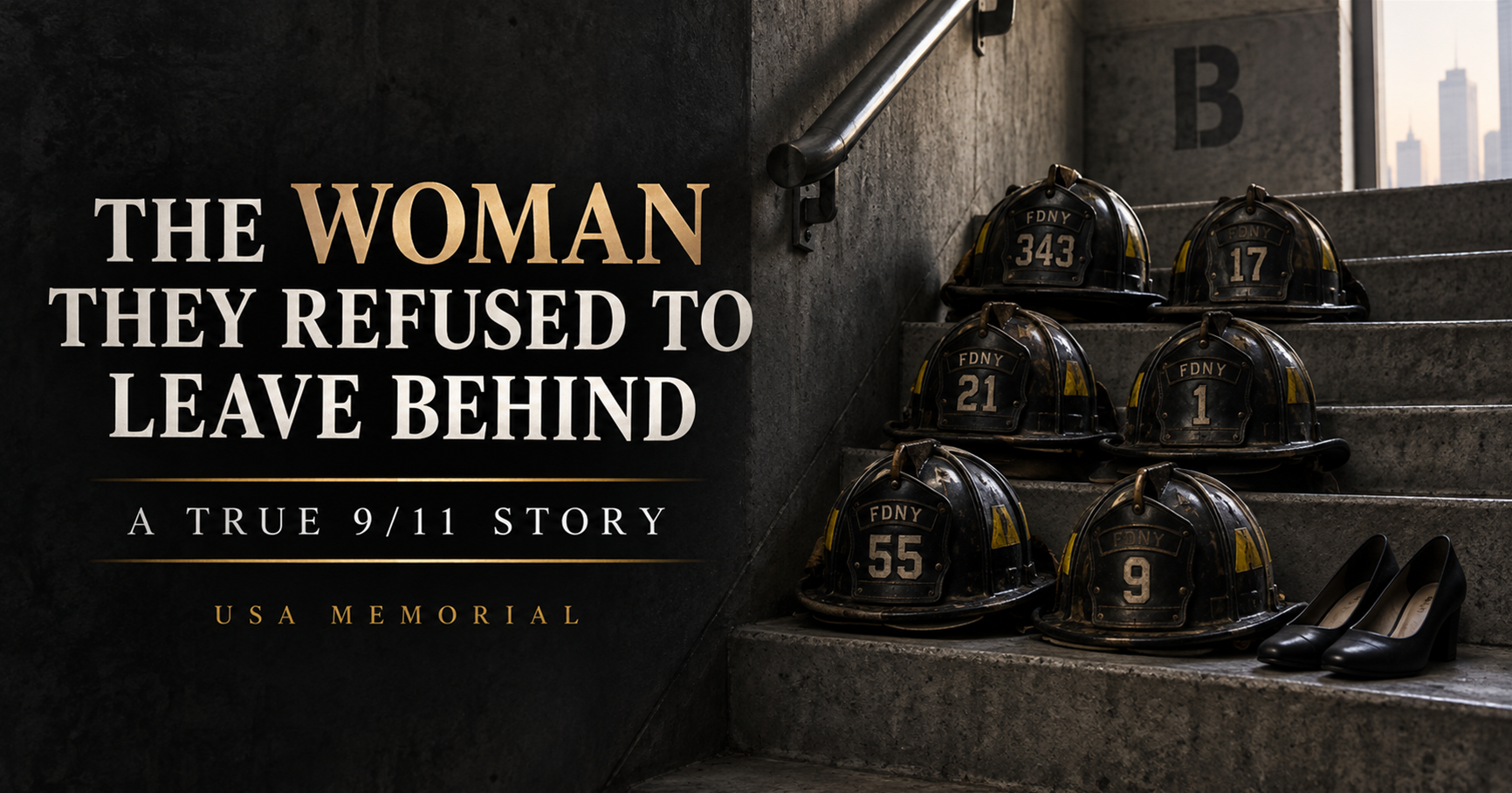
"THE WOMAN THEY REFUSED TO LEAVE BEHIND" Chapter 9
The Firehouse Without Her
The contrast between archival photographs and reconstructed scenes must remain explicit. A genuine post-attack photograph can document that Josephine and the firefighters later stood together in safety. It cannot show the moment they met inside the tower. A reconstruction can explain the stairwell geography, but it must carry a permanent label and cannot be promoted as rediscovered evidence.
The same standard applies to Reels. Real historical subjects should not be made to blink, speak, or walk through AI animation. A restrained push-in may guide attention without changing a photograph’s content. Movement belongs in labeled reconstruction shots, and even there it must remain within the verified sequence rather than inventing dramatic gestures.
This visual discipline supports the page’s credibility. USA Memorial is asking readers to trust that every important part happened. Clear separation between evidence and illustration is therefore not a technical footnote. It is part of the storytelling, allowing genuine faces, surviving objects, and physical ruins to carry more weight.
After Josephine’s death, the story remained alive at Ladder 6.
The firefighters had not known her before September 11. Their connection began during the most dangerous minutes of their lives and continued through the years that followed.
This is one of the reasons genuine photographs from after the attack matter.
A reunion image does not reconstruct the tower. It documents what the rescue created afterward: real people occupying the same frame in safety. Their faces belong to history, and their expressions do not need to be replaced by AI actors.
The rights to those images still require attention. A photograph may have been made by a newspaper, agency, documentary team, or family member. The fact that it appears online does not make it free for a commercial Facebook page. Original-source research must identify the photographer, date, caption, and license whenever possible.
When rights are unclear, the story can use a symbolic cover instead.
A concrete stair landing.
A handrail.
Six firefighter helmets beside one pair of women’s office shoes.
These objects can communicate the relationship without creating a false portrait of Josephine or the firefighters.
The most responsible cover also avoids the claim that she definitively saved them. A stronger and safer title is THE WOMAN THEY REFUSED TO LEAVE BEHIND.
It begins with the firefighters’ verified action.
It preserves the question of what happened next.
And it allows the survival pocket to remain the revelation.
For USA Memorial, this approach follows the pattern that worked in the 87-floor and 69-floor stories while avoiding repetition.
The number still matters, but it no longer has to dominate the title. The chapter structure creates a vertical countdown from the 73rd floor to the twentieth, then to the fourth. The object changes from shoes or evacuation chair to the stairwell itself.
The emotional turn also changes.
Joanne’s story moves from escape to photograph to reunion.
John’s story moves from preparedness to collective carrying to a museum object.
Josephine’s story moves from physical limitation to collective responsibility to shared survival inside the collapse.
All three place an ordinary person inside enormous history.
All three avoid opening with an explanation of geopolitics.
All three begin with something a reader can see.
For Josephine, the strongest visual is the group stopping on the stairs.
The Reels version should not show historical people blinking or speaking through AI animation. It should combine an authentic post-attack photograph, a restrained detail of Stairwell B, a permanently labeled reconstruction of the twentieth-floor meeting, and a final cut before explaining why the delay mattered.
The voice-over can remain simple:
“Six firefighters were trying to escape the North Tower. Then they found a woman who could not walk any faster. They stayed with her. Twenty-eight minutes later, the tower collapsed—and the place where they were standing changed the meaning of everything.”
The final answer belongs in the complete story.
But the final chapter belongs to Josephine.
It belongs to the distance she covered before help found her and to the dignity of continuing when her body would no longer permit the speed around her.
That is the part no slogan should erase.
Her verified journey is dramatic enough: fifty-three floors before the meeting, eight people together near the bottom, and one surviving pocket inside a fallen tower.
ADVERTISEMENT
You May Also Like
-
CompletedChapter 10

THE MAN NOBODY COULD NAME
Survivors of the South Tower remembered an unidentified young man in a red bandana who found a stairway, helped the injured, and repeatedly returned to the devastated 78th floor. Months later, Alison Crowther recognized the detail that revealed the rescuer as her 24-year-old son, Welles. His story connects eyewitness testimony, a family object, and one of the most enduring acts of civilian heroism from September 11.Stories Behind 9/114.8k words5 33 -
CompletedChapter 10
THE MORNING HE NEVER REACHED THE 105TH FLOOR
Howard Lutnick survived September 11 because he took his oldest son to his first day of kindergarten instead of going to Cantor Fitzgerald’s offices high in the North Tower. The company lost 658 employees, including his brother and best friend. This verified story follows what came next: controversy, a five-year profit pledge, a decade of health coverage, an open door for the children left behind, and an annual charitable tradition built from the firm’s devastating loss.Stories Behind 9/116.8k words5 33 -
CompletedChapter 10
THE GUIDE DOG WHO WENT DOWN 78 FLOORS
Michael Hingson was working on the 78th floor of the North Tower when Flight 11 struck above him. This verified account follows Michael, his guide dog Roselle and colleague David Frank through the stairwell, past firefighters climbing upward, into the street and below ground during the South Tower’s collapse. More than a heroic-dog story, it reveals how a real guide-dog partnership—and several people sharing different kinds of information—survived one of the defining events of September 11.Stories Behind 9/116.9k words5 59 -
CompletedChapter 10
THE CHAIR THAT CAME DOWN 69 FLOORS
When Flight 11 struck the North Tower, Port Authority accountant John Abruzzo could not evacuate by stairs. Ten coworkers placed him in an emergency chair installed after the 1993 bombing and carried him down 69 floors. Their documented escape—and the chair now preserved by the 9/11 Museum—reveals how preparation, disability inclusion, and an extraordinary decision made before the tower fell changed eleven lives.Stories Behind 9/11|Survival7.1k words5 253 -
CompletedChapter 10
The Woman Who Walked Down 87 Floors
The Woman Who Walked Down 87 Floors On the morning of September 11, 2001, Joanne “JoJo” Capestro went to work on the 87th floor of the World Trade Center's North Tower. At 8:46 a.m., everything changed. Joanne escaped by taking the stairs, passing firefighters heading upward as office workers rushed down. One of her coworkers, Harry Ramos, stopped to help a struggling stranger and never made it out. Joanne did. Minutes later, covered in dust after the collapse of the South Tower, she walked through Lower Manhattan and unknowingly crossed paths with photographer Phil Penman. He took her picture. They didn't know each other's names. Fifteen years later, the 9/11 Memorial Museum finally connected the photographer with the woman in his photograph. But their story still wasn't over.Stories Behind 9/1110.2k words5 251