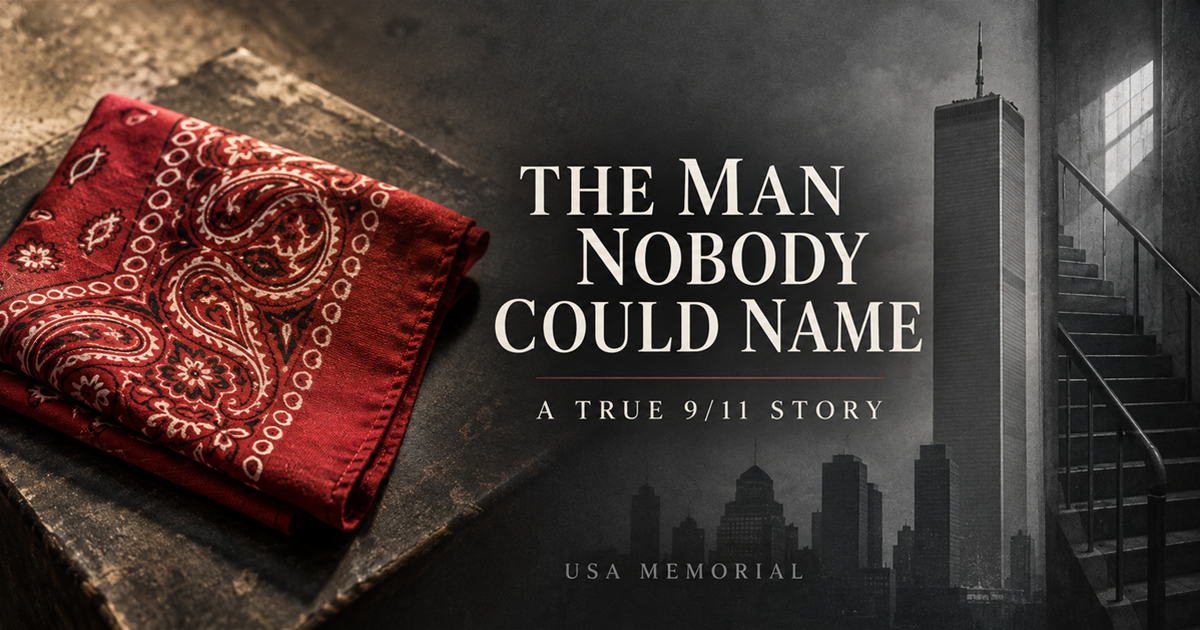
"THE MAN NOBODY COULD NAME" Chapter 1 — The Red Bandana
Inside the 9/11 Memorial Museum is a square of red cloth.
It is folded beneath glass, separated from the noise of the city and the morning that gave it meaning. Nothing about it looks powerful. It is not protective equipment. It carries no badge, radio, or official title. It is the kind of ordinary handkerchief that could have disappeared into a drawer.
But this one belonged to Welles Remy Crowther.
For months after September 11, 2001, many of the people he helped did not know his name. They remembered a young man appearing in the destruction of the South Tower’s 78th-floor sky lobby. Smoke and debris had made the floor almost unrecognizable. Some survivors were badly injured. Others could not find a usable way down.
The young man covered his nose and mouth with a red bandana.
That detail survived when almost everything else became confused.
Witnesses remembered his controlled voice. They remembered him locating a stairway and organizing people who were still able to move. They remembered that he helped injured strangers. They remembered that after leading one group toward safety, he went back.
They did not remember hearing his name.
The absence created a mystery. A rescuer had moved through the sky lobby, but the people who lived because of him could describe only fragments: his build, his manner, his instructions, and the red cloth across his face.
On that morning, Welles was 24 years old. He worked for Sandler O’Neill & Partners on the 104th floor of the South Tower. He was an equities trader, a Boston College graduate, a former lacrosse player, and a volunteer firefighter from Upper Nyack, New York.
Those identities had always lived together. Finance was his occupation. Firefighting was part of the life he had been building since his teens.
The red bandana connected them.
His father, Jefferson Crowther, had given him his first one when he was a boy. Welles carried red bandanas through school and sports and into adulthood. Family photographs showed them. Friends knew the habit. The object was so familiar that it scarcely required explanation.
Then, on September 11, it became the clearest identifying mark left by a man who did not return.
The bandana displayed by the Museum was donated by Alison and Jefferson Crowther and their family. It is not presented as a magical object or as the recovered cloth from Welles’s final rescue. It is preserved because it belonged to him and because the pattern became inseparable from the eyewitness record.
That distinction matters.
The power of the artifact does not come from pretending it witnessed something it did not. Its power comes from what survivors independently remembered: a man whose face they could not fully see, using a red bandana against smoke while guiding them toward the only known way out.
Before the bandana could identify him, however, his family would spend months with a terrible blank in the middle of his story.
They knew where Welles had worked.
They knew he had been inside the South Tower.
They knew he had not come home.
What they did not know was what he had chosen to do after the building was struck.
The answer was already living in the memories of strangers.
But none of them yet knew that the nameless man and the missing son were the same person.
ADVERTISEMENT
You May Also Like
-
CompletedChapter 10

THE WOMAN THEY REFUSED TO LEAVE BEHIND
Josephine Harris was descending from the 73rd floor of the North Tower when an injured leg slowed her. Six firefighters from Ladder Company 6 refused to leave her and matched her pace toward the lower floors. When the tower collapsed around them, a surviving section of Stairwell B turned their decision into one of September 11’s most extraordinary—and most carefully misunderstood—survival stories.Stories Behind 9/116.8k words5 31 -
CompletedChapter 10
THE MORNING HE NEVER REACHED THE 105TH FLOOR
Howard Lutnick survived September 11 because he took his oldest son to his first day of kindergarten instead of going to Cantor Fitzgerald’s offices high in the North Tower. The company lost 658 employees, including his brother and best friend. This verified story follows what came next: controversy, a five-year profit pledge, a decade of health coverage, an open door for the children left behind, and an annual charitable tradition built from the firm’s devastating loss.Stories Behind 9/116.8k words5 33 -
CompletedChapter 10
THE GUIDE DOG WHO WENT DOWN 78 FLOORS
Michael Hingson was working on the 78th floor of the North Tower when Flight 11 struck above him. This verified account follows Michael, his guide dog Roselle and colleague David Frank through the stairwell, past firefighters climbing upward, into the street and below ground during the South Tower’s collapse. More than a heroic-dog story, it reveals how a real guide-dog partnership—and several people sharing different kinds of information—survived one of the defining events of September 11.Stories Behind 9/116.9k words5 59 -
CompletedChapter 10
THE CHAIR THAT CAME DOWN 69 FLOORS
When Flight 11 struck the North Tower, Port Authority accountant John Abruzzo could not evacuate by stairs. Ten coworkers placed him in an emergency chair installed after the 1993 bombing and carried him down 69 floors. Their documented escape—and the chair now preserved by the 9/11 Museum—reveals how preparation, disability inclusion, and an extraordinary decision made before the tower fell changed eleven lives.Stories Behind 9/11|Survival7.1k words5 253 -
CompletedChapter 10
The Woman Who Walked Down 87 Floors
The Woman Who Walked Down 87 Floors On the morning of September 11, 2001, Joanne “JoJo” Capestro went to work on the 87th floor of the World Trade Center's North Tower. At 8:46 a.m., everything changed. Joanne escaped by taking the stairs, passing firefighters heading upward as office workers rushed down. One of her coworkers, Harry Ramos, stopped to help a struggling stranger and never made it out. Joanne did. Minutes later, covered in dust after the collapse of the South Tower, she walked through Lower Manhattan and unknowingly crossed paths with photographer Phil Penman. He took her picture. They didn't know each other's names. Fifteen years later, the 9/11 Memorial Museum finally connected the photographer with the woman in his photograph. But their story still wasn't over.Stories Behind 9/1110.2k words5 251