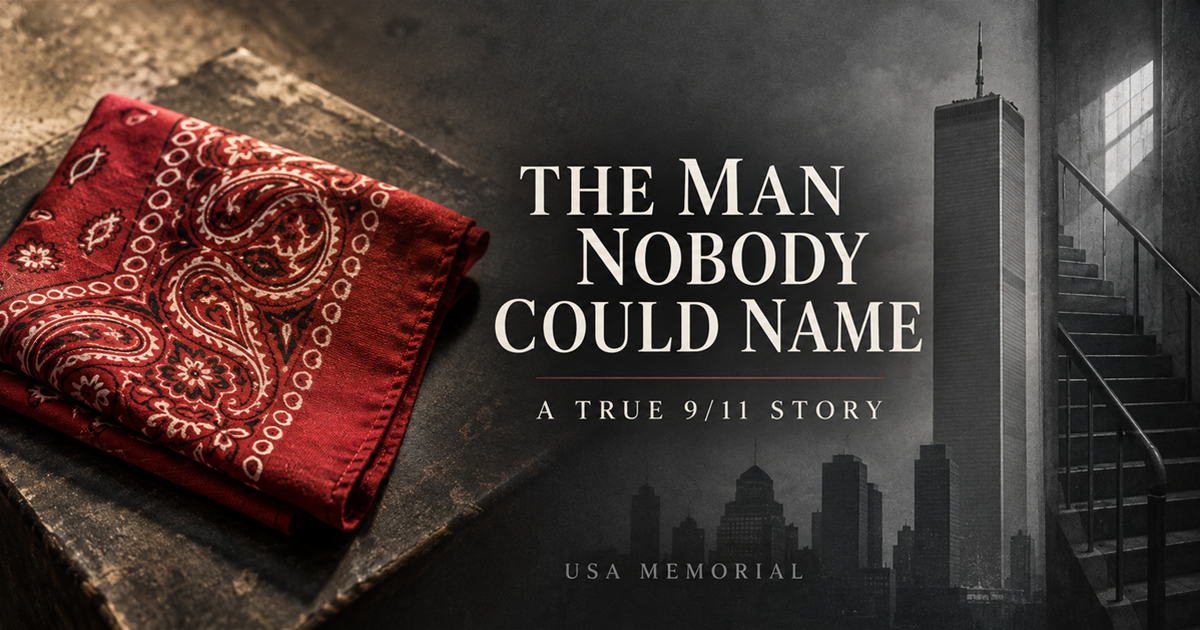
"THE MAN NOBODY COULD NAME" Chapter 2 — The Boy Who Carried Red
Long before the red bandana became a national symbol, it was a small connection between a father and his son.
Welles grew up in Upper Nyack, a community north of New York City along the Hudson River. His parents, Jefferson and Alison Crowther, raised him with his sisters. The red handkerchief entered the family story when Welles was six.
Jefferson carried bandanas himself. Alison later explained that the cloth reminded Welles of his father and became a kind of personal trademark. Welles wore or carried one through many parts of his life. It appeared beneath athletic uniforms and traveled with him beyond childhood.
The habit was memorable but not theatrical. No one could have known that it would one day allow strangers to reconstruct the final hours of his life.
Welles was also drawn early to service.
As a teenager, he joined the junior ranks connected with his local fire company. He later became a volunteer firefighter. The work gave him practical familiarity with emergencies: the need to locate exits, communicate clearly, assist injured people, and keep moving when others were disoriented.
That training did not make him invulnerable. It did not give him advance knowledge of what would happen inside the South Tower. But it helps explain why witnesses later described behavior that seemed organized amid devastation.
At Boston College, Welles played lacrosse and graduated in 1999. The school would later preserve his memory through service awards, an annual run, and football uniforms patterned after the red bandana. In the years before 9/11, however, he was simply a young graduate beginning his working life.
He joined Sandler O’Neill & Partners in the World Trade Center. The company occupied offices high in the South Tower. Welles worked on the 104th floor, far above the 78th-floor sky lobby where his actions would later be described.
The job placed him in finance, but family accounts indicate that firefighting remained important to him. His father later recalled Welles considering a change of career toward the New York City Fire Department.
That plan never had time to become a completed application, appointment, or uniform.
Yet the skills and values behind it were already present.
This is one reason the story should not be reduced to the idea that an ordinary office worker suddenly transformed into someone else. Welles did something extraordinary, but he drew on a life that had prepared him to recognize what frightened people needed.
He understood fire service.
He understood teams.
He understood that the injured could not always move without help.
And he was familiar with the object that would cover his face.
Family stories sometimes acquire polished lines after tragedy. One statement associated with Welles at Boston College says that he would change the world with his red bandana. The phrase is now part of the school’s public remembrance of him.
But the bandana’s historical importance does not depend on a prophecy.
It depends on witnesses.
On September 11, survivors did not know Welles’s childhood, his college number, his family, or his career plans. They did not know the history of the cloth across his mouth.
They saw only what he did.
The story of the boy and his bandana would come later, when a mother began fitting one unmistakable detail to the son she had lost.
First, the South Tower had to be struck.
And Welles had to make his way from the 104th floor toward a sky lobby where hundreds of lives had just been changed.
ADVERTISEMENT
You May Also Like
-
CompletedChapter 10

THE WOMAN THEY REFUSED TO LEAVE BEHIND
Josephine Harris was descending from the 73rd floor of the North Tower when an injured leg slowed her. Six firefighters from Ladder Company 6 refused to leave her and matched her pace toward the lower floors. When the tower collapsed around them, a surviving section of Stairwell B turned their decision into one of September 11’s most extraordinary—and most carefully misunderstood—survival stories.Stories Behind 9/116.8k words5 31 -
CompletedChapter 10
THE MORNING HE NEVER REACHED THE 105TH FLOOR
Howard Lutnick survived September 11 because he took his oldest son to his first day of kindergarten instead of going to Cantor Fitzgerald’s offices high in the North Tower. The company lost 658 employees, including his brother and best friend. This verified story follows what came next: controversy, a five-year profit pledge, a decade of health coverage, an open door for the children left behind, and an annual charitable tradition built from the firm’s devastating loss.Stories Behind 9/116.8k words5 33 -
CompletedChapter 10
THE GUIDE DOG WHO WENT DOWN 78 FLOORS
Michael Hingson was working on the 78th floor of the North Tower when Flight 11 struck above him. This verified account follows Michael, his guide dog Roselle and colleague David Frank through the stairwell, past firefighters climbing upward, into the street and below ground during the South Tower’s collapse. More than a heroic-dog story, it reveals how a real guide-dog partnership—and several people sharing different kinds of information—survived one of the defining events of September 11.Stories Behind 9/116.9k words5 59 -
CompletedChapter 10
THE CHAIR THAT CAME DOWN 69 FLOORS
When Flight 11 struck the North Tower, Port Authority accountant John Abruzzo could not evacuate by stairs. Ten coworkers placed him in an emergency chair installed after the 1993 bombing and carried him down 69 floors. Their documented escape—and the chair now preserved by the 9/11 Museum—reveals how preparation, disability inclusion, and an extraordinary decision made before the tower fell changed eleven lives.Stories Behind 9/11|Survival7.1k words5 253 -
CompletedChapter 10
The Woman Who Walked Down 87 Floors
The Woman Who Walked Down 87 Floors On the morning of September 11, 2001, Joanne “JoJo” Capestro went to work on the 87th floor of the World Trade Center's North Tower. At 8:46 a.m., everything changed. Joanne escaped by taking the stairs, passing firefighters heading upward as office workers rushed down. One of her coworkers, Harry Ramos, stopped to help a struggling stranger and never made it out. Joanne did. Minutes later, covered in dust after the collapse of the South Tower, she walked through Lower Manhattan and unknowingly crossed paths with photographer Phil Penman. He took her picture. They didn't know each other's names. Fifteen years later, the 9/11 Memorial Museum finally connected the photographer with the woman in his photograph. But their story still wasn't over.Stories Behind 9/1110.2k words5 251