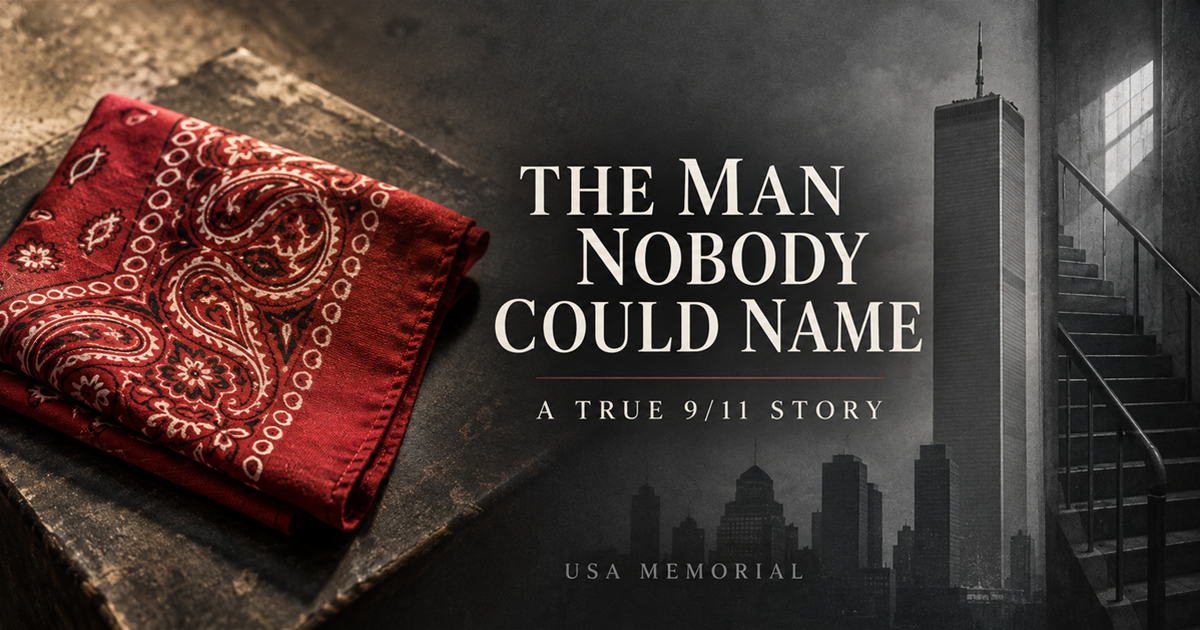
"THE MAN NOBODY COULD NAME" Chapter 3 — The 104th Floor
At 8:46 a.m. on September 11, American Airlines Flight 11 struck the North Tower.
Across the plaza, people in the South Tower could see fire and smoke pouring from the other building. Conditions inside their own tower were initially different. Announcements, personal judgment, and changing information shaped the decisions made in those early minutes.
Welles was at work on the 104th floor.
The South Tower had not yet been hit.
According to family accounts, he left a telephone message letting his mother know he was all right. It was the last contact his family received from him. The message confirmed that he had survived the first impact, but it could not tell them what would happen next.
At 9:03 a.m., United Airlines Flight 175 struck the South Tower.
The aircraft entered the building across multiple floors in the upper eighties. The impact destroyed parts of the tower, ignited fires, and severely damaged routes through the building. The 78th-floor sky lobby became one of the most heavily affected occupied spaces.
Welles was above the impact zone.
Most people trapped above the damaged floors did not escape. The official record establishes the scale of the loss, but it cannot provide a complete minute-by-minute route for every individual. For Welles, the surviving evidence comes largely from the people who encountered him below his office.
Somehow, he reached the 78th floor.
It is important not to turn that sentence into an invented action sequence. The exact path he followed from the 104th floor is not completely documented. No responsible account should supply fabricated doors, conversations, flames, or split-second decisions.
What is documented is that survivors encountered him at the sky lobby after the impact.
They described devastation and confusion. People were injured. Smoke and fire complicated movement. The normal logic of an office building—hallways, elevators, signs, predictable routes—had been broken.
Welles used the red bandana over his mouth and nose.
He located a stairway that remained passable and directed survivors toward it. Accounts describe him telling those who could stand to do so and asking them to help others who could be moved.
The instruction transformed scattered survivors into a group.
It did not remove danger. It did not guarantee that everyone could be saved. It created a next action where moments earlier there had been none.
The usable stairway was Stairway A, the route through the impact zone that remained passable for a limited number of people from above. Finding and reaching it was the difference between entrapment and a possible descent.
Welles began guiding people down.
Survivor accounts place him helping the injured and bringing groups toward safety. One group descended until it encountered firefighters farther below. At that point, Welles did not simply remain with the people he had already led away from danger.
He turned back upward.
That return is the hinge of the story.
If he had continued down, he might have reached lower floors with the first people he helped. The record cannot tell us whether that path would definitely have saved him. The South Tower had less than an hour between impact and collapse, and conditions were changing continuously.
What the record does show is that Welles repeatedly returned toward people who still needed help.
The young trader from the 104th floor was no longer moving only toward the street.
He was moving between groups of strangers and the one stairway that still offered them a chance.
ADVERTISEMENT
You May Also Like
-
CompletedChapter 10

THE WOMAN THEY REFUSED TO LEAVE BEHIND
Josephine Harris was descending from the 73rd floor of the North Tower when an injured leg slowed her. Six firefighters from Ladder Company 6 refused to leave her and matched her pace toward the lower floors. When the tower collapsed around them, a surviving section of Stairwell B turned their decision into one of September 11’s most extraordinary—and most carefully misunderstood—survival stories.Stories Behind 9/116.8k words5 31 -
CompletedChapter 10
THE MORNING HE NEVER REACHED THE 105TH FLOOR
Howard Lutnick survived September 11 because he took his oldest son to his first day of kindergarten instead of going to Cantor Fitzgerald’s offices high in the North Tower. The company lost 658 employees, including his brother and best friend. This verified story follows what came next: controversy, a five-year profit pledge, a decade of health coverage, an open door for the children left behind, and an annual charitable tradition built from the firm’s devastating loss.Stories Behind 9/116.8k words5 33 -
CompletedChapter 10
THE GUIDE DOG WHO WENT DOWN 78 FLOORS
Michael Hingson was working on the 78th floor of the North Tower when Flight 11 struck above him. This verified account follows Michael, his guide dog Roselle and colleague David Frank through the stairwell, past firefighters climbing upward, into the street and below ground during the South Tower’s collapse. More than a heroic-dog story, it reveals how a real guide-dog partnership—and several people sharing different kinds of information—survived one of the defining events of September 11.Stories Behind 9/116.9k words5 59 -
CompletedChapter 10
THE CHAIR THAT CAME DOWN 69 FLOORS
When Flight 11 struck the North Tower, Port Authority accountant John Abruzzo could not evacuate by stairs. Ten coworkers placed him in an emergency chair installed after the 1993 bombing and carried him down 69 floors. Their documented escape—and the chair now preserved by the 9/11 Museum—reveals how preparation, disability inclusion, and an extraordinary decision made before the tower fell changed eleven lives.Stories Behind 9/11|Survival7.1k words5 253 -
CompletedChapter 10
The Woman Who Walked Down 87 Floors
The Woman Who Walked Down 87 Floors On the morning of September 11, 2001, Joanne “JoJo” Capestro went to work on the 87th floor of the World Trade Center's North Tower. At 8:46 a.m., everything changed. Joanne escaped by taking the stairs, passing firefighters heading upward as office workers rushed down. One of her coworkers, Harry Ramos, stopped to help a struggling stranger and never made it out. Joanne did. Minutes later, covered in dust after the collapse of the South Tower, she walked through Lower Manhattan and unknowingly crossed paths with photographer Phil Penman. He took her picture. They didn't know each other's names. Fifteen years later, the 9/11 Memorial Museum finally connected the photographer with the woman in his photograph. But their story still wasn't over.Stories Behind 9/1110.2k words5 251