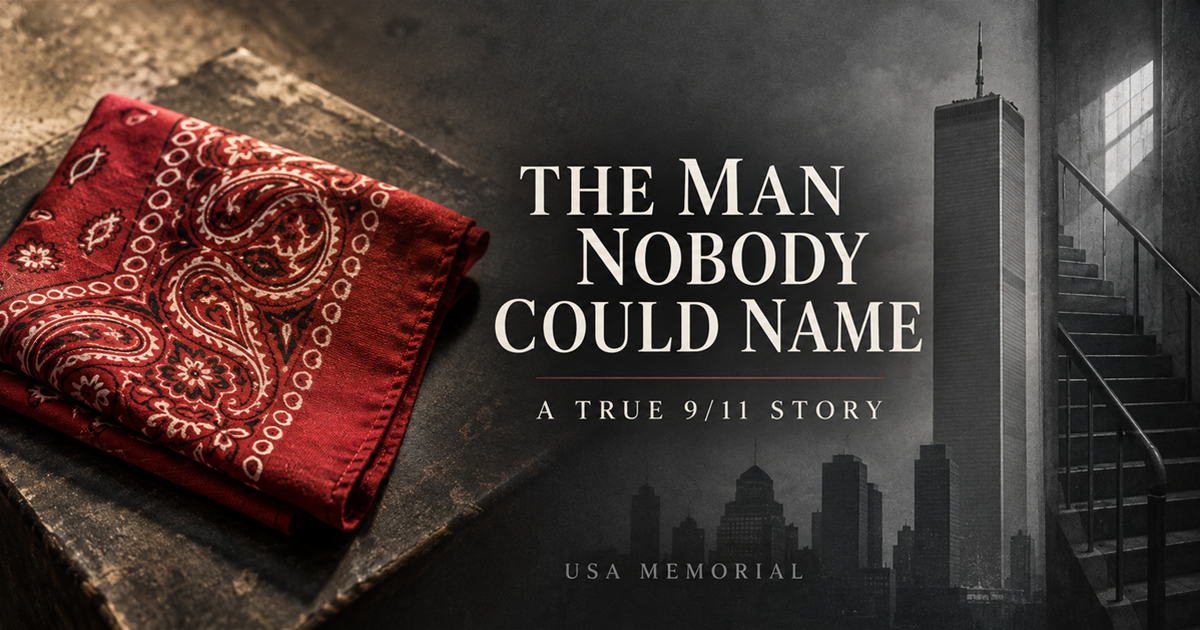
"THE MAN NOBODY COULD NAME" Chapter 9 — A Number, a Race, a Name
At Boston College, Welles Crowther’s memory does not remain inside a display case.
It runs.
Each year, people gather for the Red Bandanna 5K. The event supports the Welles Remy Crowther Charitable Trust, which has helped programs focused on young people, education, health, recreation, and character development.
The spelling varies by institution and title—bandana in some places, bandanna in others—but the visual symbol is the same.
Red fabric. White pattern. A name attached to an action.
Boston College athletes have also worn the pattern in Welles’s honor. His lacrosse number, 19, became another recurring sign. Teammates, students, and players born after 2001 learned that the design represented a real graduate who had worked on the 104th floor of the South Tower.
The traditions matter because public memory changes with time.
People who watched the attacks live remember the shock of that morning. Younger Americans encounter 9/11 first as history. They were children, infants, or not yet born when the towers fell.
An artifact can establish authenticity. A ritual can carry meaning forward.
The run, the number, and the bandana give later generations something they can see and do. Yet the most important part remains the verified human sequence behind them.
Welles reached the damaged sky lobby.
He found or identified the viable stairway.
He organized people who were able to move.
He helped injured strangers.
He led survivors down.
He went back.
The repetition is not legend added after the fact. It is the reason multiple survivor groups remembered him.
In Upper Nyack, local athletes have worn Welles’s number and carried red bandanas. Alison Crowther has joined young people at the Memorial, where her son’s name is inscribed on the South Pool parapet.
The setting brings together two versions of remembrance.
One is personal: a mother standing near her son’s name.
The other is public: students who never met him deciding that his example belongs in their own lives.
The red bandana could have become only a tragic relic.
Instead, the Crowther family and the communities around Welles turned it into an invitation to service.
That transformation should not soften what happened. The traditions exist because Welles was killed, along with thousands of others. The celebration of courage cannot erase the violence that made courage necessary.
But remembrance can decide what it carries forward.
The people who wear red today are not claiming Welles’s experience as their own. They are keeping his name attached to the values witnesses saw in the tower.
The man once known only by an object now has his story repeated by people who know exactly who he was.
ADVERTISEMENT
You May Also Like
-
CompletedChapter 10

THE WOMAN THEY REFUSED TO LEAVE BEHIND
Josephine Harris was descending from the 73rd floor of the North Tower when an injured leg slowed her. Six firefighters from Ladder Company 6 refused to leave her and matched her pace toward the lower floors. When the tower collapsed around them, a surviving section of Stairwell B turned their decision into one of September 11’s most extraordinary—and most carefully misunderstood—survival stories.Stories Behind 9/116.8k words5 31 -
CompletedChapter 10
THE MORNING HE NEVER REACHED THE 105TH FLOOR
Howard Lutnick survived September 11 because he took his oldest son to his first day of kindergarten instead of going to Cantor Fitzgerald’s offices high in the North Tower. The company lost 658 employees, including his brother and best friend. This verified story follows what came next: controversy, a five-year profit pledge, a decade of health coverage, an open door for the children left behind, and an annual charitable tradition built from the firm’s devastating loss.Stories Behind 9/116.8k words5 33 -
CompletedChapter 10
THE GUIDE DOG WHO WENT DOWN 78 FLOORS
Michael Hingson was working on the 78th floor of the North Tower when Flight 11 struck above him. This verified account follows Michael, his guide dog Roselle and colleague David Frank through the stairwell, past firefighters climbing upward, into the street and below ground during the South Tower’s collapse. More than a heroic-dog story, it reveals how a real guide-dog partnership—and several people sharing different kinds of information—survived one of the defining events of September 11.Stories Behind 9/116.9k words5 59 -
CompletedChapter 10
THE CHAIR THAT CAME DOWN 69 FLOORS
When Flight 11 struck the North Tower, Port Authority accountant John Abruzzo could not evacuate by stairs. Ten coworkers placed him in an emergency chair installed after the 1993 bombing and carried him down 69 floors. Their documented escape—and the chair now preserved by the 9/11 Museum—reveals how preparation, disability inclusion, and an extraordinary decision made before the tower fell changed eleven lives.Stories Behind 9/11|Survival7.1k words5 253 -
CompletedChapter 10
The Woman Who Walked Down 87 Floors
The Woman Who Walked Down 87 Floors On the morning of September 11, 2001, Joanne “JoJo” Capestro went to work on the 87th floor of the World Trade Center's North Tower. At 8:46 a.m., everything changed. Joanne escaped by taking the stairs, passing firefighters heading upward as office workers rushed down. One of her coworkers, Harry Ramos, stopped to help a struggling stranger and never made it out. Joanne did. Minutes later, covered in dust after the collapse of the South Tower, she walked through Lower Manhattan and unknowingly crossed paths with photographer Phil Penman. He took her picture. They didn't know each other's names. Fifteen years later, the 9/11 Memorial Museum finally connected the photographer with the woman in his photograph. But their story still wasn't over.Stories Behind 9/1110.2k words5 251