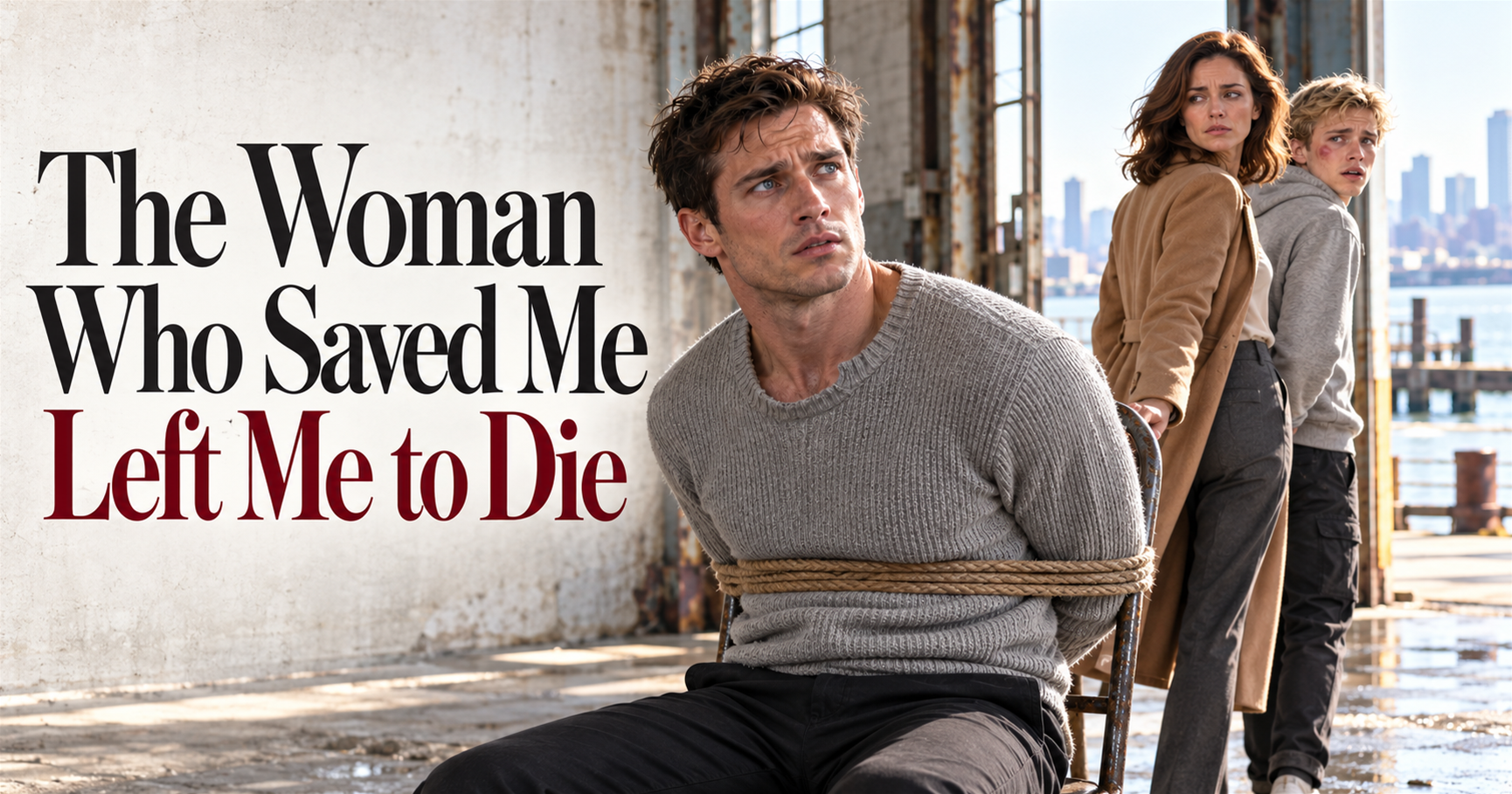
"The Woman Who Saved Me Left Me to Die" Chapter 6 — Let Them Watch
Chapter 6 — Let Them Watch
“Don’t respond tonight,” Rachel said.
“He’s using a confession they forced me to make.”
“I understand.”
“He’s made it look like I admitted this.”
“Send me the link. Preserve what you have. Then put the phone down.”
I stood at the guest-room window.
Across the courtyard, someone in an upstairs office switched off a light.
“How do I put it down?”
Rachel’s voice softened.
“By remembering that you don’t have to persuade every stranger before morning.”
I sent her the link.
Then I sent the screenshots from Audrey’s laptop and Tyler’s breakfast photograph.
I described the camera, the restarts, and Derek’s phone call.
Rachel asked me to write a chronology while the details were fresh.
I opened a blank document.
At first, I could only write fragments.
White van.
Navy jacket.
Derek.
The porch light’s out.
Him.
That last word sat alone on the screen.
I moved past it.
By two in the morning, I had six pages.
Vivian read them at the kitchen table downstairs, asking only where I wanted her to check times against her call log.
She didn’t ask why I had trusted Audrey again.
That was a kindness I felt everywhere.
The next morning, a client emailed to pause a commercial edit.
The message used the phrase “until the situation becomes clearer.”
I read it twice.
I had worked with them for four years.
Vivian offered to call.
“No,” I said. “I’ll reply.”
I wrote that I had been the victim of an assault and abduction, that the circulating video was misleading, and that my attorney would provide a factual statement.
I did not attach six pages of pain.
Then I forwarded the cancellation to Rachel.
By midday, Northlight’s receptionist had fielded three calls asking whether Vivian used company money to support an affair.
She moved them to Rachel’s office.
An industry newsletter repeated Tyler’s accusation as a question.
A question was apparently easier to publish than a fact.
My name appeared beside a photograph from an awards event seven years earlier. In it, Audrey and I were smiling.
The caption identified her as the lawyer who had once helped save my life.
Nobody asked who had left me in the warehouse.
Audrey called from a number I didn’t recognize.
I answered because Rachel’s office had been trying to arrange communication.
“Miles.”
I sat down.
“Are you hurt?”
“Yes.”
“Why didn’t you call me?”
“The police had my phone.”
“I went back.”
I pressed my palm against the table.
“When?”
“A little after noon. There were officers everywhere. Nobody would tell me anything.”
“Tyler knew where I was.”
“He said you left.”
“With Vivian?”
A pause.
“Yes.”
“And you believed him.”
“He showed me the video.”
“The one where she helped me out of the hospital?”
“He said it was outside her office.”
“Did you ask why my hands were bleeding?”
ADVERTISEMENT
“Miles—”
“Did you ask?”
She went silent.
I could hear traffic on her end.
Then she said, “You need to tell me what happened.”
“I told the police.”
“I’m your wife.”
I looked at the pages beside my laptop.
The chronology had no place for what that sentence used to mean.
“You left me there.”
“I was coming back.”
“You took him home first.”
“He was terrified.”
“So was I.”
“I know.”
“No. You knew before you walked in.”
Her breath caught.
“I made a terrible decision.”
“Yes.”
“But that doesn’t explain you staying with Vivian.”
For several seconds, I couldn’t speak.
Audrey filled the silence.
“I’m trying to understand. Tyler says you knew those men. He says the whole thing was supposed to make me choose you.”
“Tyler arranged it.”
“That’s a serious accusation.”
“He was there before you arrived. He told me what he was going to do.”
“Why would he—”
“Because he thought you’d choose him.”
Her voice sharpened.
“You can’t expect me to accept everything without proof.”
I stared at the window.
She had accepted his video without proof.
His injured cheek.
His kitchen fire.
Every emergency that required her to abandon something she had promised me.
“What do you want?” I asked.
“Meet me. Alone. Before this destroys both our lives.”
“Contact Rachel.”
“Miles, she’s going to make this adversarial.”
“It already is.”
I ended the call.
My hand shook so badly that I put the phone down on the floor instead of trusting myself to hold it.
Vivian sat beside me without speaking.
After a while, I said, “I need to work.”
“Today?”
“An hour. Something I can finish.”
She gave me a short sequence with a clean deadline.
I cut it.
Then I sent it back.
For forty-six minutes, there had been a problem I knew how to solve.
Over the next two days, Rachel took control of the public response.
She hired Daniel Foster, an investigator experienced in collecting digital material, to preserve the circulating posts and identify what could be independently checked.
I worked with him on the video.
Not to make a rival cut.
To show where the existing one broke.
The sound changed midway through a sentence. My head moved between frames without the motion connecting. A chair leg shifted position. The hospital footage had been stripped of context.
None of that, by itself, proved who had abducted me.
Daniel said so.
“But it tells us this isn’t the complete recording.”
“I know there are other takes.”
“Then we establish where they are.”
The police had recovered the warehouse camera.
One of the men had been arrested on site. Derek had fled.
Tyler had not answered my attorney’s notice demanding that he preserve and stop distributing the material.
Instead, he posted a second statement.
He called the incident an ill-conceived attempt to help a troubled marriage.
He said he had also been restrained.
ADVERTISEMENT
He described himself as “caught in the middle.”
The statement came with a photograph of his cheek.
Audrey stood beside him in it.
I closed the page.
Then I reopened it and saved it for Daniel.
On Friday, Graham Pierce contacted Rachel.
The firm had received questions from clients and wanted to issue a response. Audrey and Tyler had supplied accounts that did not match the existence of an active criminal investigation.
Graham proposed a recorded statement at the firm, with a small number of reporters allowed to ask questions afterward.
Rachel insisted that I be offered time to respond.
Graham agreed.
“You don’t have to attend,” she told me.
“I’m going.”
“We can submit a statement.”
“He’s going to stand there and call it a marriage problem.”
“We’ll correct that.”
“I want to be in the room.”
Rachel studied me across her desk.
“Then we control what we can. You speak from the facts. You don’t improvise allegations. If a question touches the investigation, you refer it to me.”
I agreed.
That afternoon, Derek’s attorney called her.
Derek had been located.
He was seeking advice about his part in the abduction and wanted to provide material to investigators.
Among it was a voice message Tyler had sent before Audrey arrived.
Derek had saved it.
He claimed he had kept it because Tyler was changing the plan and he wanted proof of the instructions.
His account did not make him innocent.
It made him useful.
The message was delivered to the police. A copy, authorized by Derek through his attorney, reached Rachel.
Daniel checked the file and its accompanying records.
Rachel notified the investigator assigned to my case before deciding what could be played publicly.
She called me into her office on Saturday morning.
“Listen.”
Tyler’s voice filled the room.
“Once she’s gone, get him on camera. Make him say he arranged it. Don’t let him talk about me.”
A pause.
Then:
“He doesn’t leave until you have something usable.”
I sat very still.
Rachel stopped playback.
“We have permission to use this limited section. We keep the rest with the investigators.”
“Play it again.”
She did.
This time, I heard the phrase I had missed in the warehouse.
Once she’s gone.
He had known Audrey would leave.
He had planned what came afterward.
Rachel waited until I looked at her.
“Are you still certain you want to attend?”
“Yes.”
On Monday, the conference room at Pierce & Whitmore was full before we arrived.
Not hundreds of people.
Enough.
Two local reporters. A camera operator. A legal-industry correspondent. Graham and the firm’s outside adviser.
Audrey stood near the windows.
Tyler stood beside her.
He wore a dark suit and an expression I had first mistaken for shyness at a barbecue.
His gaze went to my wrists.
The bruises had spread beneath the skin.
Then he looked away.
Audrey took a step toward me.
Rachel moved beside my chair.
“Any personal conversation can wait.”
Audrey stopped.
Graham opened with a brief acknowledgment of the investigation.
Then Tyler spoke.
He had notes.
He said he regretted becoming involved.
He said emotions had escalated.
He said several people had made mistakes.
A reporter interrupted.
“Did you arrange for Mr. Bennett to be taken to the warehouse?”
“No.”
Tyler answered quickly.
Then he glanced at me.
“I understand why Miles wants someone to blame. But I never asked anyone to hurt him.”
Rachel leaned toward my microphone.
“My client has preserved evidence directly relevant to that statement.”
Tyler’s smile tightened.
“A recording can be edited.”
“Yes,” I said.
It was the first thing I had said in the room.
He looked at me.
“I know.”
Daniel stood beside the screen with the file ready. Rachel placed the written source details before Graham.
Audrey stared at the waveform waiting on the display.
“Miles,” she said softly.
I kept my eyes on Tyler.
He shook his head.
“I didn’t order anything.”
I turned to Daniel.
“Play his message.”
ADVERTISEMENT
You May Also Like
-
SerialChapter 31

With Nothing Left, I Had Two Shifter Stepbrothers to Feed
Avery transmigrates into another world—and finds herself selling her own stepbrother to a slave trader. She looks at the arrogant buyer before her, then at the stepbrother behind her, his face empty of hope. She pushes away the beast crystals being offered. “I’m not selling him.” But after taking him home, she discovers they have nothing but bare walls. Without selling someone, they really might not survive. Her other stepbrother is away with the hunting party, but his share of the meat is barely enough to feed Avery alone. Three people in the household. Two going hungry. Yet both brothers work tirelessly, never complaining, too timid to stand up for themselves. What else can Avery do? She touches her own animal ears, rolls up her sleeves, and gets to work feeding her brothers. … A few world-building details: Females retain a partly animal form, while males ordinarily look human and shift into beasts when hunting. The extent of their transformations and mutations depends on their rank…Human Nature|Survival|Spirits|Glow-Up|Fake Relationship36.3k words5 3 -
CompletedChapter 20
Blacklisted for Three Years, I Returned with My Genius Son.
Three years ago, Adrian Blackwell believed another woman's tears—and destroyed Claire Bennett's career. He never knew she was raising his son. Now Claire has returned to television with five-year-old Noah, a boy who can negotiate a bargain, solve a puzzle, and spot a fake smile before the cameras do. One viral clip brings them everything Claire needs: paid work, a fresh start, and a chance to stop running. It also brings Adrian. The resemblance is impossible to ignore. So is his demand to know why she kept Noah from him. But while Adrian wants answers, the woman he once protected wants Claire gone again. This time, she's willing to use Claire's child to make it happen. Claire has already lost her name, her career, and years of her life. She won't let them take her son's voice too.Billionaire|Fake Relationship|Second Chance23.4k words5 9 -
CompletedChapter 10
I Hid Beneath a Mafia Boss's Desk. He Refused to Give Me Back.
Emily Carter is barefoot beneath a mafia boss's desk when her husband walks in and tells him she's unstable. For three years, Derek has controlled her money, her friendships, and the story everyone believes about their marriage. Tonight, Emily has nowhere left to run. But Alexander Moretti refuses to hand her over. Then Derek mentions her dead father's name—and the man who hasn't flinched at a single threat suddenly loses his composure. Emily thought she was escaping a cruel husband. Now she must uncover what he has been searching for, why Alexander knew her father, and how much of her marriage was a lie.Billionaire|Mafia|Glow-Up|Fake Relationship9.9k words5 23 -
CompletedChapter 25
My Ice-Cold Ex Became Obsessed After I Lost My Memory.
For two years, I loved Sebastian Hale, the brilliant surgeon who never seemed to need me. On our anniversary, I asked for a hug. He told me to go home. When I finally left him, he let me. Then a car accident erased the last two years of my life. I woke up believing we had only just fallen in love. But the man beside my hospital bed was nothing like the cold boyfriend I remembered. His eyes were bloodshot. His hands trembled. And when I reached for him, he held me as though letting go would destroy him. He said we were still together. My best friend said I had already walked away. Someone was lying about the life I couldn’t remember. And the closer I got to Sebastian, the more I wondered: had he never loved me, or had he been hiding something far more dangerous?Substitute Lover|Sweet Romance|HE15.5k words5 10 -
CompletedChapter 10
I Saved a Dying Girl. She Was the Daughter I Never Knew.
Luca Mancini went to the hospital looking for news of his wounded best friend. Instead, he helped save a seventeen-year-old girl whose face reminded him of the woman he had never stopped loving. He never knew Sofia had been pregnant. He never received her letters. But discovering who kept them apart cannot erase the night she asked for his help—and he failed to listen. Now his daughter wants to know whether he will stay. Sofia wants him to understand that being allowed into their lives does not mean being forgiven. Luca can offer protection, money, and everything his power can buy. Winning back the woman he lost will demand something he has never learned to give: a choice.Dark Secrets|Fake Relationship9.9k words5 9 -
CompletedChapter 11
He Let His Best Friend Humiliate Me. I Made Him Beg.
Sloane Sterling thought her fiancé would protect her. Instead, he watched while his best friend pinned her in the mud, tore her clothes, and turned her humiliation into a joke. When Grant fired a paintball round into her injured wrist, Sloane stopped waiting for an apology. She called Dante. Now Grant and Riley are about to learn what it feels like to be trapped, exposed, and powerless while everyone watches. Sloane doesn’t want their excuses or their promises. She wants them to remember every second—and she plans to take back the future they thought they could control.Dark Humor|Fake Relationship10.7k words5 11 -
CompletedChapter 11
My Younger Boyfriend Begs Me to Spoil Him
Vivian Blake spent three years building the career of the man she loved. Then he announced his new girlfriend—the woman who had blackmailed Vivian into paying two million dollars to protect him. That night, Vivian offered a handsome twenty-three-year-old bartender a better deal: cars, a house, a career. All he had to do was come home with her. Jamie Cole wanted something else. Her attention. Her affection. A place in her bed—and her life. He blushes when she touches him, begs her to keep him, and refuses to let their relationship stay secret. But when someone tries to buy him away from her, the sweet younger man suddenly knows how to silence an entire room. Vivian thought she was spoiling an ambitious little actor. Now she needs to discover who she actually brought home—and how long he’s been waiting for her.Sweet Romance|Fake Relationship|HE11.4k words5 13 -
CompletedChapter 11
Our Marriage Contract Expired. My Billionaire Husband Wouldn’t Let Me Go.
Audrey Lane has packed her suitcase, signed the divorce papers, and prepared to take her little girl out of Julian Mercer's life. Their three-year marriage agreement is over. She refuses to spend another day being wanted in his bed and kept at a distance everywhere else. But one last kiss becomes the goodbye neither of them can finish. Then morning comes—and her billionaire husband refuses to let her take the child who calls him Daddy. Audrey wants a life she can choose: her daughter beside her, her jewelry studio secure, and her wrongfully imprisoned father home. Julian wants her to stay. As her former lover returns and carefully planted lies threaten everything she's rebuilding, Julian finally begins to show her what his silence has hidden. He wants her. He always has. But desire isn't an apology, protection isn't permission, and the most dangerous secret in their marriage belongs to the man asking her to trust him.Billionaire|Fake Relationship10.9k words5 14 -
CompletedChapter 11
My Husband Swore He Never Touched Me. Then Who Got Me Pregnant?
Evelyn Hart tells her husband she’s carrying his child. Nathaniel Cross tells her he has never touched her. She remembers the night he came for her. He insists it never happened. After twenty years of loving him, Evelyn discovers that their marriage was built around a revenge she never understood. When his supposed lover dies, Evelyn becomes the woman everyone blames—and escaping him costs more than she could have imagined. Months later, blind and grieving, she meets Luke, a gentle stranger who asks before touching her and stays when she’s afraid. For the first time, Evelyn wants a future without her husband. But Luke’s hands feel familiar. His voice sometimes changes. And whenever she mentions Nathaniel, the man who makes her feel safe goes strangely silent.Billionaire|Dark Secrets|Substitute Lover|Fake Relationship14.8k words5 28