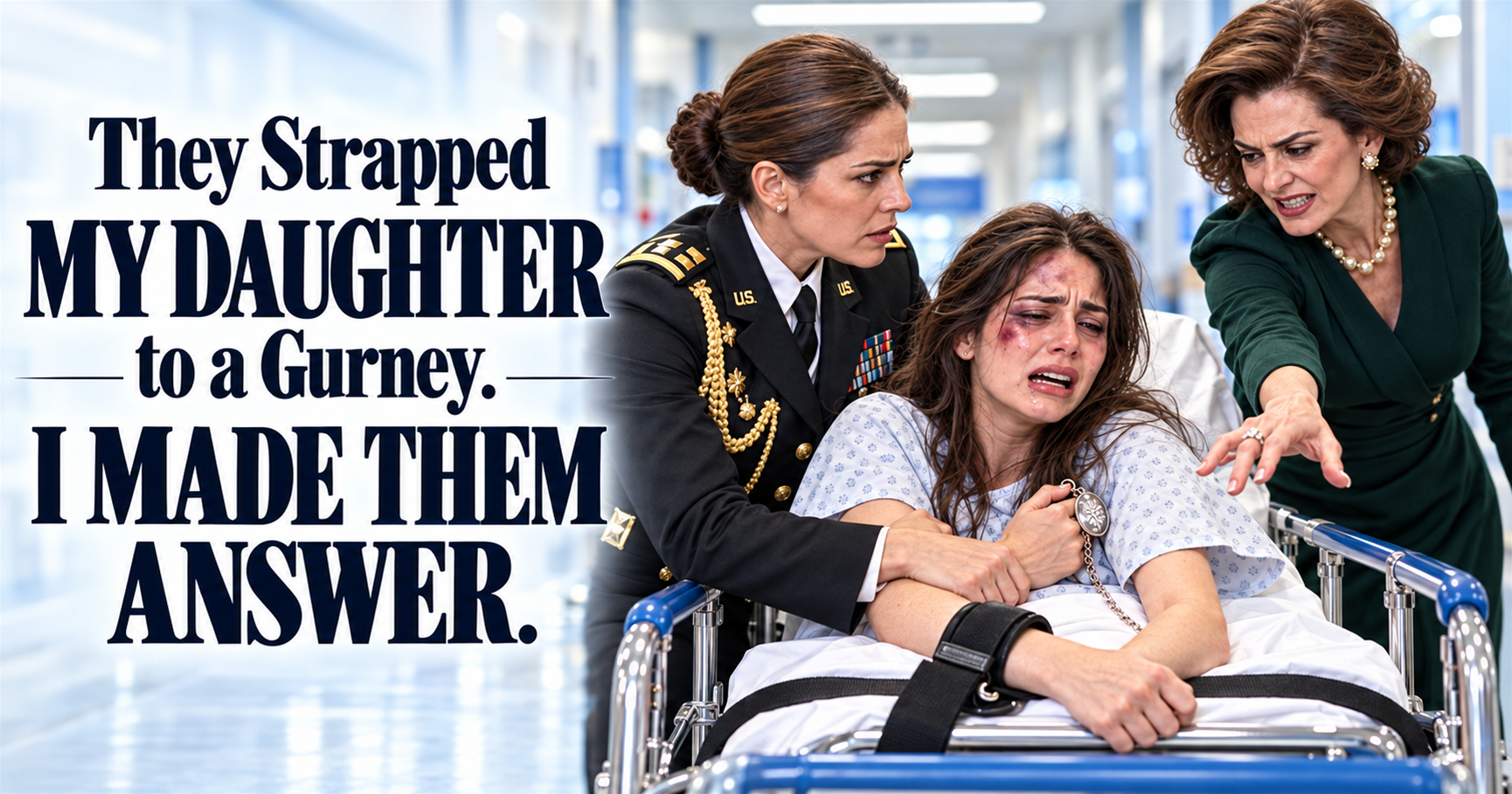
"They Strapped My Daughter to a Gurney. I Made Them Answer." Chapter 11 — Nothing Left to Hide
Chapter 11 — Nothing Left to Hide
“No,” I said.
Claire looked at the unopened bottle in her lap.
“It won’t feel that simple.”
“I know.”
I took her hand.
“You’re out of that house. Your account is in the record. You kept evidence that other people are checking. None of that disappears because a decision hurts.”
She leaned against me.
We sat until Owen came to find us.
The verdict was ready.
Julian was found guilty of assaulting her.
Claire did not cry when it was announced.
She closed her eyes.
Her hand tightened around mine, then slowly opened.
I had imagined triumph.
I had imagined watching Julian understand that he could no longer tell a room who my daughter was.
What I felt was exhaustion.
What I heard was Claire exhaling.
Outside, Owen explained the next steps. Sentencing would follow. There were still other proceedings.
Claire listened, asked two questions, and said she wanted to go home.
On the drive, she lowered the window.
Cold air moved through the car.
“Too much?” she asked.
“No.”
She left it down.
Julian received a custodial sentence. The court continued restrictions intended to keep him away from Claire.
At sentencing, he apologized.
He spoke about stress, regret, and the loss of his marriage.
Claire had prepared her own statement.
She read it without looking at him.
“I used to measure a good day by whether you were pleased with me,” she said. “I don’t do that anymore.”
She folded the page when she finished.
We left before his family could approach.
The company case took longer.
As independent records were obtained, the disputed shipments stopped being a collection of suspicious files taken by a frightened employee.
They became transactions with dates, approvals, payments, and missing equipment.
Grant’s retained records helped establish the decision trail. They also established his own participation.
He could not preserve enough material to protect himself without preserving some of what implicated him.
Vivian’s name appeared on approvals connected to transactions she had publicly described as operational matters beneath her attention.
Emails showed which concerns had reached her.
Financial records showed where money had gone.
The investigation did not confirm every suspicion Claire had raised.
Some discrepancies had ordinary explanations.
Others did not.
Claire read both kinds of findings.
“I’m glad they checked,” she told me.
Even then.
Especially then.
Grant admitted his role in the fraudulent transactions and cooperated. His sentence included prison time and repayment obligations.
Vivian eventually entered a guilty plea in the financial case after months of fighting the evidence. She received a longer prison sentence and was required to contribute to restitution.
I saw her at one of the proceedings.
She wore the same pearls she had worn in the hospital.
For years, she had made stillness look like authority.
This time, she kept adjusting the clasp of her handbag.
When she looked toward us, Claire met her eyes.
ADVERTISEMENT
Vivian looked away first.
Whitmore Medical Supply lost major contracts and came under independent oversight as it repaid affected customers and restructured.
Employees who had played no part in the scheme paid a price, too.
Claire hated that.
Owen reminded her that exposing the losses had not created them.
She understood.
It still hurt.
Kessler surrendered his medical license during the proceedings arising from his conduct. His cooperation did not erase the records he had helped create.
Briarwood changed its review procedures for disputed transfer documents and complaints from patients whose relatives were speaking for them.
Claire requested her corrected records.
She read every page.
Then she placed them in a folder and put the folder away.
The divorce was finalized on a rainy Thursday.
Owen called while we were shopping for a lamp.
Claire stood between two displays, holding a shade she had already decided was ugly.
When the call ended, she looked at me.
“It’s done.”
I took the shade from her.
“Do you want to leave?”
“No.”
She looked around.
“I still need a lamp.”
That was how we celebrated.
We bought one.
A month later, she moved into a small apartment fifteen minutes from my house.
It had uneven kitchen drawers and a balcony barely wide enough for two chairs.
She loved it.
The first evening, I helped her unpack dishes.
I reached for the cups, then stopped.
“Where do you want these?”
She pointed to a cabinet.
“Second shelf.”
I put them there.
When we finished, she handed me a key.
“For emergencies.”
I held it in my palm.
“Do grocery emergencies count?”
“Call first.”
“I’ll try to remember.”
She smiled.
“You’d better.”
She continued therapy.
She had difficult nights. Once, months after the trial, the sound of a cart rolling behind her in a medical office sent her outside shaking.
She called me.
I came.
Another time, she called to complain about a neighbor playing music.
I let her complain for twenty minutes.
I had missed ordinary calls more than I knew.
She returned to work with a small compliance organization that helped companies build better internal reporting systems.
Before accepting, she asked who reviewed concerns when senior management was involved.
She asked how records were preserved.
She asked what happened when an employee made an honest mistake while raising a legitimate problem.
The director answered.
Claire accepted the position.
She bought a plant for her desk.
Almost a year after the hospital, she brought me the locket.
The broken chain was wrapped in tissue.
“Can you fix it now?”
“Yes.”
“I don’t want the break polished out completely.”
I looked up.
“You’re sure?”
She touched the damaged link.
“I don’t need it to look like nothing happened.”
I took it to a jeweler who repaired the chain and left a small visible join.
When I gave it back, Claire opened the oval.
It was empty.
“What are you putting in it?” I asked.
“I haven’t decided.”
She fastened it around her neck anyway.
Two weeks later, we drove to the Shenandoah Valley.
The craft market had changed. The stall where I had bought her locket was gone, replaced by a woman selling pottery bowls.
We walked between tables of candles, knitted scarves, and silver jewelry.
Claire stopped at a display.
“Go look at the pottery,” she said.
“I can take a hint.”
“Then take it.”
I wandered away.
She found me ten minutes later carrying a small paper bag.
At a café, she pushed it across the table.
Inside was a silver locket with a flower engraved on the front.
I opened it.
There was a photograph of us when she was ten.
Claire had lost a front tooth. I was wearing a sweatshirt with paint on the sleeve. Her arms were wrapped around my neck, and both of us were laughing at something outside the frame.
“When did you find this?”
“In the boxes you keep promising to organize.”
“That narrows it down.”
She turned the locket over.
On the back, she had engraved three words.
Objective secured, Mom.
I pressed my thumb against the lettering.
“Am I allowed to ask about the operation?”
Claire smiled.
“The operation’s over, Mom.”
Outside, people moved between the stalls carrying purchases and paper cups. The afternoon was getting cold.
Claire stood and put on her plain winter coat.
Then she held out her hand.
“Come on. I want to see the rest before we go.”
I took it.
She led me into the market, choosing our direction without looking back to ask permission.
FIM
ADVERTISEMENT
You May Also Like
-
CompletedChapter 10

Her Family Stole My Father’s Legacy. I Bought Theirs
Victoria Delacroix slapped me in front of thirty wealthy guests and ordered security to throw me out. She thought I didn’t belong in her family’s luxury boutique. She didn’t know I already controlled the company. One phone call ended her evening. An old sketchbook changed everything I thought I knew about my father. He was a Black tailor from Queens who died believing his greatest opportunity had ended in failure. But the designs that made the Delacroix name famous carried his handwriting. Her family had taken his work, denied him payment, and erased his name. Now her father was offering me two million dollars to keep it that way. He should have asked what I wanted before putting a price on my silence.Human Nature|Glow-Up9.8k words5 0 -
CompletedChapter 11
I Owned the Hotel That Turned My Daughter Away
Ethan Vance arrives at a luxury hotel carrying his sleeping daughter and a crushed bouquet of roses for his late wife. The receptionists see his wet jacket and decide he doesn’t belong. They refuse to help. They dismiss the housekeeper who offers his daughter a blanket. They have no idea he owns the hotel. One phone call exposes their mistake. But before Ethan can take his daughter upstairs, the manager produces an envelope in his dead wife’s handwriting—addressed to Ethan and the housekeeper he has just met. He came to remember the woman he loved. Now he must discover the part of her life she never shared.Billionaire|Human Nature|Dark Secrets11.7k words5 0 -
CompletedChapter 10
They Thought I Couldn’t Afford to Quit.
For nine years, Catherine “Cat” Bennett kept the clients happy, the projects moving, and her shrinking team afloat. Then HR offered her a sixty percent pay cut. Same accounts. Same responsibilities. Less than half the salary. Her boss knew she was a single mother. He knew she had a mortgage and a son who needed asthma medication. He expected her to sign. Cat cried in her car instead. Then a former colleague called. Their biggest competitor had been trying to recruit her for years—and its CEO wanted a meeting. By the time Cat returned to give HR her answer, she had a signed offer in her bag. Her boss had prepared for an employee who couldn’t afford to leave. He hadn’t prepared for what losing her would cost.Dark Humor|Human Nature|Age Gap9.7k words5 4 -
CompletedChapter 10
The Barefoot Boy Who Helped My Daughter Stand.
For three years, Nathaniel Hayes has searched for a way to help his daughter walk again. Then, at an elegant family celebration, nine-year-old Lily takes the hand of a barefoot boy—and rises from her wheelchair. Nathaniel is stunned. Lily’s grandfather wants the boy removed. But ten-year-old Noah Bennett hasn’t come looking for money or a miracle. He recognizes something in Lily that the adults around her haven’t understood. As an unlikely friendship brings laughter back into the house, Lily begins talking about the accident that killed her mother. And someone in the family has a reason to wish she’d stayed silent.Billionaire|Human Nature|Dark Secrets10.2k words5 3 -
CompletedChapter 10
The Man I Kept in Chains Came Back for Me.
Julian Ashford once had enough money to keep Adrian Mercer in chains—and too little understanding of love to know why he wanted him to stay. Then Adrian destroyed his family’s fortune and waited for the spoiled young heir to come begging. Julian never did. Five years later, Julian delivers food through freezing rain, counts every dollar, and avoids the powerful man who ruined him. Adrian says he hates him. Julian believes him. But hatred doesn’t explain the car that follows him everywhere. The familiar candy beside his medicine. Or why Adrian keeps reaching for him after telling him to leave. Julian wants to call it even and move on. Then another man kisses him. That night, Adrian appears outside his door.Human Nature|Healing Romance|HE6.8k words5 0 -
CompletedChapter 11
The Dancer They Paid to Humiliate
Emily Carter was hired to dance at a billionaire's charity gala. Instead, she became the evening's biggest joke. As wealthy socialites mocked her curves and laughed behind champagne glasses, Emily refused to stop dancing. But when a mysterious necklace slipped from her dress, billionaire Alexander Whitmore suddenly rose from his chair and shouted, "STOP THE MUSIC!" That necklace belonged to a Whitmore heiress who vanished decades ago. Now, the woman everyone humiliated may hold the key to...Billionaire|Human Nature|Dark Secrets|Plot Twist|Glow-Up12.3k words5 8 -
CompletedChapter 124
I Died on My Wedding Night. My Enemy’s Hair Turned White.
I loved Julian Whitmore for nineteen years. On the night we made our marriage official, he murdered me for the heart beating in my chest. Death should have ended the betrayal. Instead, I became a ghost, forced to watch my husband play the grieving widower while my family helped bury the truth. I could see everything. Prove nothing. Touch no one. Then Lucian Blackwood began looking for me. My ruthless business rival. The man I had spent years fighting. The last person I expected to care whether I lived or died. While the people I loved profited from my disappearance, he refused to stop searching. And every secret I uncovered about him made my wasted life hurt more. I wanted revenge. I wanted my mother safe. But the closer Lucian came to the truth, the more frightened I became of what finding me would cost him.Human Nature|Dark Secrets82.6k words5 17 -
CompletedChapter 10
The Woman They Shouldn’t Have Slapped
Vivian Whitmore looked at the elegant Black woman standing in her father’s boardroom and decided she didn’t belong. First came the questions. Then the insults. Then Vivian slapped her in front of everyone. Amina Diop didn’t slap her back. She picked up her phone. “Hold tomorrow’s funding release.” Vivian had no idea she had just struck the founder of Diop Capital—the firm her family’s company desperately needed. But Amina had come to that meeting with questions of her own. Millions of dollars were unaccounted for. Someone had been approving payments for work nobody could produce. And the man standing beside Vivian had just recognized her. He looked terrified. Not because of the slap.Human Nature|Dark Secrets7.6k words5 164 -
CompletedChapter 5
The Heiress in an Apron
Three drops of champagne. One shove. A hundred guests who did nothing. Ella Bennett is helping serve drinks at an elegant English wedding when a wealthy guest pushes her into a fountain—and demands that she be fired. Soaked and bleeding, Ella asks for an apology. Instead, she gets laughter. Then the estate manager asks whether she wants him to end the reception. A powerful hotel executive arrives at her request. And the woman who humiliated her calls her father for help—only to hear one chilling question: “Victoria. What did you do?” Everyone wants to know who the waitress really is. Before the night is over, they’ll wish they had asked sooner.Human Nature|Dark Secrets|Glow-Up4.8k words5 7 -
CompletedChapter 9
THE BOY WHO WOULDN'T KNEEL
When two armed men storm a supermarket, everyone gets down. Ten-year-old Noah Bennett stays standing. “You’ve got thirty seconds to leave.” The gunman laughs—until the security shutter starts to fall. Then he finds the scar behind Noah’s ear and recognizes whose son he is. Six months ago, Noah buried his father. Tonight, someone is watching through the supermarket cameras. Someone who knows the gunman’s name. As the exits close, Noah realizes this was never a robbery gone wrong. And he may be the reason it happened.Human Nature|Survival|Dark Secrets8.9k words5 9