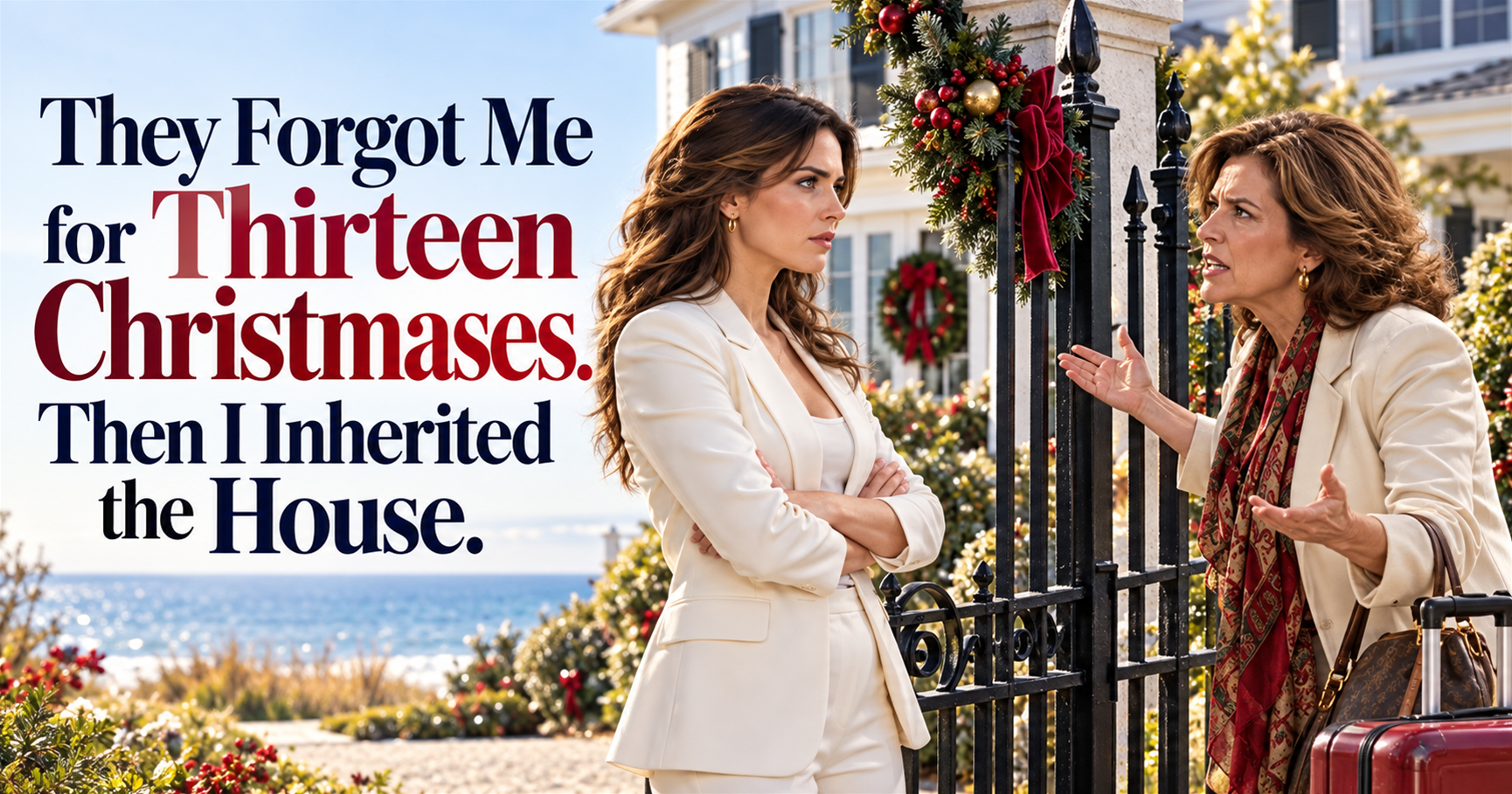
"They Forgot Me for Thirteen Christmases. Then I Inherited the House." Chapter 3 — Say It Was an Accident
Chapter 3 — Say It Was an Accident
My mother folded the page.
I reached for it.
“Don’t.”
She stopped, then handed it back.
“I was trying to keep things from getting worse.”
“For whom?”
“For everyone.”
I waited.
Behind her, someone shut a car door. One of the children asked for a snack. My cousin’s wife led the younger kids toward an SUV and opened a bag of crackers.
Ordinary things kept happening.
I had imagined, once, that if I ever proved what my family had done, the moment would be unmistakable. Everyone would understand at the same time.
Instead, Dad checked whether the cooler was leaking.
Barbara checked her phone.
Mom searched for a version of the truth that would hurt less.
“I thought you and Barbara needed some space,” she said.
“Then why didn’t you tell me?”
“You were already upset.”
“So you told me dinner was canceled.”
“Claire—”
“It happened the next year, too.”
Her eyes filled.
I had spent years stopping when that happened.
This time, I turned to Megan.
“Did you know?”
She glanced at Mom.
“Don’t look at her. I’m asking you.”
“Yes.”
“Did you know the first year?”
“Yes.”
“Did you know every year after that?”
Megan held the sleeve of her coat between her fingers.
“We didn’t have the same discussion every year.”
“What discussion did you have?”
She swallowed.
“Sometimes Aunt Barbara would say you were working. Sometimes Mom said she’d call you.”
“And when I didn’t arrive?”
“We ate.”
It was the smallest answer she could have given.
It was also the first honest one.
I pressed the papers against the folder to keep the wind from taking them.
“Did any of you forget?”
Megan shook her head.
My mother covered her mouth.
I looked at Dad.
He still wouldn’t meet my eyes.
Thirteen Christmases.
A turkey sandwich from a gas station after a late shift. Dinner at a coworker’s apartment, where her mother kept apologizing for not having enough matching plates. One December spent sick on my couch, waiting for a call that didn’t come.
All those years, I had wondered whether I expected too much.
Now Megan was standing in front of me, telling me they had eaten.
Barbara shoved her phone into her pocket.
“This is cruel. Your mother doesn’t deserve to be interrogated in public.”
“You arranged a public arrival.”
“Because we’re a family.”
“Then answer the question.”
“What question?”
“Why did asking about Grandma’s money mean I couldn’t sit at the table?”
Barbara’s mouth tightened.
“Because you didn’t understand what you were talking about.”
“Explain it now.”
“I handled things for my mother. You were barely out of school.”
“I could read a credit card statement.”
“You saw a few charges and decided I was stealing.”
“I asked who bought a television.”
“And made your grandmother suspicious of everyone.”
Nathan shifted beside me.
“Evelyn’s later concerns didn’t come from Claire.”
ADVERTISEMENT
Barbara turned on him.
“You hardly knew her compared to us.”
“I worked with her for several years.”
“During the years she was getting confused.”
There it was.
The explanation she had used whenever Grandma disagreed with her.
Mom wiped beneath one eye.
“She did forget things toward the end.”
“She forgot where she put her glasses,” I said. “She didn’t forget that she hadn’t gone on Tyler’s vacation.”
Tyler looked up from his phone.
“What vacation?”
Barbara answered quickly.
“That has nothing to do with this.”
I looked at him.
“Grandma’s card paid a deposit on a rental near Myrtle Beach thirteen years ago.”
“I was seventeen. I didn’t book anything.”
“I know.”
Barbara’s jaw worked.
I hadn’t accused her son. That seemed to bother her more than if I had.
Nathan opened his case and removed a thin folder.
“Some transactions need clarification. Barbara, a request for records has already been sent to your attorney.”
“My attorney handles my business.”
“And he can advise you about responding.”
Mom turned toward him.
“What transactions?”
I took a copy of one bank statement.
“Grandma asked the bank for these herself. She didn’t get them from Barbara.”
“When?” Mom asked.
“Last spring.”
I remembered the drive.
Grandma had asked me to take her to a branch across Wilmington instead of the one near her grocery store. She said she wanted to speak to someone who didn’t know Barbara.
I thought she was embarrassed about needing help.
Now I knew she was trying to get an answer she could trust.
I held up the page.
“Two transfers left her account while she was in the hospital in May. One for sixty-four hundred dollars. One for thirty-eight hundred.”
Barbara folded her arms again.
“She authorized them before she went in.”
“What were they for?”
“Personal matters.”
“Whose?”
“My mother helped her children. She didn’t demand an invoice for every kindness.”
“So they were gifts?”
“I didn’t say that.”
“What did you say?”
“That you’re turning ordinary family arrangements into something ugly.”
Nathan spoke before I could.
“We’re not asking Barbara to account for every family gift. There are legitimate expenses in these records, and those will be separated from disputed payments.”
Barbara seized on it.
“Thank you. At least someone understands.”
He continued.
“Evelyn identified these particular transfers as payments she had not authorized.”
My mother looked at the statement.
“Did she tell you that, Claire?”
“She wrote it down.”
I showed her the note clipped behind it.
Grandma’s handwriting was smaller than it had been on my childhood birthday cards, but the letters were steady.
I was in the hospital. Barbara says I told her to take it. I did not.
Mom read it twice.
Barbara stepped closer to the bars.
“My mother said different things on different days.”
“Then you should have asked before moving her money,” I said.
“You weren’t there.”
ADVERTISEMENT
“I was there every evening after work.”
“You weren’t there when she gave me permission.”
“Was it permission to borrow, permission to spend for her, or a gift?”
Barbara stared at me.
Nathan touched the edge of my folder.
It was a reminder to slow down.
We had discussed this. A family argument wasn’t a substitute for reviewing documents. I couldn’t prove every payment by making Barbara angry enough to contradict herself.
But she had already offered three explanations.
I wanted to know which one she expected us to believe.
“Pick one,” I said.
My father finally spoke.
“Barbara, just tell her what the money was for.”
She looked at him as if he had pushed her.
“After everything I did for your mother-in-law?”
“That isn’t an answer,” he said.
The surprise on Mom’s face matched mine.
Barbara pulled herself upright.
“Your grandmother gave me money because I took care of her. She understood that running back and forth cost time. It cost gas. It cost me business.”
“So these transfers were payment?”
“They were hers to give.”
“Did she ask you to repay them?”
“No.”
Nathan reached into his case.
He took out his phone and a signed statement.
Barbara watched his hands.
“What’s that supposed to be?”
“Evelyn made a recording in my office,” he said. “She also reviewed and signed a written account.”
“She was eighty-two.”
“Yes.”
“She was ill.”
“Yes.”
“Then you should know better than to let Claire use her like this.”
I felt the folder bend beneath my fingers.
Grandma had spent her last months making sure her own words could survive her.
Barbara was already trying to erase them.
“She asked him to keep this,” I said. “She asked me to listen.”
Mom looked at the phone.
“What did she say?”
“We can hear her.”
Barbara shook her head.
“This is a setup.”
“You said she never asked you to repay those transfers.”
“Because she didn’t.”
“And she told you the money was yours?”
“Yes, Claire. She told me I could keep it. There. Is that clear enough for you?”
I looked at Nathan.
He unlocked the phone and opened the audio file, then handed it to me.
Barbara glanced toward the cars.
Megan moved closer to the gate.
My mother stood very still.
For thirteen years, they had made me explain why I was hurt.
This time, I had asked a question and waited for an answer.
I held the phone where everyone could hear it and pressed play.
A chair scraped faintly in the recording.
Then my grandmother cleared her throat.
“Barbara, if you’re telling them again that those transfers were gifts, I want everyone listening to hear exactly what happened.”
ADVERTISEMENT
You May Also Like
-
CompletedChapter 10

Her Family Stole My Father’s Legacy. I Bought Theirs
Victoria Delacroix slapped me in front of thirty wealthy guests and ordered security to throw me out. She thought I didn’t belong in her family’s luxury boutique. She didn’t know I already controlled the company. One phone call ended her evening. An old sketchbook changed everything I thought I knew about my father. He was a Black tailor from Queens who died believing his greatest opportunity had ended in failure. But the designs that made the Delacroix name famous carried his handwriting. Her family had taken his work, denied him payment, and erased his name. Now her father was offering me two million dollars to keep it that way. He should have asked what I wanted before putting a price on my silence.Human Nature|Glow-Up9.8k words5 0 -
CompletedChapter 11
I Owned the Hotel That Turned My Daughter Away
Ethan Vance arrives at a luxury hotel carrying his sleeping daughter and a crushed bouquet of roses for his late wife. The receptionists see his wet jacket and decide he doesn’t belong. They refuse to help. They dismiss the housekeeper who offers his daughter a blanket. They have no idea he owns the hotel. One phone call exposes their mistake. But before Ethan can take his daughter upstairs, the manager produces an envelope in his dead wife’s handwriting—addressed to Ethan and the housekeeper he has just met. He came to remember the woman he loved. Now he must discover the part of her life she never shared.Billionaire|Human Nature|Dark Secrets11.7k words5 0 -
CompletedChapter 10
They Thought I Couldn’t Afford to Quit.
For nine years, Catherine “Cat” Bennett kept the clients happy, the projects moving, and her shrinking team afloat. Then HR offered her a sixty percent pay cut. Same accounts. Same responsibilities. Less than half the salary. Her boss knew she was a single mother. He knew she had a mortgage and a son who needed asthma medication. He expected her to sign. Cat cried in her car instead. Then a former colleague called. Their biggest competitor had been trying to recruit her for years—and its CEO wanted a meeting. By the time Cat returned to give HR her answer, she had a signed offer in her bag. Her boss had prepared for an employee who couldn’t afford to leave. He hadn’t prepared for what losing her would cost.Dark Humor|Human Nature|Age Gap9.7k words5 5 -
CompletedChapter 10
The Barefoot Boy Who Helped My Daughter Stand.
For three years, Nathaniel Hayes has searched for a way to help his daughter walk again. Then, at an elegant family celebration, nine-year-old Lily takes the hand of a barefoot boy—and rises from her wheelchair. Nathaniel is stunned. Lily’s grandfather wants the boy removed. But ten-year-old Noah Bennett hasn’t come looking for money or a miracle. He recognizes something in Lily that the adults around her haven’t understood. As an unlikely friendship brings laughter back into the house, Lily begins talking about the accident that killed her mother. And someone in the family has a reason to wish she’d stayed silent.Billionaire|Human Nature|Dark Secrets10.2k words5 6 -
CompletedChapter 10
The Man I Kept in Chains Came Back for Me.
Julian Ashford once had enough money to keep Adrian Mercer in chains—and too little understanding of love to know why he wanted him to stay. Then Adrian destroyed his family’s fortune and waited for the spoiled young heir to come begging. Julian never did. Five years later, Julian delivers food through freezing rain, counts every dollar, and avoids the powerful man who ruined him. Adrian says he hates him. Julian believes him. But hatred doesn’t explain the car that follows him everywhere. The familiar candy beside his medicine. Or why Adrian keeps reaching for him after telling him to leave. Julian wants to call it even and move on. Then another man kisses him. That night, Adrian appears outside his door.Human Nature|Healing Romance|HE6.8k words5 0 -
CompletedChapter 11
The Dancer They Paid to Humiliate
Emily Carter was hired to dance at a billionaire's charity gala. Instead, she became the evening's biggest joke. As wealthy socialites mocked her curves and laughed behind champagne glasses, Emily refused to stop dancing. But when a mysterious necklace slipped from her dress, billionaire Alexander Whitmore suddenly rose from his chair and shouted, "STOP THE MUSIC!" That necklace belonged to a Whitmore heiress who vanished decades ago. Now, the woman everyone humiliated may hold the key to...Billionaire|Human Nature|Dark Secrets|Plot Twist|Glow-Up12.3k words5 8 -
CompletedChapter 124
I Died on My Wedding Night. My Enemy’s Hair Turned White.
I loved Julian Whitmore for nineteen years. On the night we made our marriage official, he murdered me for the heart beating in my chest. Death should have ended the betrayal. Instead, I became a ghost, forced to watch my husband play the grieving widower while my family helped bury the truth. I could see everything. Prove nothing. Touch no one. Then Lucian Blackwood began looking for me. My ruthless business rival. The man I had spent years fighting. The last person I expected to care whether I lived or died. While the people I loved profited from my disappearance, he refused to stop searching. And every secret I uncovered about him made my wasted life hurt more. I wanted revenge. I wanted my mother safe. But the closer Lucian came to the truth, the more frightened I became of what finding me would cost him.Human Nature|Dark Secrets82.6k words5 17 -
CompletedChapter 10
The Woman They Shouldn’t Have Slapped
Vivian Whitmore looked at the elegant Black woman standing in her father’s boardroom and decided she didn’t belong. First came the questions. Then the insults. Then Vivian slapped her in front of everyone. Amina Diop didn’t slap her back. She picked up her phone. “Hold tomorrow’s funding release.” Vivian had no idea she had just struck the founder of Diop Capital—the firm her family’s company desperately needed. But Amina had come to that meeting with questions of her own. Millions of dollars were unaccounted for. Someone had been approving payments for work nobody could produce. And the man standing beside Vivian had just recognized her. He looked terrified. Not because of the slap.Human Nature|Dark Secrets7.6k words5 266 -
CompletedChapter 5
The Heiress in an Apron
Three drops of champagne. One shove. A hundred guests who did nothing. Ella Bennett is helping serve drinks at an elegant English wedding when a wealthy guest pushes her into a fountain—and demands that she be fired. Soaked and bleeding, Ella asks for an apology. Instead, she gets laughter. Then the estate manager asks whether she wants him to end the reception. A powerful hotel executive arrives at her request. And the woman who humiliated her calls her father for help—only to hear one chilling question: “Victoria. What did you do?” Everyone wants to know who the waitress really is. Before the night is over, they’ll wish they had asked sooner.Human Nature|Dark Secrets|Glow-Up4.8k words5 12 -
CompletedChapter 9
THE BOY WHO WOULDN'T KNEEL
When two armed men storm a supermarket, everyone gets down. Ten-year-old Noah Bennett stays standing. “You’ve got thirty seconds to leave.” The gunman laughs—until the security shutter starts to fall. Then he finds the scar behind Noah’s ear and recognizes whose son he is. Six months ago, Noah buried his father. Tonight, someone is watching through the supermarket cameras. Someone who knows the gunman’s name. As the exits close, Noah realizes this was never a robbery gone wrong. And he may be the reason it happened.Human Nature|Survival|Dark Secrets8.9k words5 12