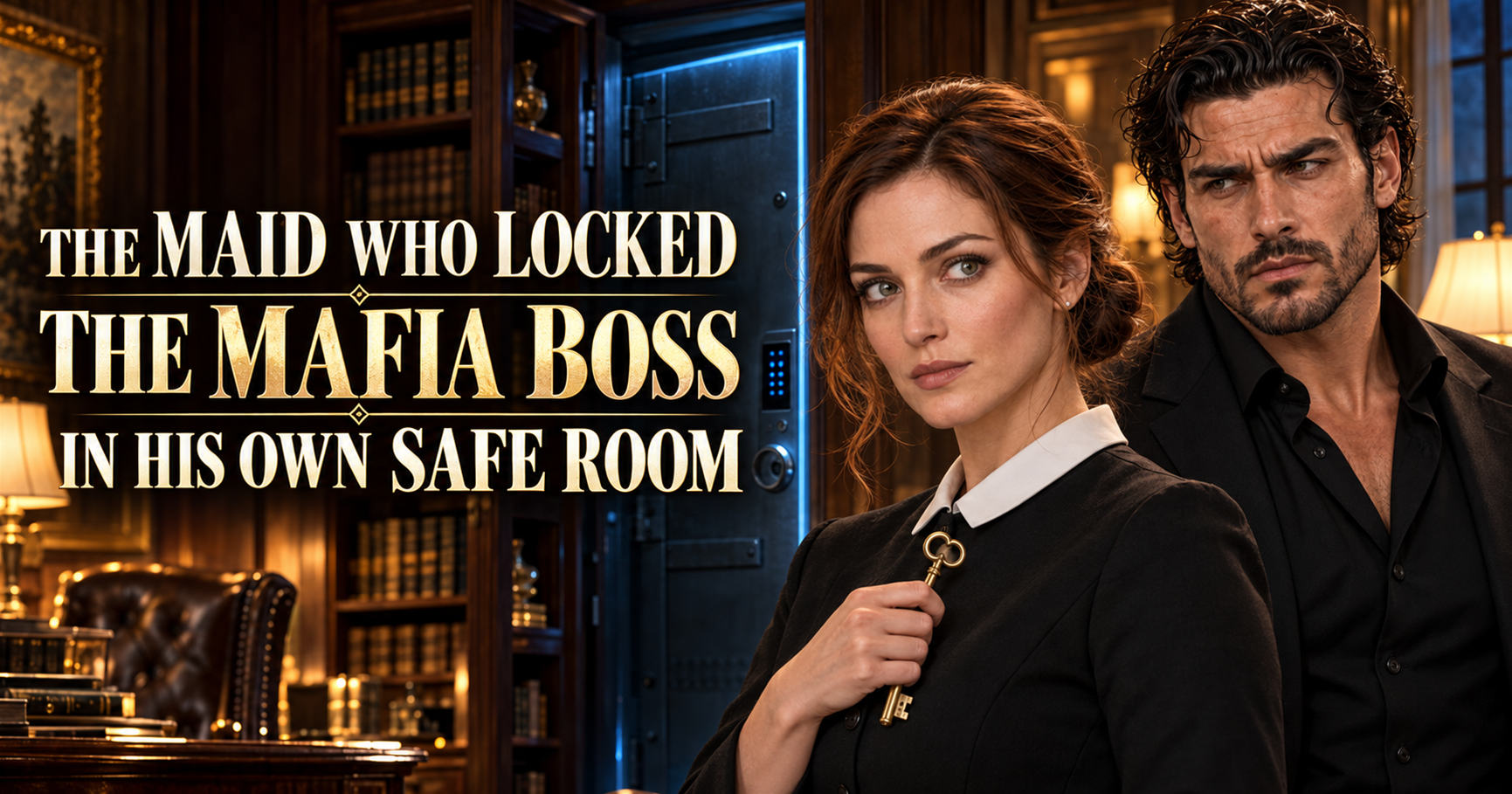
"The Maid Who Locked the Mafia Boss in His Own Safe Room" Chapter 11 — A House with Open Doors
Eleven months later, Mara locked Vincent DeLuca out of the mansion again.
This time, she did it because he arrived early.
“The sign is not finished,” she called through the front door.
Vincent stood on the stone steps in a charcoal suit, holding a paper bag from Rosa’s bakery. A federal supervision officer waited discreetly beside the car.
“I spent eight months in a detention center,” he said. “I can survive an unfinished sign.”
“You also spent eight months learning that doors open when other people decide.”
“A lesson you began teaching effectively.”
Mara smiled and turned the key.
The house no longer belonged to Vincent. Under his cooperation agreement, the Westchester estate, waterfront warehouses, cash properties, and controlling shares in DeLuca Logistics had been forfeited.
The criminal cases filled entire court calendars.
Tony faced federal charges for attempted mass-casualty terrorism, murder, kidnapping, racketeering, and evidence tampering. Keller pleaded guilty and identified the corrupt deputy marshal who arranged Mara’s abduction. Three port officials and two customs supervisors followed.
Owen’s testimony connected every account.
Vincent pleaded guilty to racketeering conspiracy, obstruction, and directing illegal gambling and extortion operations. Prosecutors credited his archive, testimony, asset surrender, and role in preventing the port explosion. The judge imposed a sentence that included time served, eighteen months of home confinement, five years of supervised release, and permanent separation from the logistics company.
It was not absolution.
Nor did Mara treat it as one. Loving Vincent did not rewrite the people he had frightened, the businesses his organization had pressured, or the years when he could have chosen a cleaner life and did not.
People Vincent had harmed received restitution from the forfeited assets. Some refused it. Some wrote statements he read without defending himself. He attended every required hearing and never called cooperation a sacrifice.
DeLuca Logistics survived under an independent board, a union compliance council, and a new name: Harborline Freight.
The mansion became the Bennett Crisis Center, offering emergency housing, legal referrals, and trauma counseling for whistleblowers and families escaping organized crime.
Today was its opening.
Mara let Vincent inside.
The disguised safe-room door stood open behind the study bookcase. Shelves that once held weapons and cash now held children’s backpacks, prepaid phones, medication kits, and copies of protection-order forms.
Vincent stopped in front of it.
“You left the door open.”
“That is the point.”
He looked around the study. The desk remained, but Elena’s household inventory books were displayed in a glass case with a plaque honoring her attempt to expose the truth. Beside them sat the brass master key.
Mara had not polished it.
The cut her palm received that night had faded into a thin white line.
Owen entered from the service hall carrying a box of donated laptops. He walked with a cane and complained about physical therapy with enough energy to reassure everyone.
He had spent six months in a temporary witness-protection location before returning under his own name. Naomi helped clear the false theft accusation from his employment record. Harborline offered him a compliance position.
ADVERTISEMENT
He declined.
“I have already given that family enough spreadsheets,” he said.
Instead, he ran the center’s financial-crime hotline and trained employees to preserve evidence safely.
Rosa followed with trays of cookies.
“The sign is crooked,” she announced.
Mara looked toward the front hall. “It is not even hanging yet.”
“Then it is crooked in spirit.”
Elias arrived last. He had lost his private-security license during the investigation but faced no charges after evidence proved he had tried to correct Vincent’s worst orders and had cooperated fully. He now directed safety training for Harborline and volunteered at the center.
Naomi attended without agents, though she reminded Vincent that her presence did not modify his supervision conditions.
“You make every celebration sound like a deposition,” he told her.
“That is why I am invited.”
Reporters gathered outside, but Mara allowed only one pool camera inside for the opening. She stood at the former study desk and spoke without notes.
“People believe locked doors create safety,” she said. “Sometimes they do. Sometimes they hide the person causing the danger. This center exists so no one has to decide alone which kind of door is in front of them.”
She did not mention romance, redemption, or mafia legends. She spoke about emergency funds, confidential hotlines, safe transportation, and lawyers who answered after midnight.
When the ceremony ended, Vincent found her in the kitchen stacking paper cups.
“The director usually delegates that,” he said.
“The former housekeeper knows where everything belongs.”
“You were never only a housekeeper.”
“Be careful. That sentence can sound insulting.”
He took the cups from her. “You were the best housekeeper I employed, a terrifying investigator, and the only person who ever improved my security by locking me behind it.”
“Better.”
Home confinement restricted Vincent to Rosa’s building in the Bronx except for approved work, court, treatment, and volunteer hours. He spent those hours teaching small-business owners how criminal lenders disguised debt and helping federal monitors identify old DeLuca practices.
Mara never moved in with him.
They had dinners, arguments, counseling appointments, supervised travel requests, and ordinary Sunday mornings at Rosa’s table. Their relationship grew without a mansion forcing proximity or an empire making departure dangerous.
Vincent had learned to ask.
“Walk with me?” he said.
They crossed the garden to the old greenhouse. Its broken security cameras had been removed. In their place were rows of herbs planted by the center’s first residents.
Vincent stopped beside a pot of rosemary.
“My supervision officer approved a change of residence when home confinement ends next month.”
“Congratulations.”
“I found an apartment in Riverdale.”
“Close to Rosa.”
“Close enough for her to criticize it.”
He took a small wooden box from his pocket.
Mara folded her arms. “That looks dangerously like a life-changing decision.”
“It is a question. You retain complete authority over the answer.”
Inside was a simple gold ring set with a small green stone the color of her eyes. No family diamond. No DeLuca crest. Nothing inherited from an empire.
“I cannot offer you a name without consequences,” he said. “I cannot promise an uncomplicated future. I can promise no locked truths, no decisions made on your behalf, and no belief that loving you gives me ownership of you.”
Mara’s eyes filled.
“That is a very long way to ask whether I will marry you.”
“I had eleven months to prepare.”
“And you still forgot to kneel.”
Vincent went down on one knee between the rosemary and basil.
“Mara Bennett, will you marry me?”
She let him wait long enough to remember he was not in control.
“Yes.”
He stood and kissed her as voices erupted from the greenhouse doorway. Owen, Rosa, Elias, and Naomi had ignored every instruction to remain inside.
Rosa wiped her eyes and blamed the herbs.
Later, Mara returned to the study alone. She placed the engagement box beside the old brass key.
The safe-room door remained open.
On the night they met as equals, she had locked Vincent away from death. In the months that followed, he had surrendered the empire that taught him control was love.
Now the house belonged to people seeking safety, the key belonged behind glass, and neither Mara nor Vincent needed a locked door to make the other stay.
ADVERTISEMENT
You May Also Like
-
CompletedChapter 10

He Fired Me from My Father's Company, I Came Back as His Boss
Elena Bennett had just delivered her department’s strongest quarter in three years when her CEO fired her in front of the entire management team. Her replacement was already sitting at the table—with her proposal under his name. Martin Reed said she lacked leadership. He ordered her to surrender her badge and had security escort her out of the company her father built. For years, Elena had watched her work earn other people promotions. As a Black woman in rooms where her confidence was called an attitude problem, she had learned to choose her battles. This time, she chose to stop asking for recognition. Two weeks earlier, her father’s trust had given her control of ninety percent of the company’s voting power. Martin thought he had dismissed an employee. When Elena returned and took the seat at the head of the boardroom table, he ordered someone to call security. The company secretary looked at Elena instead.Billionaire|Dark Secrets|Glow-Up10.5k words5 0 -
CompletedChapter 10
My Daughter Proposed to the Man Everyone Feared
My four-year-old daughter walked up to the man everyone feared and announced she was going to marry him. I thought she'd just cost me my job. Then Alessandro Romano laughed. The wealthy widower hadn't welcomed a child into his silent mansion in years. But Sophie wasn't afraid of his tattoos, his sharp orders, or the men who went quiet whenever he entered a room. She only noticed his sad eyes. So she gave him her most precious possession: a little gray pebble. He kept it. I should have been thinking about keeping my job. Instead, I started noticing the meals he saved for me, the stories he read to my daughter, and the way he said my name when no one else was listening. Then Sophie recognized a woman in an old photograph. “Mommy, why does he have Grandma’s picture?” My mother had never mentioned Alessandro Romano. And whatever connected our families had been buried long before we arrived.Billionaire|Dark Secrets|Glow-Up11.5k words5 0 -
CompletedChapter 10
My Daughter Exposed the Billionaire’s Fake Fiancée
My four-year-old daughter walked into a billionaire’s meeting, pointed at his future father-in-law, and said, “You told the doctor to lie about the baby.” I was the housekeeper. I expected to lose my job. Instead, Vincent Moretti stopped signing. His fiancée claimed she was carrying his child. Her father wanted the agreement finalized. And my little girl was holding a piece of paper they desperately wanted back. When they tried to frighten her into silence, Vincent stepped between them. I thought exposing their lie would end the trouble. Then someone offered me money to make my daughter take it back—and when I refused, they made it look as though I had already been paid. Now the man who protected us has every reason to question me. And losing his trust is beginning to frighten me almost as much as losing my heart.Billionaire|Dark Secrets10.0k words5 2 -
CompletedChapter 11
I Took Three Bullets for the Mafia Boss’s Son. He Called Me His Wife.
Sarah Miller knew every server working that night. The man pulling a gun from his jacket wasn’t one of them. And he wasn’t aiming at notorious crime boss Lorenzo Caruso. He was aiming at Lorenzo’s six-year-old son. Sarah ran. Three bullets later, she woke in a hospital with a shattered routine, a terrified younger brother, and a dangerous man who refused to leave her unprotected. She wanted to go home. Lorenzo wanted her somewhere his enemies couldn’t reach. Then his family tried to send her away. “Sarah is my wife.” There had been no proposal. No wedding. Not even a warning. Now Sarah wears a borrowed ring in a house full of secrets, beside a man whose tenderness unsettles her more than his reputation. His little boy begs her not to disappear. His enemies want to know what she saw. And Lorenzo is beginning to want far more than a chance to repay her.Maid/Nanny|Dark Secrets|Glow-Up12.5k words5 0 -
CompletedChapter 11
I Owned the Hotel That Turned My Daughter Away
Ethan Vance arrives at a luxury hotel carrying his sleeping daughter and a crushed bouquet of roses for his late wife. The receptionists see his wet jacket and decide he doesn’t belong. They refuse to help. They dismiss the housekeeper who offers his daughter a blanket. They have no idea he owns the hotel. One phone call exposes their mistake. But before Ethan can take his daughter upstairs, the manager produces an envelope in his dead wife’s handwriting—addressed to Ethan and the housekeeper he has just met. He came to remember the woman he loved. Now he must discover the part of her life she never shared.Billionaire|Human Nature|Dark Secrets11.7k words5 5 -
CompletedChapter 11
The Baby Who Remembered Me
Twenty-two days after burying her son, Liana Graves takes a housekeeping job because grief doesn't pay the rent. She expects dirty laundry and polished silver. She doesn't expect Matteo Varric’s inconsolable baby—or the way he stops crying the moment he sees her. Matteo trusts almost no one. Yet his son reaches for the new maid, settles against her chest, and falls asleep to a tune she once sang to her own child. Liana tells herself the familiar gestures mean nothing. Then she discovers a tiny scar she knows too well. As she and Matteo grow closer, a troubling connection between their children begins to emerge. For Liana, the truth could mean an impossible second chance. For Matteo, it could mean losing everything he thought he had left.Maid/Nanny|Mafia|Dark Secrets11.0k words5 3 -
CompletedChapter 10
The Mafia Boss Saw the Bruises I Hid.
After twelve hours caring for everyone but herself, nurse Hannah Brooks collapses on a rain-soaked Chicago sidewalk. The stranger who catches her is gentle—until her sleeve slips and he sees the bruises. Damen Moretti is a man people know better than to cross. Hannah should be frightened of his attention. Instead, when her controlling ex refuses to let her go, Damen’s home becomes the first place she can sleep without listening for footsteps. Behind closed doors, the ruthless mafia boss remembers how she takes her coffee, lets her scold him over his injuries, and looks at her as though wanting her is the one thing he cannot control. But his protection comes with enemies, and his tenderness conceals a grief he has never explained. As Hannah begins to trust him with her heart, Damen must decide how much of his carefully built empire he will risk to keep her in his arms.Mafia|Age Gap|Glow-Up|Sweet Romance12.7k words5 8 -
CompletedChapter 10
My Daughter Asked My Billionaire Boss to Be Her Daddy.
For two years, I kept my head down and did my job. Then my six-year-old daughter walked into Adrian Kane’s private corridor and asked Manhattan’s most feared billionaire to be her daddy. Her reason broke my heart. His response changed everything. Adrian rules a world where powerful men obey him without question. Yet my daughter critiques his pancakes, steals his fries, and somehow makes him laugh. I should be careful. He is my boss, his family is dangerous, and Mia is already saving him a seat at our table. But then he asks to take me to dinner—without my daughter. And I begin to wonder how long he has been looking at me that way.Billionaire|Age Gap|Glow-Up|Sweet Romance9.9k words5 6 -
CompletedChapter 11
The Little Girl Who Borrowed a Mafia Boss
Everyone knew better than to interrupt Alessandro Moretti’s private meetings. Then a little girl in a yellow dress walked in and asked to borrow him for a day. Sophia wanted swings, ice cream, and someone to sit beside her mommy on the park bench. Maria, the maid who had raised her, expected to lose her job. Instead, New York’s most feared mafia boss cleared his schedule. For one beautiful afternoon, Maria let herself imagine a life she had never dared to want. Then Sophia’s purple crayon uncovered a secret—and Alessandro discovered that the little girl holding his hand was his daughter. As buried lies unravel and Sophia’s birth mother returns, Maria fears the family forming around her will become the one thing she cannot keep. But Alessandro has begun looking at her differently. And being wanted by a man like him may be more dangerous to her heart than being feared by everyone else.Billionaire|Mafia|Dark Secrets|Second Chance13.0k words5 4