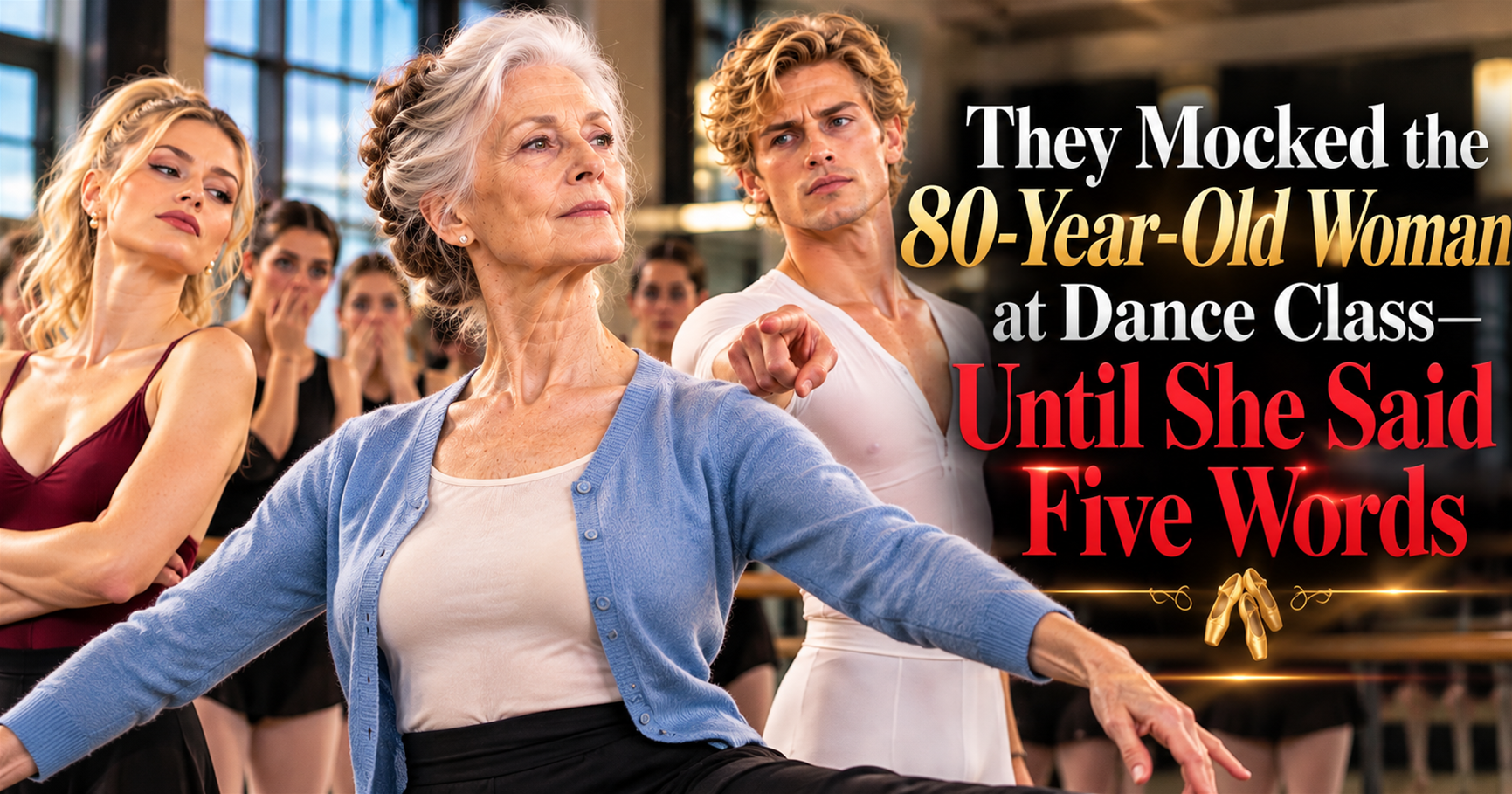
"They Mocked the 80-Year-Old Woman at Dance Class—Until She Said Five Words" Chapter 10 — THE DANCE THAT SILENCED NEW YORK
Eleanor could hear her own breathing behind the curtain.
It was not the steady breath of the young woman who had once practiced until dawn. It came slowly now, and she had learned not to fight its rhythm. Her doctor had cleared her for the adapted performance. Adrian had planned the stage so she could stop whenever she needed. A chair waited in the wings, not as a symbol of weakness but as a practical kindness.
Emily sat at the piano. Margaret stood beside her, listening for the first note. Daniel occupied the front row, his hands clasped so tightly that his knuckles had gone pale.
Vanessa stepped into the light.
“Before tonight,” she said, “I thought the greatest dancer was the person who could do the most difficult movement. Then I met a woman I was foolish enough to laugh at.”
The audience went still.
“She taught me that a movement means nothing if you don't understand why you're making it. Tonight you'll see a new work by Eleanor Whitmore. It's called The Last Winter.”
Vanessa stepped aside.
No one introduced Eleanor as a miracle. No one asked the audience to applaud her for being eighty. They were simply invited to watch a choreographer present her work.
The curtain opened.
Eleanor stood beneath a single warm light in a navy dress and soft dance shoes. The stage was bare. There was no projection of her younger face, no sentimental montage, no attempt to pretend that the past could be restored.
Emily played the first notes.
Eleanor lifted one arm.
The gesture was small enough that someone in the back row might have missed it. Then her fingers opened, and the gesture became a question. She shifted her weight from one foot to the other, placing each step with the attention of a person crossing unfamiliar ground.
Richard had taken a seat at the back of the theater. He told himself he had come to see whether the evidence display made defamatory claims. Yet his eyes never left the stage.
He recognized the structure of the opening phrase. Not because it was borrowed from his famous piece, but because he remembered the way Eleanor thought: a movement introduced, interrupted, and returned to with new meaning.
He had once called that habit too subtle for an audience.
Now the audience leaned forward.
Eleanor moved three steps toward the empty side of the stage. Her right hand reached out, then drew back. For a moment it seemed she was meeting someone who wasn't there.
Daniel felt a sharp ache in his chest. He remembered his father standing in their kitchen, inviting Eleanor to dance while dinner burned. She had laughed and told him there was no room. He had moved the chairs anyway.
Daniel had never understood why his mother sometimes looked sad when music played. Tonight he saw that joy and grief could occupy the same movement.
ADVERTISEMENT
The piano grew quieter.
Eleanor reached the passage that had troubled her for decades. In the old notebook, there had been a blank space where a difficult turn should have been. At twenty-six, she would have filled it with speed. At eighty, she chose something else.
She made a slow half-turn.
Then she stopped.
Two full beats passed without movement.
Someone in the audience shifted, then settled. The stillness was not an error. It was the center of the dance.
Eleanor raised her hand toward the empty space. The fingers trembled slightly. She allowed them to tremble. She had spent too many years apologizing for what time had changed.
The music returned.
She lowered her hand, stepped backward, and turned her face toward the light. The final phrase was no grand leap. It was an arrival. Her shoulders softened. Her feet came together. She stood upright and let the last note fade.
For a moment, nobody applauded.
Adrian, waiting in the wings, felt panic flicker through him. Had the audience misunderstood?
Then he saw the faces in the first row. A woman was crying silently. A young dancer had both hands over her mouth. Daniel had risen without realizing it.
The first applause came from Margaret. Then Emily. Then the whole theater stood.
Eleanor looked startled, almost amused. She had not been expecting the noise. She had been waiting for the quiet after the last note, the quiet in which she could finally tell herself the piece was finished.
Adrian joined her onstage but did not take her hand or raise it like a prizefighter's. He stood a respectful distance away and applauded with everyone else.
Eleanor bowed once.
At the back, Richard did not stand. He sat staring at the stage, remembering a rehearsal room with one narrow window and a young woman who had insisted the fourth movement was wrong.
He had corrected her in front of the company. She had lowered her eyes, then written the proper movement in her notebook anyway.
He had told himself for decades that he had refined her ideas into something valuable. But the dance he had just witnessed had no need of his refinement. It had reached the audience without him.
After the applause, Eleanor took the microphone only because Vanessa brought it to her.
“I was asked recently whether I wanted to dance like I did when I was twenty-six,” she said. “I don't. That woman hadn't lived my life yet.”
A ripple of gentle laughter moved through the room.
“I wanted to finish something I started. And I wanted the people who come after me to know that their work deserves their name.”
She glanced toward Adrian.
“Please don't mistake confidence for knowledge. Sometimes the person you should learn from is the person you were about to dismiss.”
The applause returned, quieter and deeper.
In the lobby, reporters gathered around Olivia's exhibition. They asked about the recording, the letter, and whether the conservatory would change its official records. Olivia answered carefully. She said the evidence supported a serious review; she did not claim a court had decided anything.
Catherine arrived from the gala, having heard that her father had disappeared. She found him near the exit, looking older than he had that morning.
“You left your own tribute,” she whispered.
Richard did not answer.
A reporter recognized him. The woman approached with a microphone, followed by a cameraman.
“Mr. Sterling, your conservatory has credited you as the sole creator of Variation No. 7 for decades. Did Eleanor Whitmore create the original work?”
Catherine reached for her father's arm. “We're not taking questions.”
But Richard was looking past the microphone. Eleanor had just emerged from backstage with Daniel, and for the first time in fifty-four years she did not look away from him.
The reporter repeated her question.
Richard remembered the young Eleanor after the first successful performance, standing outside his office with a program in her hand. She had asked him to correct one line. He had said there would be time. Every year afterward, there had been another premiere, another award, another reason not to reopen the past. He had mistaken the passing of time for proof that the matter was settled.
Richard opened his mouth.
ADVERTISEMENT
You May Also Like
-
CompletedChapter 11

I Came to Break Off Our Engagement. The Cold Commander Wouldn't Let Me Go.
Ella Bennett escaped her family's cruel scheme—and spent one unforgettable night with a man whose name she never learned. A month later, she's pregnant. With her grandmother's care held hostage, Ella travels to meet Cole Whitmore, the cold commander her family expects her to marry. She intends to end the engagement, not make him responsible for a stranger's child. Cole refuses even to meet her. He's searching for another woman, and sends money to make Ella leave. Then he sees her. Suddenly, the man who wanted her gone is begging her to stay. But Ella has already learned what promises can cost. Before she'll trust his, Cole will have to prove he wants her—not just the baby.Billionaire|Love After Marriage|Sweet Romance|Second Chance15.2k words5 0 -
CompletedChapter 11
My Stepson Bought Me a Mansion. His Birth Mother Was Furious.
Before we married, my husband promised his son from his first marriage wouldn’t disrupt our life. Then, on Thanksgiving night, a fourteen-year-old boy appeared on our doorstep, soaked through and shivering. “Could I stay here for two nights?” When I hesitated, he apologized and turned back toward the rain. I caught his wrist and let him in. I thought he needed a warm bed. Then I noticed how he watched our faces before taking food—and how quickly he offered to leave whenever his mother called. Giving him a place to stay was easy. Convincing him he deserved one would take years. Twenty years later, he bought me a mansion. His birth mother arrived demanding to know why the house belonged to me. But money wasn’t the only thing she wanted from the boy she had once let walk away.Human Nature11.9k words5 5 -
CompletedChapter 11
My Husband Swore He Never Touched Me. Then Who Got Me Pregnant?
Evelyn Hart tells her husband she’s carrying his child. Nathaniel Cross tells her he has never touched her. She remembers the night he came for her. He insists it never happened. After twenty years of loving him, Evelyn discovers that their marriage was built around a revenge she never understood. When his supposed lover dies, Evelyn becomes the woman everyone blames—and escaping him costs more than she could have imagined. Months later, blind and grieving, she meets Luke, a gentle stranger who asks before touching her and stays when she’s afraid. For the first time, Evelyn wants a future without her husband. But Luke’s hands feel familiar. His voice sometimes changes. And whenever she mentions Nathaniel, the man who makes her feel safe goes strangely silent.Billionaire|Dark Secrets|Substitute Lover|Fake Relationship14.8k words5 7 -
CompletedChapter 11
My Mafia Husband Bet on My Unborn Baby. I Made Him Pay.
Eight months pregnant, Claire Bennett discovers her mafia husband’s vasectomy records—and overhears his friends betting on who fathered her baby. Vincent isn’t shocked by their wager. He’s running it. Behind his devoted-husband image lies a calculated betrayal, and the woman he calls his sister has helped arrange every part of it. Claire quietly gathers evidence and prepares to leave. But when Vincent forces her to attend a welcome-home party, she discovers how far he will go to keep her powerless. He expects a disgraced wife begging him to stay. Instead, Claire begins taking apart everything he thought he owned—including her.Mafia|Second Chance13.6k words5 6 -
CompletedChapter 11
The Mafia Boss’s Seventh Nurse
Mara Bennett only accepts the live-in nursing job because she desperately needs money for her younger brother’s cancer treatment. Her patient is Vincent DeLuca, one of Chicago’s most feared mafia bosses—a ruthless man left badly injured after an ambush and determined to drive away anyone who tries to help him. Six nurses have already quit. Mara becomes the seventh, but she refuses to be intimidated. As Vincent slowly begins to recover, Mara discovers that someone inside his own estate has been secretly keeping him weak. Worse, the danger soon reaches her brother. Trapped between betrayal, buried family secrets, and a growing attraction neither of them is willing to admit, Mara must decide how far she is willing to go to save a man who trusts no one. And Vincent must decide whether the woman who broke every rule he gave her might be the only person he can trust with his life—and his heart.Billionaire|Mafia|Healing Romance|Dark Secrets|Plot Twist|Redemption Arc|HE11.0k words5 3 -
CompletedChapter 11
The Mafia Boss’s Secret Son
Elena Bennett loved Dante Moretti for eight years, but every time she asked about marriage, Chicago’s most powerful mafia boss gave her the same answer: he couldn’t marry her. Then an invitation arrived. Dante was marrying Victoria—Elena’s older sister. Heartbroken, Elena disappeared to Switzerland. Three weeks later, she discovered she was pregnant. For nearly three years, she raised their son, Leo, without ever telling Dante he was a father. But when her father’s death forces Elena back to Chicago, one accidental encounter at O’Hare changes everything. Leo takes one look at Dante and innocently says, “Mommy… that man looks like me.” Dante immediately realizes the truth. Now the man Elena spent years trying to forget wants answers—and a place in his son’s life. But buried inside her father’s estate is an old contract that reveals something even more devastating: Dante’s marriage to Victoria was never what Elena believed. And the real reason he refused to marry Elena may change everything she thought she knew about the man who broke her heart.Billionaire|Mafia|Mutual Pining|Dark Secrets|Plot Twist|Reunion Romance|Redemption Arc|Marriage of Convenience|Second Chance11.7k words5 10 -
CompletedChapter 11
The Little Girl Who Put a Purple Crayon Beside My Loaded Pistol
Anthony Moretti has spent decades making dangerous men obey him. Then a three-year-old girl walks into his secret meeting, places a purple crayon beside his loaded pistol, and asks to borrow him for one day. Sophia needs someone for Family Day. Her father is dead, her mother needs to work, and Anthony looks like a man who can clear his own schedule. He says yes. But his most trusted lieutenant seems strangely interested in whether he’ll keep that promise. And when an ordinary afternoon ends with a photograph of the woman Anthony believed he buried thirty-four years ago, he starts asking questions someone close to him has spent a lifetime preventing. Sophia only wanted a day at school, the swings, and strawberry ice cream. Anthony may have to dismantle the life he built to give her anything more.Maid/Nanny|Human Nature12.3k words5 12