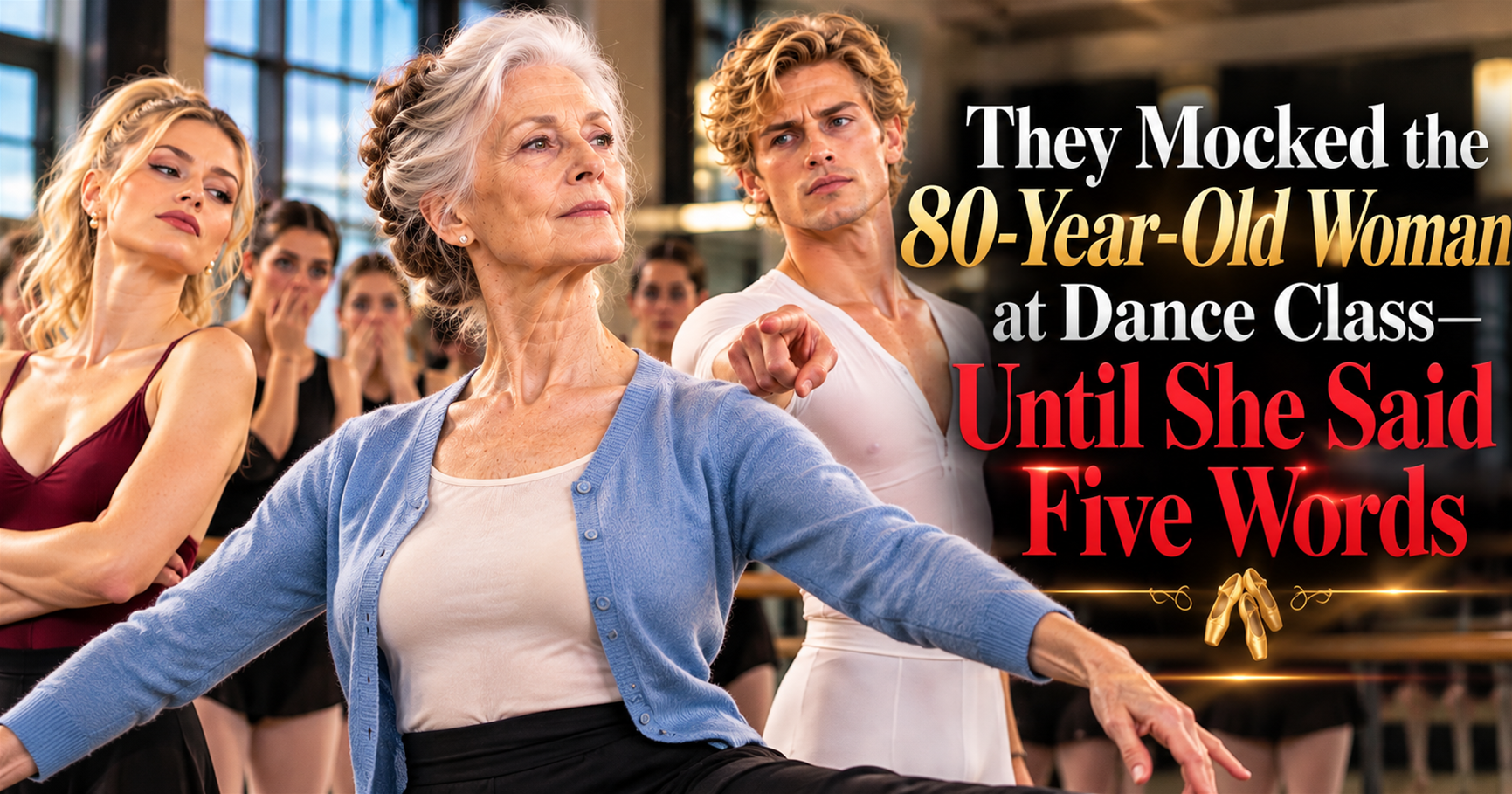
"They Mocked the 80-Year-Old Woman at Dance Class—Until She Said Five Words" Chapter 11 — HER NAME WAS ELEANOR WHITMORE
Richard Sterling did not give the reporters the confession they wanted.
He said that the creation of dance was collaborative, that memories faded, and that he welcomed a fair examination of the archives. Catherine quickly guided him out of the theater before another question could be asked.
By morning, clips of Eleanor's performance were circulating among dancers and arts writers. Some headlines celebrated an eighty-year-old woman who had returned to the stage. Others focused on the documents and the long absence of her name from the official record.
Eleanor disliked the headlines that called her a miracle.
“I took a few steps,” she told Daniel over breakfast. “People should be more surprised that I remembered the whole thing.”
Daniel smiled. “You know it was more than a few steps.”
“Yes,” she said. “It was my own work. That's the part I want them to remember.”
The review did not end overnight. An independent archival specialist compared Eleanor's notebooks with surviving rehearsal records. The audio recording was evaluated for provenance. Margaret gave a detailed account of the 1972 sessions, including what she had witnessed and what she could not remember clearly. Daniel supplied the letter from Richard, and Olivia documented the chain of custody for the materials.
Some questions remained unsettled. There were missing programs, contradictory recollections, and decades of institutional habit. But the surviving evidence established that Eleanor had made substantial original contributions to the work first known as Winter Flight. The conservatory's claim that Richard had been its sole creator could no longer be defended.
At a board meeting six weeks after the performance, Catherine read the proposed correction aloud.
“Winter Flight, later presented as Variation No. 7. Original choreography by Eleanor Whitmore, with revisions and staging by Richard Sterling.”
The room was silent.
One trustee asked whether the wording would damage the institution.
Catherine looked at the report in front of her. She thought of all the students who had memorized her father's name, and none who had heard Eleanor's.
“The record was damaged already,” she said. “We're deciding whether to repair it.”
The board approved the correction and commissioned a broader review of historical credits. The decision did not settle every possible legal question, nor did it undo the years Eleanor had lost. It did something concrete: the conservatory's official archive would finally tell a more accurate story.
Olivia called Eleanor that afternoon.
“They voted,” she said.
Eleanor was sitting by her window, watching the last leaves fall along the Upper West Side.
“Did they write my name?”
“They did.”
Eleanor closed her eyes. The silence on the line stretched so long that Olivia wondered whether the call had dropped.
“Mrs. Whitmore?”
“I'm here,” Eleanor whispered. “I just needed a moment to hear it.”
Richard issued a brief statement acknowledging that Eleanor's contributions had not been properly credited. It was not the sweeping apology Daniel had imagined, and Eleanor did not pretend it was enough to heal everything. But she refused to let the quality of Richard's remorse determine the value of her victory.
ADVERTISEMENT
“He doesn't get to decide when my story is complete,” she told her son.
Adrian, meanwhile, had been offered his old position back. The conservatory wanted to present his return as proof that the controversy had ended.
He declined the publicity campaign. Instead, he negotiated a teaching role with an explicit commitment to historical research and access for older dancers. His first workshop would be open to adults of all ages, with adaptations made according to ability rather than assumptions.
When he told Eleanor, she raised an eyebrow.
“Are you expecting a medal?”
“No,” he said. “Maybe advice.”
“Start by asking people what they can do before telling them what they can't.”
He wrote that down.
Vanessa volunteered for the workshop. Tyler helped Olivia digitize the old programs. Emily began arranging music for an intergenerational performance. Their efforts did not erase the afternoon they had laughed at Eleanor. They showed what it meant to act differently afterward.
In early December, the old West 57th Street studio opened for one final gathering before the building's renovation. The mirrors had been cleaned. The worn wooden floor still creaked near the corner where the piano had once stood.
Former students arrived with photographs and memories. A few carried canes. Some had stopped dancing decades earlier. They were welcomed without anyone asking whether they could still turn or leap.
On the wall beside the door hung a new plaque.
ELEANOR WHITMORE
DANCER AND CHOREOGRAPHER
CO-CREATOR OF WINTER FLIGHT, 1972
Below it was a sentence Eleanor had approved herself:
HER WORK WAS NEVER FORGOTTEN. ONLY HER NAME WAS MISSING.
She stood in front of it for a long time.
Daniel waited nearby, holding the coat she had insisted she didn't need. He remembered all the ordinary years in which his mother had made a life without applause: school lunches, overdue library books, hospital visits, birthdays, quiet evenings with his father. None of those years had been wasted. And still, something important had been taken from her.
“Are you happy?” he asked.
Eleanor touched the edge of the plaque. “I am.”
“You don't look surprised.”
“I always knew whose dance it was.”
Daniel laughed softly. “I wish Dad were here.”
“So do I,” she said. “He would have brought far too many flowers.”
Margaret joined them with a small bouquet. “Then these are from both of us.”
Eleanor embraced her old friend. Neither woman tried to hide her tears.
Across the room, Adrian was demonstrating the familiar fourth movement to a group of students. His left arm rose, and Eleanor watched him for several seconds.
“Adrian,” she called.
He stopped immediately. “Yes?”
“You're still lifting that arm too high.”
The room erupted in laughter.
This time, nobody was laughing at Eleanor. They were laughing with the woman who knew the movement better than anyone.
Adrian lowered his arm. “Like this?”
“A little more.”
He tried again.
“Better,” she said.
“Will you show me?”
Eleanor stepped toward him, but she did not perform the movement for the room. Instead, she studied the students' faces: curious, attentive, and willing to learn.
“First,” she said, “learn how to listen.”
Adrian nodded. Then he asked her to explain why the arm belonged where it did.
Eleanor told them about the small winter window, the light on the floor, and the feeling of reaching toward something just out of sight. As she spoke, the dancers adjusted their positions. They were no longer copying a famous man's steps. They were learning what the person who created the movement had meant.
At the end of the gathering, the lights dimmed one by one. The studio would close, the mirrors would come down, and new people would use the building for something else. Eleanor was not afraid of that change.
She had finished The Last Winter. Her name had returned to the archive. Young dancers would carry the story forward.
At the door, she looked back once at the empty floor.
Fifty-four years earlier, she had left this place believing she had been erased. Now she understood that an institution could remove a name from a program, but it could not undo the work that name had made.
Daniel offered his arm. She took it, and together they walked into the cold New York evening.
Eleanor had not come back to reclaim her youth.
She had come back to reclaim her name.
ADVERTISEMENT
You May Also Like
-
CompletedChapter 11

I Came to Break Off Our Engagement. The Cold Commander Wouldn't Let Me Go.
Ella Bennett escaped her family's cruel scheme—and spent one unforgettable night with a man whose name she never learned. A month later, she's pregnant. With her grandmother's care held hostage, Ella travels to meet Cole Whitmore, the cold commander her family expects her to marry. She intends to end the engagement, not make him responsible for a stranger's child. Cole refuses even to meet her. He's searching for another woman, and sends money to make Ella leave. Then he sees her. Suddenly, the man who wanted her gone is begging her to stay. But Ella has already learned what promises can cost. Before she'll trust his, Cole will have to prove he wants her—not just the baby.Billionaire|Love After Marriage|Sweet Romance|Second Chance15.2k words5 0 -
CompletedChapter 11
My Stepson Bought Me a Mansion. His Birth Mother Was Furious.
Before we married, my husband promised his son from his first marriage wouldn’t disrupt our life. Then, on Thanksgiving night, a fourteen-year-old boy appeared on our doorstep, soaked through and shivering. “Could I stay here for two nights?” When I hesitated, he apologized and turned back toward the rain. I caught his wrist and let him in. I thought he needed a warm bed. Then I noticed how he watched our faces before taking food—and how quickly he offered to leave whenever his mother called. Giving him a place to stay was easy. Convincing him he deserved one would take years. Twenty years later, he bought me a mansion. His birth mother arrived demanding to know why the house belonged to me. But money wasn’t the only thing she wanted from the boy she had once let walk away.Human Nature11.9k words5 5 -
CompletedChapter 11
My Husband Swore He Never Touched Me. Then Who Got Me Pregnant?
Evelyn Hart tells her husband she’s carrying his child. Nathaniel Cross tells her he has never touched her. She remembers the night he came for her. He insists it never happened. After twenty years of loving him, Evelyn discovers that their marriage was built around a revenge she never understood. When his supposed lover dies, Evelyn becomes the woman everyone blames—and escaping him costs more than she could have imagined. Months later, blind and grieving, she meets Luke, a gentle stranger who asks before touching her and stays when she’s afraid. For the first time, Evelyn wants a future without her husband. But Luke’s hands feel familiar. His voice sometimes changes. And whenever she mentions Nathaniel, the man who makes her feel safe goes strangely silent.Billionaire|Dark Secrets|Substitute Lover|Fake Relationship14.8k words5 7 -
CompletedChapter 11
My Mafia Husband Bet on My Unborn Baby. I Made Him Pay.
Eight months pregnant, Claire Bennett discovers her mafia husband’s vasectomy records—and overhears his friends betting on who fathered her baby. Vincent isn’t shocked by their wager. He’s running it. Behind his devoted-husband image lies a calculated betrayal, and the woman he calls his sister has helped arrange every part of it. Claire quietly gathers evidence and prepares to leave. But when Vincent forces her to attend a welcome-home party, she discovers how far he will go to keep her powerless. He expects a disgraced wife begging him to stay. Instead, Claire begins taking apart everything he thought he owned—including her.Mafia|Second Chance13.6k words5 6 -
CompletedChapter 11
The Mafia Boss’s Seventh Nurse
Mara Bennett only accepts the live-in nursing job because she desperately needs money for her younger brother’s cancer treatment. Her patient is Vincent DeLuca, one of Chicago’s most feared mafia bosses—a ruthless man left badly injured after an ambush and determined to drive away anyone who tries to help him. Six nurses have already quit. Mara becomes the seventh, but she refuses to be intimidated. As Vincent slowly begins to recover, Mara discovers that someone inside his own estate has been secretly keeping him weak. Worse, the danger soon reaches her brother. Trapped between betrayal, buried family secrets, and a growing attraction neither of them is willing to admit, Mara must decide how far she is willing to go to save a man who trusts no one. And Vincent must decide whether the woman who broke every rule he gave her might be the only person he can trust with his life—and his heart.Billionaire|Mafia|Healing Romance|Dark Secrets|Plot Twist|Redemption Arc|HE11.0k words5 3 -
CompletedChapter 11
The Mafia Boss’s Secret Son
Elena Bennett loved Dante Moretti for eight years, but every time she asked about marriage, Chicago’s most powerful mafia boss gave her the same answer: he couldn’t marry her. Then an invitation arrived. Dante was marrying Victoria—Elena’s older sister. Heartbroken, Elena disappeared to Switzerland. Three weeks later, she discovered she was pregnant. For nearly three years, she raised their son, Leo, without ever telling Dante he was a father. But when her father’s death forces Elena back to Chicago, one accidental encounter at O’Hare changes everything. Leo takes one look at Dante and innocently says, “Mommy… that man looks like me.” Dante immediately realizes the truth. Now the man Elena spent years trying to forget wants answers—and a place in his son’s life. But buried inside her father’s estate is an old contract that reveals something even more devastating: Dante’s marriage to Victoria was never what Elena believed. And the real reason he refused to marry Elena may change everything she thought she knew about the man who broke her heart.Billionaire|Mafia|Mutual Pining|Dark Secrets|Plot Twist|Reunion Romance|Redemption Arc|Marriage of Convenience|Second Chance11.7k words5 10 -
CompletedChapter 11
The Little Girl Who Put a Purple Crayon Beside My Loaded Pistol
Anthony Moretti has spent decades making dangerous men obey him. Then a three-year-old girl walks into his secret meeting, places a purple crayon beside his loaded pistol, and asks to borrow him for one day. Sophia needs someone for Family Day. Her father is dead, her mother needs to work, and Anthony looks like a man who can clear his own schedule. He says yes. But his most trusted lieutenant seems strangely interested in whether he’ll keep that promise. And when an ordinary afternoon ends with a photograph of the woman Anthony believed he buried thirty-four years ago, he starts asking questions someone close to him has spent a lifetime preventing. Sophia only wanted a day at school, the swings, and strawberry ice cream. Anthony may have to dismantle the life he built to give her anything more.Maid/Nanny|Human Nature12.3k words5 12