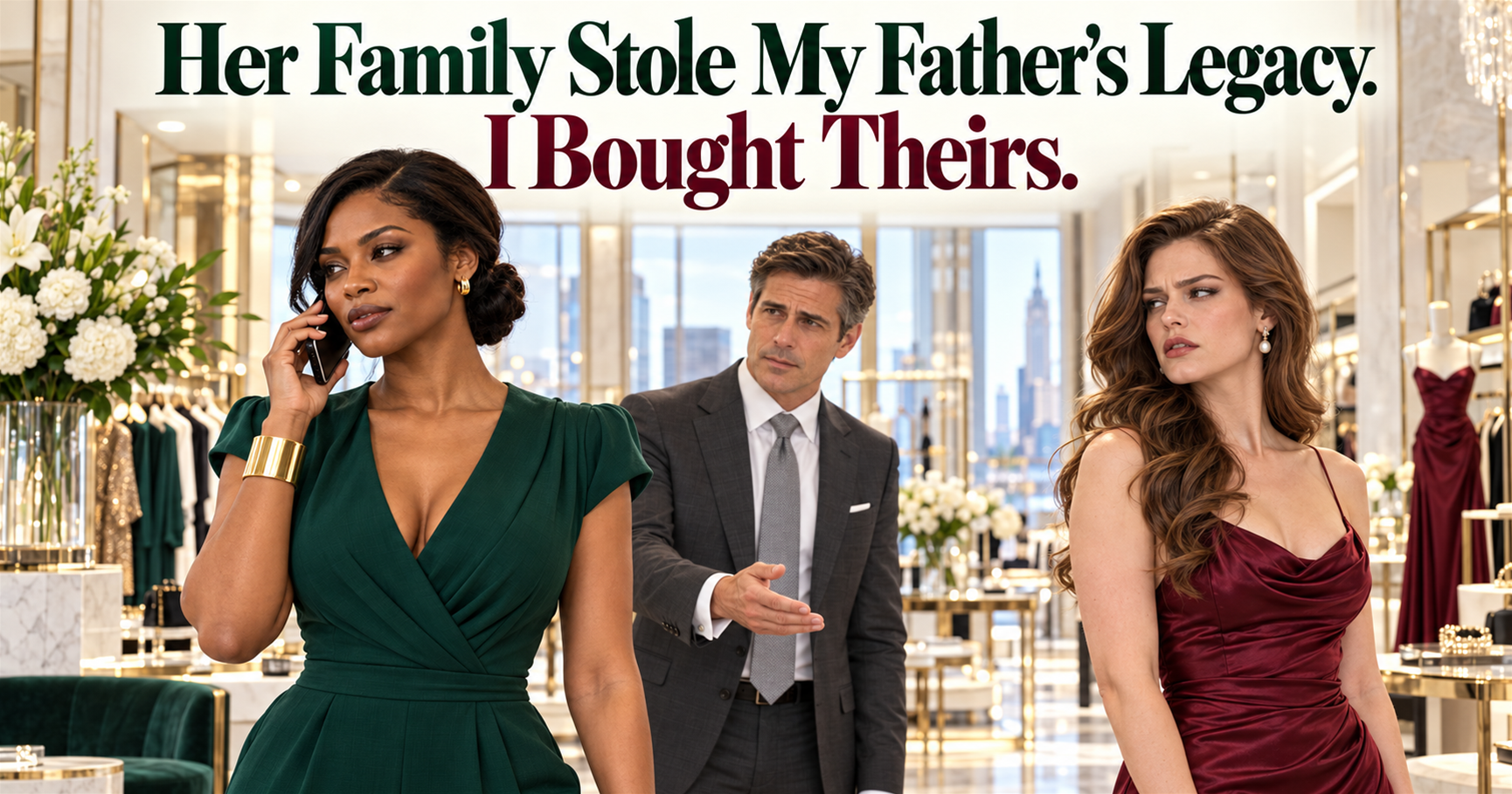
"Her Family Stole My Father’s Legacy. I Bought Theirs" Chapter 9
Say His Name
We held the presentation seven weeks after the slap.
There were no champagne towers.
I hadn't banned champagne. I simply couldn't bear another room arranged to look as though nothing unpleasant had ever happened inside it.
The central display held six garments. Some were archival pieces borrowed for the evening. Others had been carefully reconstructed from the documented patterns, with every new hand credited alongside the original designer.
The ivory coat stood nearest the entrance.
Beneath it was a photograph of my father.
Mom arrived early.
She wore a midnight-blue dress Helen had altered for her, with a narrow neckline and sleeves that showed her wrists. Her hair was pinned back, and she carried an envelope in her handbag as carefully as another woman might carry jewelry.
"What have you brought?" I asked.
"You'll see later."
She looked at my emerald jumpsuit.
"You wore it again."
"I like it."
She touched the gold bracelet she'd given me when I started my company.
"Good."
We walked toward the coat together.
This time, the plaque read:
Original design by Daniel Morgan, 1996.
Developed and produced with the Delacroix workroom.
Below it, a longer note explained the corrected attribution and the records supporting it.
Mom stopped so suddenly that I took another step before realizing she wasn't beside me.
She stood with one hand pressed flat against her chest.
"Ruth?" Helen said softly from behind us.
Mom shook her head, not in refusal, but because words were more than she could manage.
I went back and took her arm.
For almost a minute, the three of us stood in front of my father's name.
Then Mom reached into her bag for a tissue.
"He would say the light was too harsh on the lining," she said.
Helen laughed through her tears.
"He certainly would."
The guests began arriving at six.
We had invited clients, fashion journalists, former workroom staff, suppliers, and the employees whose hands kept the house running. Nobody had to hover near a wall waiting to be useful. Lucy showed her younger sister the main salon. An embroidery assistant introduced her parents to Naomi.
Henry came at half past six.
He had been invited to hear the correction, not to approve it. Elaine had provided his representative with the material in advance. Any response he wished to offer could be considered against the same records available to everyone else.
He wore a dark suit and brought no family.
I met him near the door.
"I didn't expect you to come," I said.
"You made it difficult not to."
"Nobody required you to be here."
He looked over my shoulder at the photograph.
I wondered whether he recognized Dad's smile. Whether he had ever seen it directed at him before a contract became an excuse to take what wasn't freely offered.
Those were questions I couldn't answer.
I didn't ask them.
ADVERTISEMENT
At seven, I stood beside the display without climbing onto a stage.
I had written a speech. It was four pages long, carefully reasoned, and entirely wrong for what I wanted to say.
I left it in my office.
"Thank you for coming," I began. "Tonight we are correcting part of this house's history."
I heard a chair shift. Mom sat in the front row, her hands folded tightly in her lap.
"The 1996 collection helped establish the business many of you know. Six of its designs began with Daniel Morgan, a tailor who worked in Queens. His contribution was not properly credited. Correspondence sent to him denied that his submissions had been used. The workroom records and the garments themselves show otherwise."
I paused, making myself breathe.
"He was my father."
A few people looked toward Mom.
I stayed with her eyes until I could continue.
"An independent specialist has reviewed the surviving material. The corrected information will remain in our archive and accompany these designs. It will not disappear when this event ends."
Naomi explained the records briefly. Helen described the first sample fitting and the way Dad had adjusted a sleeve without taking the coat off the model.
Then we opened the display for questions.
I stepped back beside Mom, relieved to have finished speaking without losing my voice.
Henry stood near the second row.
A journalist approached him with a notebook.
I was close enough to hear.
"Mr. Delacroix, do you accept the attribution?"
He looked at her, then at the coat.
"Daniel made a contribution to the collection."
The old narrowing of the truth. The smallest sentence he thought might get him through a room.
I turned toward him.
"Which contribution, Henry?"
Several people fell quiet.
He watched me for a long moment.
I did not fill it for him.
Finally, he looked at the display.
"He designed the coat," he said.
The words were plain. Almost disappointingly small for what they carried.
Mom made a sound beside me.
I took her hand.
The journalist wrote the sentence down.
Nobody applauded Henry for saying it. The conversation moved on, and he was left standing beneath the work he had spent thirty years claiming through his family's name.
He left before eight.
I watched him pass the new plaque on his way to the door.
For once, there was nothing of my father's he could take with him.
Later, a former customer approached Mom and asked whether she had known Daniel.
"I was his wife," she said.
"I remember his shop. He made my husband's wedding suit. My husband still refuses to let it go."
Mom smiled.
I stood a little apart and let her have the conversation.
The photographer asked for a picture near the coat. Mom almost refused, then beckoned Helen over and pulled me to her other side.
"He'd complain that we're blocking the good shoulder," I whispered.
"Let him complain," she whispered back.
When the guests had gone, Mom finally opened the envelope from her handbag.
Inside was the photograph from the old shop: Dad with his tape measure, me in my paper crown.
She placed it beside the new plaque.
"There," she said.
We stood in the quiet boutique, looking at a man who had once believed this house might change his life.
"I wish he could see it," I said.
Mom slipped an arm around my waist.
"So do I."
She didn't tell me he was watching. She didn't ask me to turn the ache into gratitude.
We missed him together.
And this time, his name was in the room with us.
ADVERTISEMENT
You May Also Like
-
CompletedChapter 10

My Daughter Proposed to the Man Everyone Feared
My four-year-old daughter walked up to the man everyone feared and announced she was going to marry him. I thought she'd just cost me my job. Then Alessandro Romano laughed. The wealthy widower hadn't welcomed a child into his silent mansion in years. But Sophie wasn't afraid of his tattoos, his sharp orders, or the men who went quiet whenever he entered a room. She only noticed his sad eyes. So she gave him her most precious possession: a little gray pebble. He kept it. I should have been thinking about keeping my job. Instead, I started noticing the meals he saved for me, the stories he read to my daughter, and the way he said my name when no one else was listening. Then Sophie recognized a woman in an old photograph. “Mommy, why does he have Grandma’s picture?” My mother had never mentioned Alessandro Romano. And whatever connected our families had been buried long before we arrived.Billionaire|Dark Secrets|Glow-Up11.5k words5 0 -
CompletedChapter 11
I Took Three Bullets for the Mafia Boss’s Son. He Called Me His Wife.
Sarah Miller knew every server working that night. The man pulling a gun from his jacket wasn’t one of them. And he wasn’t aiming at notorious crime boss Lorenzo Caruso. He was aiming at Lorenzo’s six-year-old son. Sarah ran. Three bullets later, she woke in a hospital with a shattered routine, a terrified younger brother, and a dangerous man who refused to leave her unprotected. She wanted to go home. Lorenzo wanted her somewhere his enemies couldn’t reach. Then his family tried to send her away. “Sarah is my wife.” There had been no proposal. No wedding. Not even a warning. Now Sarah wears a borrowed ring in a house full of secrets, beside a man whose tenderness unsettles her more than his reputation. His little boy begs her not to disappear. His enemies want to know what she saw. And Lorenzo is beginning to want far more than a chance to repay her.Maid/Nanny|Dark Secrets|Glow-Up12.5k words5 0 -
CompletedChapter 11
I Owned the Hotel That Turned My Daughter Away
Ethan Vance arrives at a luxury hotel carrying his sleeping daughter and a crushed bouquet of roses for his late wife. The receptionists see his wet jacket and decide he doesn’t belong. They refuse to help. They dismiss the housekeeper who offers his daughter a blanket. They have no idea he owns the hotel. One phone call exposes their mistake. But before Ethan can take his daughter upstairs, the manager produces an envelope in his dead wife’s handwriting—addressed to Ethan and the housekeeper he has just met. He came to remember the woman he loved. Now he must discover the part of her life she never shared.Billionaire|Human Nature|Dark Secrets11.7k words5 0 -
CompletedChapter 11
My Brother Sold Me to the Alpha Who Chose Me
For sixteen years, Elara Vale has paid for a crime she was told she committed at six. Her wolf is bound. Her brother rules their pack. And the mate she once hoped would save her rejected her in the basement where she slept. Then Alpha Ronan Thorne arrives to negotiate an alliance. He is powerful, crimson-eyed, and feared by men who have never feared anything. Elara expects him to believe what everyone else believes about her. Instead, he stops her brother’s raised hand. Then he changes the terms of the deal. Elara leaves with half a bag of belongings, convinced she has simply been traded to another master—until Ronan reads her the contract. She is to become his wife. But learning to trust his touch may be harder than surviving his enemies. Something inside Elara is beginning to wake, and the people who bound her wolf are determined to keep what they stole. Her brother thought he knew exactly what he was selling. Ronan is about to discover who he chose.Werewolves|Glow-Up11.7k words5 0 -
CompletedChapter 11
Sold to the Sleeping Alpha Prince
My father traded me for a canceled debt. My boyfriend sent me away so he could marry my stepsister. Neither expected me to survive the sleeping prince’s wolf. Prince Lucien Voss has been unconscious for months. His parents need an heir, but his deadly spirit wolf refuses every woman brought to his bedside. Until me. The beast everyone fears presses its muzzle into my trembling hand—and suddenly, the girl nobody wanted becomes the Luna Princess. Now I sleep beside a man who cannot answer me. I change his shirts, tend his scars, and whisper things I would never confess to anyone awake. Then my former lover follows me into the palace, determined to use my new position to claim a kingdom. I escape him and stumble back to the prince’s bed. A warm hand closes around my wrist. The sleeping prince opens his eyes. “Who touched you?”Werewolves|Glow-Up|Sweet Romance11.7k words5 0 -
CompletedChapter 10
The Mafia Boss Saw the Bruises I Hid.
After twelve hours caring for everyone but herself, nurse Hannah Brooks collapses on a rain-soaked Chicago sidewalk. The stranger who catches her is gentle—until her sleeve slips and he sees the bruises. Damen Moretti is a man people know better than to cross. Hannah should be frightened of his attention. Instead, when her controlling ex refuses to let her go, Damen’s home becomes the first place she can sleep without listening for footsteps. Behind closed doors, the ruthless mafia boss remembers how she takes her coffee, lets her scold him over his injuries, and looks at her as though wanting her is the one thing he cannot control. But his protection comes with enemies, and his tenderness conceals a grief he has never explained. As Hannah begins to trust him with her heart, Damen must decide how much of his carefully built empire he will risk to keep her in his arms.Mafia|Age Gap|Glow-Up|Sweet Romance12.7k words5 8 -
CompletedChapter 10
My Daughter Asked My Billionaire Boss to Be Her Daddy.
For two years, I kept my head down and did my job. Then my six-year-old daughter walked into Adrian Kane’s private corridor and asked Manhattan’s most feared billionaire to be her daddy. Her reason broke my heart. His response changed everything. Adrian rules a world where powerful men obey him without question. Yet my daughter critiques his pancakes, steals his fries, and somehow makes him laugh. I should be careful. He is my boss, his family is dangerous, and Mia is already saving him a seat at our table. But then he asks to take me to dinner—without my daughter. And I begin to wonder how long he has been looking at me that way.Billionaire|Age Gap|Glow-Up|Sweet Romance9.9k words5 5 -
CompletedChapter 10
They Thought I Couldn’t Afford to Quit.
For nine years, Catherine “Cat” Bennett kept the clients happy, the projects moving, and her shrinking team afloat. Then HR offered her a sixty percent pay cut. Same accounts. Same responsibilities. Less than half the salary. Her boss knew she was a single mother. He knew she had a mortgage and a son who needed asthma medication. He expected her to sign. Cat cried in her car instead. Then a former colleague called. Their biggest competitor had been trying to recruit her for years—and its CEO wanted a meeting. By the time Cat returned to give HR her answer, she had a signed offer in her bag. Her boss had prepared for an employee who couldn’t afford to leave. He hadn’t prepared for what losing her would cost.Dark Humor|Human Nature|Age Gap9.7k words5 4 -
CompletedChapter 10
The Barefoot Boy Who Helped My Daughter Stand.
For three years, Nathaniel Hayes has searched for a way to help his daughter walk again. Then, at an elegant family celebration, nine-year-old Lily takes the hand of a barefoot boy—and rises from her wheelchair. Nathaniel is stunned. Lily’s grandfather wants the boy removed. But ten-year-old Noah Bennett hasn’t come looking for money or a miracle. He recognizes something in Lily that the adults around her haven’t understood. As an unlikely friendship brings laughter back into the house, Lily begins talking about the accident that killed her mother. And someone in the family has a reason to wish she’d stayed silent.Billionaire|Human Nature|Dark Secrets10.2k words5 3 -
CompletedChapter 10
My Online Boyfriend Is My Sharp-Tongued Roommate
My roommate thinks I’m desperate to seduce him. My online boyfriend thinks I’m adorable. One makes me cry. The other sends me money, spoils me with gifts, and patiently listens while I complain about the arrogant jerk I live with. Dating Z started as a way to pay my college bills. A cheap wig, a dress, and one viral video had given him the wrong impression. I never expected to fall for him. Now I want to meet the man behind the messages. But my roommate has started acting strangely. He apologizes. Brings me my favorite food. Blushes when I get too close. And when I send Z a teasing photo, a chair crashes across our room. Apparently, my boyfriend has a secret, too.Dark Secrets|Glow-Up|Second Chance5.8k words5 5