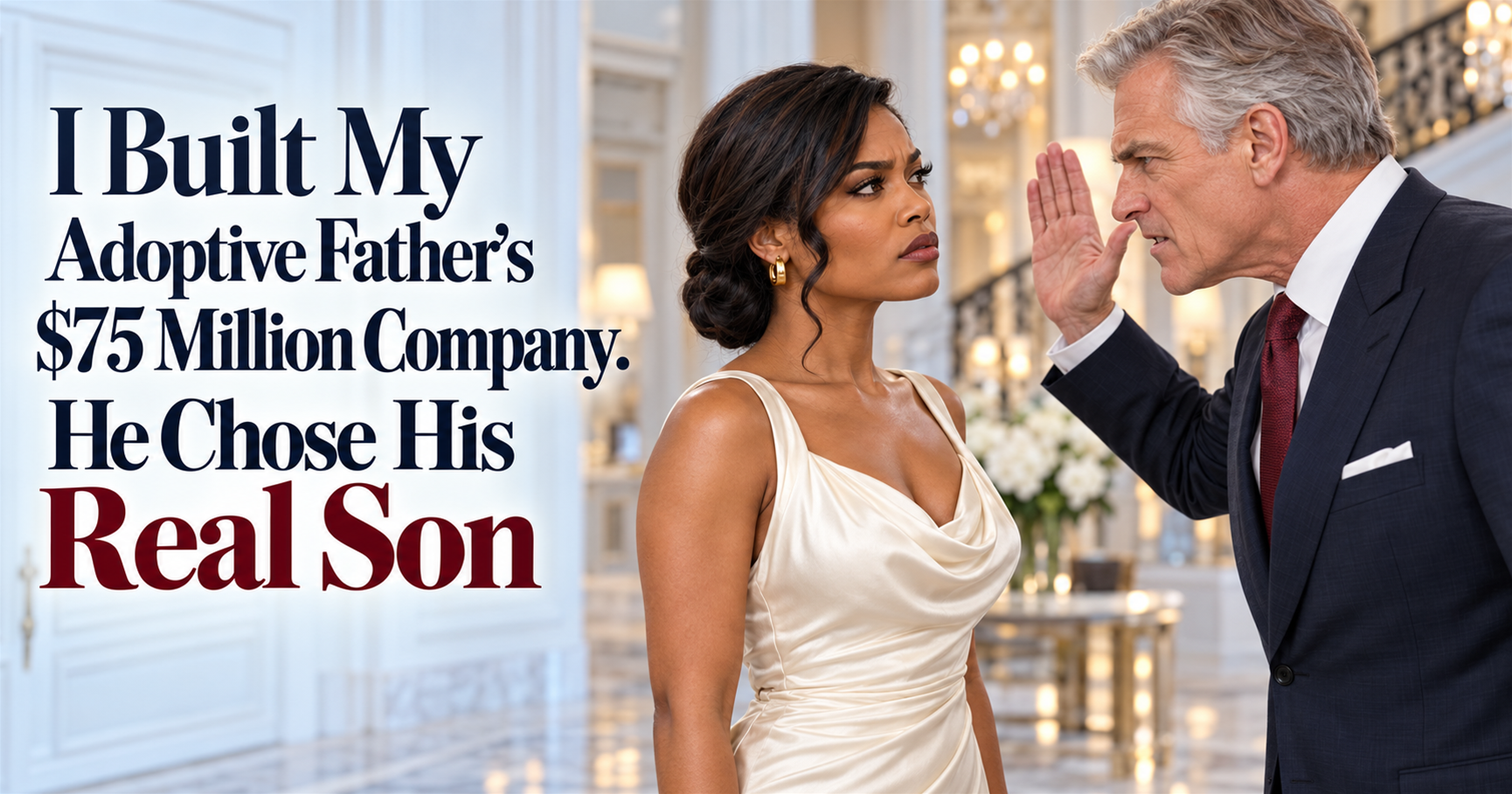
"I Built My Adoptive Father’s $75 Million Company. He Chose His Real Son" Chapter 8
The Girl in the Photograph
The reporter's deadline was six o'clock.
It was four twenty-three.
I read the questions standing outside the coffee shop while people moved around me. A man brushed my shoulder and apologized. I stepped closer to the wall.
The reporter, Simone Grant, wrote for a regional business publication. Her questions quoted family sources who described an elderly founder blindsided by the daughter he had welcomed into his home.
There was a question about my shares. There was a question about Dad's health. There was a question about whether years of family generosity had given me an unfair advantage in negotiations.
There was no question about the rescue funding or the company's condition when I joined.
I called Marissa on my way upstairs.
"We can provide a clear preliminary response now," she said. "Then offer the relevant records after we've reviewed what can be shared. Don't let their deadline pressure you into handing over unredacted customer information."
We sent confirmation that the transfers were completed, that Dad had signed with advice available to him, and that the board had rejected the proposed succession. We offered a documented interview and asked for time to assemble the supporting materials.
Simone acknowledged receipt. Her editor was proceeding that evening.
The headline appeared at seven twelve.
Family Rift at Harper & Company Raises Questions About Founder’s Legacy.
My childhood photograph sat above the first paragraph.
Dad had given an interview. He spoke about the day they brought me home, the first time I called him Dad, the sacrifices they had made so I could have opportunities.
Then he described himself as saddened by recent events and worried that the company had lost its family values.
Ethan said he had hoped for a peaceful transition.
My response appeared near the bottom. It was accurate, but beside the photograph and the story of my adoption, it read like a legal defense of a crime nobody had quite named.
I kept scrolling back to the picture.
I remembered the photographer asking me to stand closer. Dad had put his arm around me, and I had leaned into him without hesitation. I had not known that a photograph could outlive the promise I thought it recorded.
I had loved that rabbit. Its name was Button. Mom had let me choose it on the way to their house because I had arrived with almost nothing of my own.
That memory had belonged to me too.
Now it was an illustration in their argument that I should surrender.
The comments came quickly. Some readers asked why the company's performance was barely discussed. Others called me ungrateful. A few saw a Black woman beside a white family and filled in their own reasons I should have been thankful.
I closed the page when someone suggested I should remember where they found me.
My phone rang. Mom.
I answered because I wanted to ask one question.
ADVERTISEMENT
"Did you give them the photograph?"
"Your father wanted people to understand our history."
"Did you give it to them?"
"Yes."
I sat down on the edge of my bed.
"You could have asked me."
"It's a family photograph."
"It's my childhood."
"And ours. You can't erase what we did for you because you're angry."
I looked at the little gold earrings on my dresser. I still hadn't put them away.
"I haven't erased anything. You've put a picture of me as a child beside an accusation you know isn't true."
"Your father didn't accuse you of anything."
"He described the transfers as though he hadn't understood them. You were there when he told me what terms he was willing to accept."
She was quiet.
"He feels betrayed," she said finally.
"Then he can say that. He doesn't get to rewrite what he signed."
"Please think before you respond publicly."
"I wish you'd thought before you gave them my photograph."
I ended the call.
For a while, I sat without moving. Then I called Nia and asked if I could come to her studio.
She was mounting fabric panels for a hotel installation. I held one corner while she fixed the other, and for several minutes we talked about nothing except whether it hung straight.
Then she handed me a bottle of water.
"I saw the article," she said.
"Did I sound guilty?"
"You sounded like someone answering questions they hadn't bothered to ask your father."
I rubbed at a spot of adhesive on my thumb.
"There were good days. I don't want to pretend there weren't."
"You don't have to."
"They'll say that's what I'm doing."
"What do you want people to know?"
I looked around her studio: invoices, samples, half-finished work that belonged to her. Nobody could turn her childhood into a condition on the door.
"What actually happened."
"Then tell them that. You don't have to prove the whole family was terrible before you're allowed to defend yourself."
The next morning, I met with Marissa, Paul, and Claire. We assembled only records relevant to the claims: completed transfers, dated correspondence, the rescue funding, and the board's current decision. Commercially sensitive material was removed or summarized where appropriate.
I called Simone.
"You offered to review documentation," I said. "I'd like you to do that. I also want an interview long enough to answer more than whether I loved my parents."
"I can make time this afternoon."
"There are people who worked through those years. You can speak to them independently. Ask them what I did, and ask what my father did. I'm not asking you to leave out his contribution."
She paused. "Your father may not like where this goes."
Through the boardroom glass, I could see Paul speaking to a payroll specialist. The office was filling. People needed us to get back to work.
"I understand."
"Are you comfortable having the funding history examined? It won't only be his decisions under scrutiny."
"Yes. Ask me about mine too."
She set a time.
After the call, Marissa asked whether I wanted a few more hours before the interview.
I thought about eight-year-old me, clutching Button because I had been told he was mine to keep.
"No," I said. "I'm ready to answer."
ADVERTISEMENT
You May Also Like
-
CompletedChapter 10

She Fired Me Before a $950 Million Deal, The Patent Was Mine
Maya Perry spent six years helping build a company that now wanted to erase her. Minutes before a $950 million acquisition, her CEO fires her in front of the buyers. Security waits by the doors. Another executive stands beside a presentation stripped of Maya’s name. They expect the Black engineer they kept out of the spotlight to leave quietly. Instead, Maya asks one question. “Has your team verified that Blackidge owns the foundational Cascade Shield patent?” The buyer puts down his pen. Because the patent is hers—and Maya never signed it away. Now the executives who wanted her gone need her signature. But as their offers turn into threats, Maya discovers that stealing her work may be the least dangerous thing they’ve done.Dark Humor|Human Nature|Dark Secrets|Glow-Up9.8k words5 0 -
CompletedChapter 10
Arrogant CEO's Wife Grabs My VIP Seat at a Gala — So I Canceled Their $2.9B Investment
Addison Bishop has a verified invitation, her name on the place card, and every right to sit at the gala’s VIP table. But the CEO’s wife takes one look at the quietly dressed Black woman and decides she doesn’t belong. Vivienne Kincaid crushes Addison’s name card, claims her seat, and orders security to remove her. Around them, wealthy guests watch without intervening—until a terrified executive rushes across the ballroom. The woman they just humiliated holds the final approval for their $2.9 billion investment. Now Vivienne’s husband wants a private conversation. His lawyers want to contain the damage. And Addison wants answers. Because the more they try to explain away what happened at that table, the more they reveal about the company she was supposed to trust.Human Nature|Dark Secrets|Glow-Up10.5k words5 0 -
CompletedChapter 10
He Fired Me from My Father's Company, I Came Back as His Boss
Elena Bennett had just delivered her department’s strongest quarter in three years when her CEO fired her in front of the entire management team. Her replacement was already sitting at the table—with her proposal under his name. Martin Reed said she lacked leadership. He ordered her to surrender her badge and had security escort her out of the company her father built. For years, Elena had watched her work earn other people promotions. As a Black woman in rooms where her confidence was called an attitude problem, she had learned to choose her battles. This time, she chose to stop asking for recognition. Two weeks earlier, her father’s trust had given her control of ninety percent of the company’s voting power. Martin thought he had dismissed an employee. When Elena returned and took the seat at the head of the boardroom table, he ordered someone to call security. The company secretary looked at Elena instead.Billionaire|Dark Secrets|Glow-Up10.5k words5 0 -
CompletedChapter 11
My “Straight” Roommate Keeps Sabotaging My Dates
My roommate is straight. He’s told me often enough. He also holds my hand, dries my hair, and treats every man I like as a personal threat. Cole Bennett is the campus basketball captain, my best friend, and one of the few people who understands my sign language. When I finally meet a cute guy, asking Cole to help us communicate seems like a brilliant idea. Until he starts changing what I say. A dinner invitation becomes an excuse to leave. My movie date gets interrupted by a barrage of messages—and Cole himself, waiting outside with my favorite drink. He calls it looking out for me. Then I ask him to translate a confession. Apparently, there are limits to how helpful my “straight” roommate is willing to be.Dark Secrets|Glow-Up|Sweet Romance9.6k words5 0 -
CompletedChapter 10
My Shy Roommate Wasn’t So Innocent After All
My roommate blushes when I look at him, brings me breakfast, and thinks I haven’t noticed the way he stares. Of course I’ve noticed. Owen Carter is six feet four of muscle, good manners, and terrible excuses for avoiding eye contact. Getting him into my bed takes a little creativity. Getting him to admit he wants me takes considerably more. I’m happy to help. What starts with teasing turns into something harder to control. I get jealous. He gets brave. And when my father tries to pull us apart, the shy boy who can barely hold my gaze becomes the man who won’t let anyone hurt me. I thought I knew exactly what I was doing when I made my roommate fall for me. Now I’m beginning to wonder how much he’s been holding back.Dark Secrets|Sweet Romance9.7k words5 0 -
CompletedChapter 10
He Fired Me as “Dead Weight.” Then His Company Needed My Permission to Run
For nearly nine years, Emma Langford helped keep Nexora Systems running. The new CEO needed nineteen days to decide she was “dead weight.” A brilliant Black systems architect, Emma was used to having her warnings dismissed and her ideas praised only after someone else repeated them. But being escorted out with her belongings in a cardboard box still hurt. Then a reminder appeared on her phone. The company’s core service agreement was about to expire. The business that owned the service was hers. Emma sent the notice. She offered a temporary extension. The CEO refused to approve it. By Monday morning, he was calling her. He wanted his employee back. Emma was ready to discuss whether she wanted him as a client.Dark Secrets|Glow-Up10.0k words5 0