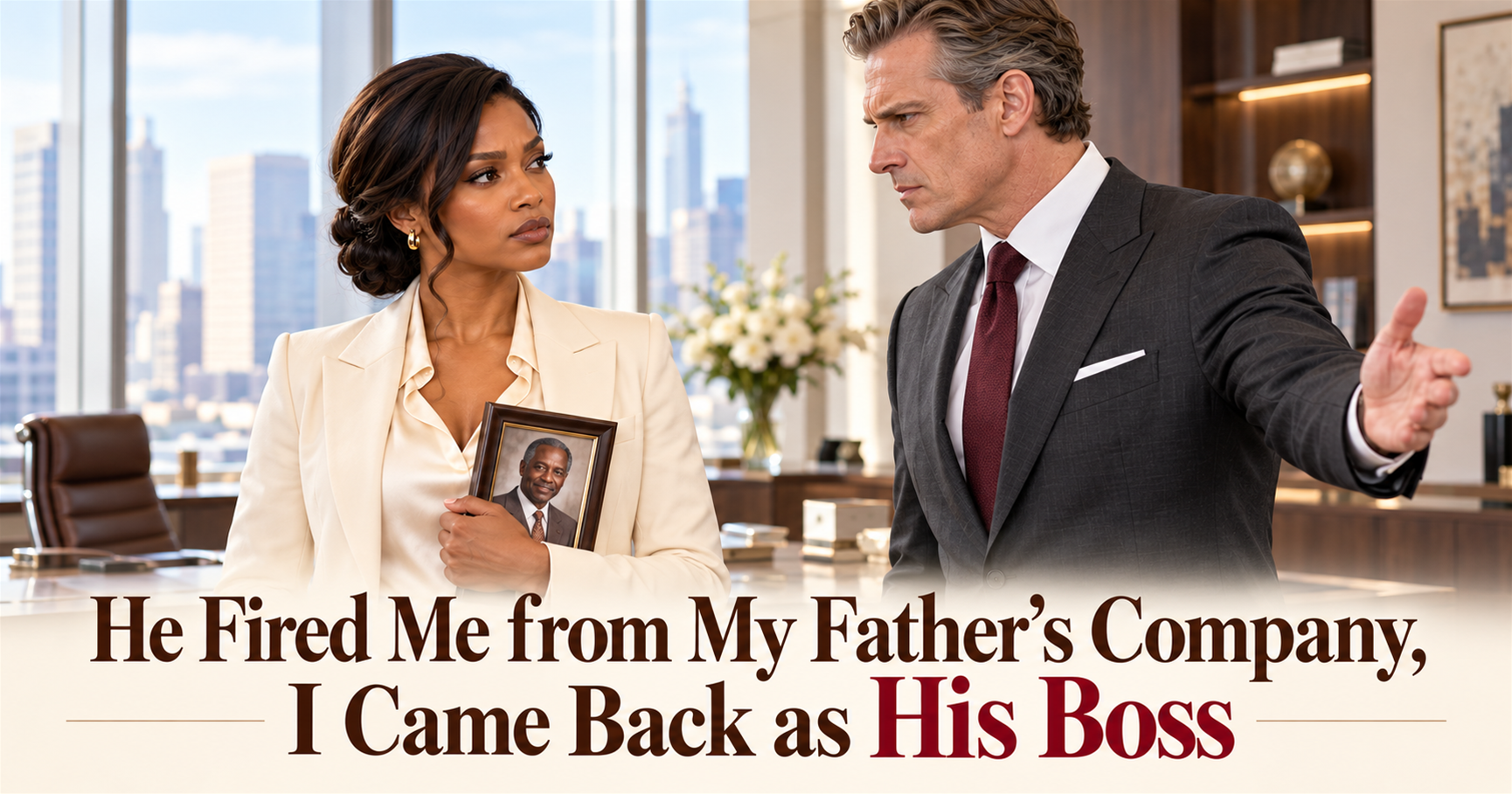
"He Fired Me from My Father's Company, I Came Back as His Boss" Chapter 8
Return Your Badge
Martin was already in the small conference room when I arrived. He had chosen a chair beside the window instead of the head of the table.
A week earlier, I might have mistaken that for humility.
He stood when I entered.
"Thank you for making time."
"You asked for fifteen minutes."
I sat across from him and opened my notebook.
He placed a draft announcement between us. It described his planned departure to pursue new opportunities after a successful period of organizational development.
I read it without touching it.
"That's the statement you want released?"
"It protects the business from unnecessary speculation."
"It also says you chose to leave."
"I'm willing to resign. That should be worth something."
"What are you asking for?"
He named an additional payment, a recommendation, and a commitment that the internal review findings wouldn't affect how the company described his leadership to prospective employers.
He had prepared his exit more carefully than he had prepared mine.
"Your existing contractual matters will be handled by the appropriate people," I said. "I won't promise an inaccurate reference or approve that announcement."
His polite expression slipped.
"What do you gain by destroying my reputation?"
"I'm not writing your reputation. We're deciding what this company will say and what decisions it will make based on its records."
"You could end this quietly."
I thought about the meeting where he had fired me. The nameplate beneath Grant's folder. Dalton studying his papers. Aaron waiting outside my office while I packed the photograph.
"You had a chance to treat me with basic dignity," I said. "You decided you didn't need to. I won't give you a false account of the last four years because you've discovered that dignity matters when you're the one leaving."
He leaned back, staring at me as if he was trying to locate the woman who had once rewritten his reports at ten at night.
"I made one bad personnel decision."
"You made a series of decisions. The review is about those decisions."
"You want me to beg?"
"I want you to stop negotiating as if I owe you a rescue."
The sentence left us both quiet.
I had never said anything like it to him. I had thought many versions of it, usually while driving home after agreeing to something I resented.
He looked older in the morning light. I didn't enjoy that. I enjoyed the fact that his displeasure no longer dictated what I could say.
At eight-forty-three, I closed my notebook.
"The meeting begins at nine. You're entitled to respond to the completed findings there."
He didn't offer his hand when I stood.
In the boardroom, Ruth distributed the final pack. The finance reconciliation confirmed that the milestones attributed to Martin's intervention matched the department projects already identified. The original service reports and their revisions established which warnings had been softened before reaching directors.
ADVERTISEMENT
The personnel timeline contained the dates of Grant's appointment discussions, my dismissal, and the contradictory descriptions sent afterward.
Martin challenged the interpretation. He didn't supply a different sequence.
Priya asked whether he accepted that he had described consultations that hadn't happened.
"I accept that communication could have been handled better," he said.
Leonard closed his folder. "That answer is part of the difficulty."
Martin was given time to make his response. I listened to it all. He listed his years of service, invoked market pressure, and said every executive depended on work performed by others.
Nobody disputed that last point. The issue was what he had claimed, concealed, and done with the authority he held.
When Ruth asked him to step outside for the directors' deliberation, he looked at Dalton.
Dalton held the door open.
The discussion after he left was shorter than I expected. Questions remained about payments and the future design of executive incentives. Those could be resolved separately. The directors had enough to decide who should lead the company.
They voted unanimously to remove Martin as chief executive.
Then I left the room while the other directors considered my appointment. I had already supplied the management plan they requested, including near-term priorities and the responsibilities I would delegate. The Hensley renewal was part of the record, not the whole argument.
Standing in the corridor, I pressed my palms together.
I hadn't been nervous while confronting Martin. I was nervous now.
Ownership gave me a voice. Taking responsibility for hundreds of other people's working lives was something else.
When Ruth called me back, Dalton stood.
"The board has approved your appointment as chief executive officer," he said. "Subject to the terms we've circulated, which you've reviewed."
I looked at the chair, then at the directors.
"I accept."
There were signatures. There was a formal record. My hand was steady until I finished the last page.
Martin returned to hear the decisions. He listened without sitting down.
"You're making a mistake," he told Dalton.
"The decisions are recorded," Ruth said. "We'll provide the written notice and the arrangements for your departure."
For a moment, I thought he might shout. His fingers flexed at his sides.
Then he turned to me.
"I hope you're ready for what comes with that chair."
"I'll take responsibility for it," I said.
He left the room ahead of us.
In the corridor, he stopped at his assistant's desk.
"I need you to clear the office and send my things down."
His assistant looked toward Denise, who had arrived with Aaron.
Denise spoke first. "We'll arrange a time for collecting your personal belongings. For today, I need your access card and company devices."
Martin's face darkened.
"I can return them after I've finished."
"They need to be returned now," she said.
The office had gone quiet around us. People weren't pretending to be busy anymore.
I stood a few steps away, close enough to hear every word. Maya was at the service-office door. Grant remained seated behind the glass of the small meeting room.
Martin looked at me.
For the first time, he seemed to understand that I could make this easier for him and was choosing to let the ordinary process proceed.
"Elena."
I met his eyes.
"Please return your badge, Martin."
He reached inside his jacket. The card caught on the edge of the pocket. He pulled harder, then placed it on the desk.
The sound was small.
I would remember it longer than anything he had said that week.
Denise checked the returned laptop and phone. Aaron waited beside the elevator, giving him the same space he had given me.
No one applauded. No one needed to.
Martin walked through the office carrying his personal briefcase while the people he had interrupted, dismissed, and ordered back to work watched him go.
I let myself feel the satisfaction. I had earned it. I didn't owe him the pretense that his departure meant nothing to me.
After the elevator doors closed, Ruth placed a small brass key in my hand.
"The office cabinet," she said. "Your father's old papers are still inside."
I walked to the chief executive's door.
Martin's name was still on the wall beside it. Someone would remove it later.
I closed my fingers around the key and stood there, suddenly unable to move.
For the first time since the firing, I wished I could call my father about something other than what had been done to me.
ADVERTISEMENT
You May Also Like
-
CompletedChapter 10

I Came Back from a Business Trip and Found My Office Belongings in Trash Bags in the Lobby
Belle Carwin returns from a business trip with a $4.8 million contract—and finds three years of her life stuffed into garbage bags in the lobby. Her boss has fired her, handed her accounts to a well-connected replacement, and told their biggest client she quit without notice. For years, Belle let someone else take credit for her work. Now the twenty-eight-year-old Black consultant has no job, no access badge, and no intention of signing away her future. Then the client calls. He knows who earned his business. And he wants Belle working for him. Days after being thrown out, she walks back into the same conference room and takes a seat beside the client. This time, her former boss has to explain the work she claimed was hers.Dark Humor|Dark Secrets|Glow-Up9.9k words5 0 -
CompletedChapter 10
She Fired Me Before a $950 Million Deal, The Patent Was Mine
Maya Perry spent six years helping build a company that now wanted to erase her. Minutes before a $950 million acquisition, her CEO fires her in front of the buyers. Security waits by the doors. Another executive stands beside a presentation stripped of Maya’s name. They expect the Black engineer they kept out of the spotlight to leave quietly. Instead, Maya asks one question. “Has your team verified that Blackidge owns the foundational Cascade Shield patent?” The buyer puts down his pen. Because the patent is hers—and Maya never signed it away. Now the executives who wanted her gone need her signature. But as their offers turn into threats, Maya discovers that stealing her work may be the least dangerous thing they’ve done.Dark Humor|Human Nature|Dark Secrets|Glow-Up9.8k words5 0 -
CompletedChapter 10
Arrogant CEO's Wife Grabs My VIP Seat at a Gala — So I Canceled Their $2.9B Investment
Addison Bishop has a verified invitation, her name on the place card, and every right to sit at the gala’s VIP table. But the CEO’s wife takes one look at the quietly dressed Black woman and decides she doesn’t belong. Vivienne Kincaid crushes Addison’s name card, claims her seat, and orders security to remove her. Around them, wealthy guests watch without intervening—until a terrified executive rushes across the ballroom. The woman they just humiliated holds the final approval for their $2.9 billion investment. Now Vivienne’s husband wants a private conversation. His lawyers want to contain the damage. And Addison wants answers. Because the more they try to explain away what happened at that table, the more they reveal about the company she was supposed to trust.Human Nature|Dark Secrets|Glow-Up10.5k words5 0 -
CompletedChapter 11
My “Straight” Roommate Keeps Sabotaging My Dates
My roommate is straight. He’s told me often enough. He also holds my hand, dries my hair, and treats every man I like as a personal threat. Cole Bennett is the campus basketball captain, my best friend, and one of the few people who understands my sign language. When I finally meet a cute guy, asking Cole to help us communicate seems like a brilliant idea. Until he starts changing what I say. A dinner invitation becomes an excuse to leave. My movie date gets interrupted by a barrage of messages—and Cole himself, waiting outside with my favorite drink. He calls it looking out for me. Then I ask him to translate a confession. Apparently, there are limits to how helpful my “straight” roommate is willing to be.Dark Secrets|Glow-Up|Sweet Romance9.6k words5 0 -
CompletedChapter 10
My Shy Roommate Wasn’t So Innocent After All
My roommate blushes when I look at him, brings me breakfast, and thinks I haven’t noticed the way he stares. Of course I’ve noticed. Owen Carter is six feet four of muscle, good manners, and terrible excuses for avoiding eye contact. Getting him into my bed takes a little creativity. Getting him to admit he wants me takes considerably more. I’m happy to help. What starts with teasing turns into something harder to control. I get jealous. He gets brave. And when my father tries to pull us apart, the shy boy who can barely hold my gaze becomes the man who won’t let anyone hurt me. I thought I knew exactly what I was doing when I made my roommate fall for me. Now I’m beginning to wonder how much he’s been holding back.Dark Secrets|Sweet Romance9.7k words5 0 -
CompletedChapter 10
He Fired Me as “Dead Weight.” Then His Company Needed My Permission to Run
For nearly nine years, Emma Langford helped keep Nexora Systems running. The new CEO needed nineteen days to decide she was “dead weight.” A brilliant Black systems architect, Emma was used to having her warnings dismissed and her ideas praised only after someone else repeated them. But being escorted out with her belongings in a cardboard box still hurt. Then a reminder appeared on her phone. The company’s core service agreement was about to expire. The business that owned the service was hers. Emma sent the notice. She offered a temporary extension. The CEO refused to approve it. By Monday morning, he was calling her. He wanted his employee back. Emma was ready to discuss whether she wanted him as a client.Dark Secrets|Glow-Up10.0k words5 0