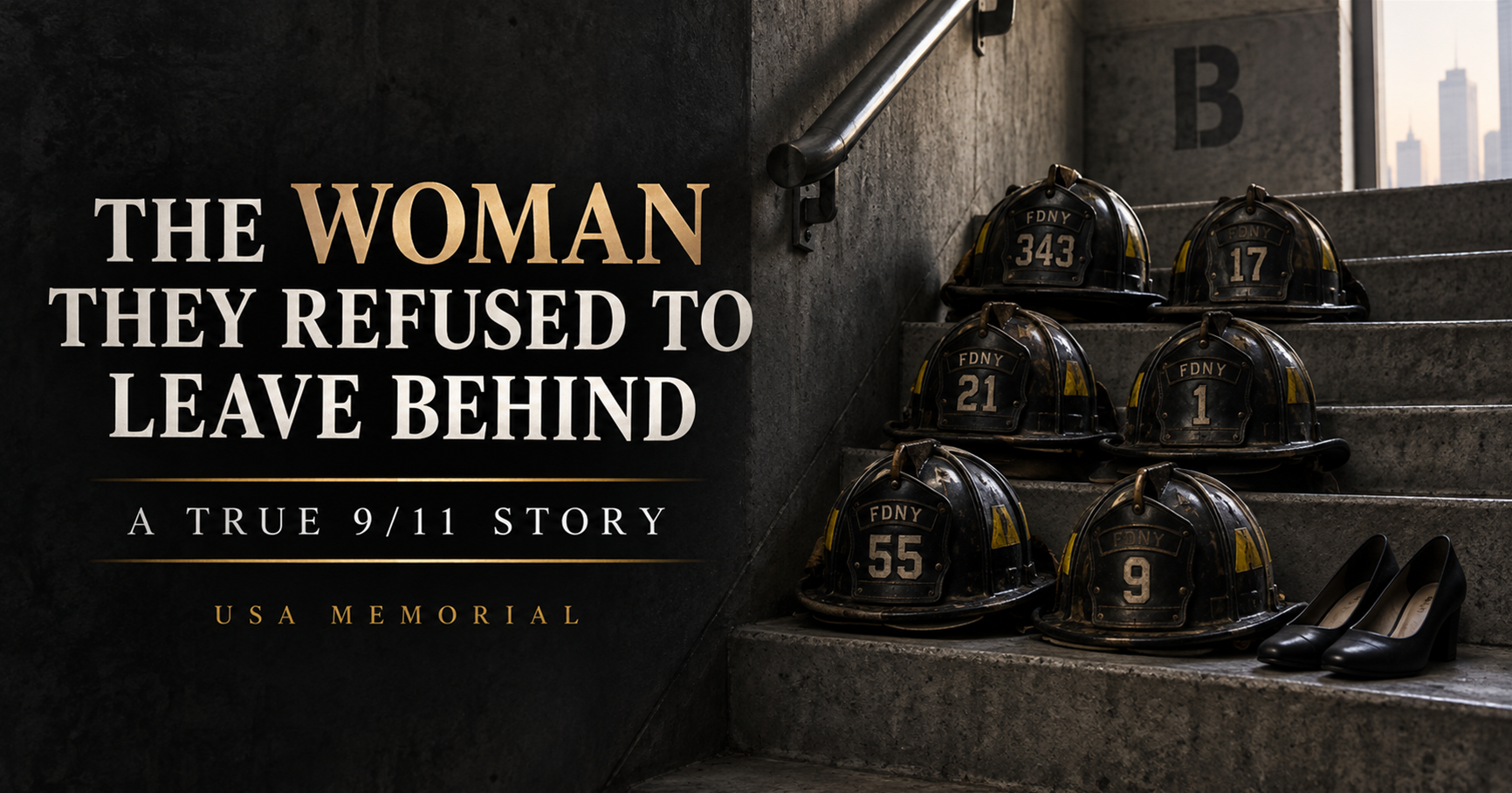
"THE WOMAN THEY REFUSED TO LEAVE BEHIND" Chapter 10
The Slowest Person in the Stairwell
Josephine did not know her difficulty would later be interpreted as part of anyone else’s survival. She was not delaying the firefighters to protect them. She was moving as fast as her body permitted. That difference separates history from mythology and gives her greater dignity: she did not need supernatural knowledge or a hidden purpose to matter.
The firefighters’ choice also requires no promise of reward. If the tower had remained standing long enough for everyone to exit, staying with her would still have been right. If the outcome had been tragic, refusing to abandon her would still have expressed the same principle. Survival made the decision famous; it did not create its moral value.
That is the final circle of the story. A condition that looked like weakness changed the movement of a team. A team that appeared to be rescuing one woman later described her as part of their rescue. And a stairwell designed only as a way through the building became the surviving place that allowed all of them to be found.
Josephine Harris entered the history of September 11 because she could not walk any faster.
That fact can sound cruel when isolated.
Her injured leg made escape harder. It forced her to continue after faster evacuees had passed. It placed her in need of help while a second tower had already collapsed and the North Tower remained unstable.
Then Ladder 6 found her.
The firefighters did not know that Stairwell B would partially survive. They did not know the North Tower had only minutes left. They did not know later documentaries and books would examine their route.
They knew one person was struggling.
So they stayed.
The group descended from approximately the twentieth floor to the lower levels. Port Authority Police Lieutenant David Lim joined them. At 10:28 a.m., the tower came down.
They survived inside the remains of Stairwell B.
The available evidence supports an extraordinary sequence but not a perfect equation. Josephine’s slower pace helped determine the group’s location. The surviving stairwell protected that location. The firefighters later believed helping her may have saved them.
No one can prove the alternate ending.
That uncertainty is not a flaw in the story. It is part of honest history.
The moral decision was clear even when the physical outcome was not.
They refused to make survival a race in which the person with the weakest leg could be discarded.
In many disaster stories, speed is the hero. People run, doors close, vehicles leave, and seconds decide everything. Josephine’s story complicates that pattern. It asks whether a group still belongs together when one person cannot match the urgency around them.
Ladder 6 answered through action.
The answer did not guarantee their lives.
But it meant Josephine did not face the last flights alone.
Afterward, the firefighters called her their guardian angel because the delay appeared to have held them near the place that survived. Josephine did not need the title to make her important. She had already completed a descent from the 73rd floor to the point where they met. She had endured long enough for strangers to become companions.
Stairwell B became the physical evidence.
The surviving firefighters became the witnesses.
Josephine became the person who changed the pace of the group.
Together, they became one of the rare stories of people who lived through the North Tower’s collapse from inside it.
The story does not end by claiming fate arranged every step. It ends with something more useful and more human.
When six firefighters had every reason to hurry, they saw a woman who could not.
They could not know that a building would fall around them.
They could not know which part would remain.
They could only decide whether she still counted as one of the people they were there to protect.
She did.
They matched her pace.
And when the North Tower disappeared, the slowest person in their stairwell was still with them.
Years later, the surviving staircase, the interviews, and the firefighters’ memory all pointed back to the same decision on the twentieth floor.
They had stayed together.
That remains the clearest truth the ruins left behind.
No invention can improve it.
ADVERTISEMENT
You May Also Like
-
CompletedChapter 10

THE MAN NOBODY COULD NAME
Survivors of the South Tower remembered an unidentified young man in a red bandana who found a stairway, helped the injured, and repeatedly returned to the devastated 78th floor. Months later, Alison Crowther recognized the detail that revealed the rescuer as her 24-year-old son, Welles. His story connects eyewitness testimony, a family object, and one of the most enduring acts of civilian heroism from September 11.Stories Behind 9/114.8k words5 33 -
CompletedChapter 10
THE MORNING HE NEVER REACHED THE 105TH FLOOR
Howard Lutnick survived September 11 because he took his oldest son to his first day of kindergarten instead of going to Cantor Fitzgerald’s offices high in the North Tower. The company lost 658 employees, including his brother and best friend. This verified story follows what came next: controversy, a five-year profit pledge, a decade of health coverage, an open door for the children left behind, and an annual charitable tradition built from the firm’s devastating loss.Stories Behind 9/116.8k words5 33 -
CompletedChapter 10
THE GUIDE DOG WHO WENT DOWN 78 FLOORS
Michael Hingson was working on the 78th floor of the North Tower when Flight 11 struck above him. This verified account follows Michael, his guide dog Roselle and colleague David Frank through the stairwell, past firefighters climbing upward, into the street and below ground during the South Tower’s collapse. More than a heroic-dog story, it reveals how a real guide-dog partnership—and several people sharing different kinds of information—survived one of the defining events of September 11.Stories Behind 9/116.9k words5 59 -
CompletedChapter 10
THE CHAIR THAT CAME DOWN 69 FLOORS
When Flight 11 struck the North Tower, Port Authority accountant John Abruzzo could not evacuate by stairs. Ten coworkers placed him in an emergency chair installed after the 1993 bombing and carried him down 69 floors. Their documented escape—and the chair now preserved by the 9/11 Museum—reveals how preparation, disability inclusion, and an extraordinary decision made before the tower fell changed eleven lives.Stories Behind 9/11|Survival7.1k words5 253 -
CompletedChapter 10
The Woman Who Walked Down 87 Floors
The Woman Who Walked Down 87 Floors On the morning of September 11, 2001, Joanne “JoJo” Capestro went to work on the 87th floor of the World Trade Center's North Tower. At 8:46 a.m., everything changed. Joanne escaped by taking the stairs, passing firefighters heading upward as office workers rushed down. One of her coworkers, Harry Ramos, stopped to help a struggling stranger and never made it out. Joanne did. Minutes later, covered in dust after the collapse of the South Tower, she walked through Lower Manhattan and unknowingly crossed paths with photographer Phil Penman. He took her picture. They didn't know each other's names. Fifteen years later, the 9/11 Memorial Museum finally connected the photographer with the woman in his photograph. But their story still wasn't over.Stories Behind 9/1110.2k words5 251