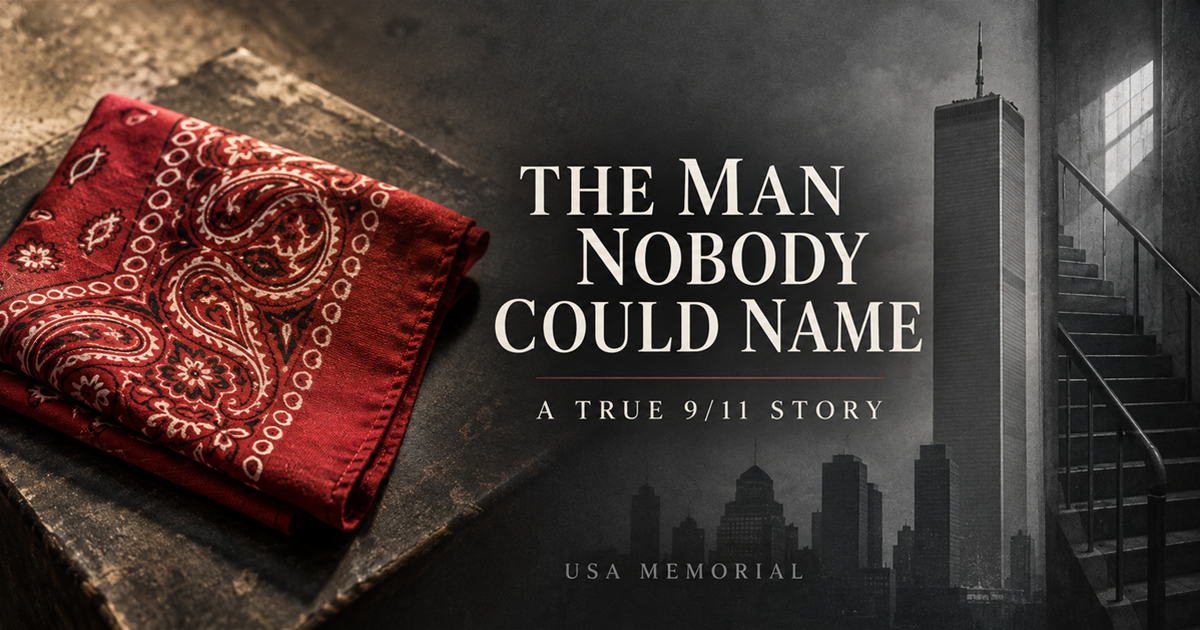
"THE MAN NOBODY COULD NAME" Chapter 10 — The Name Behind the Hero
The most famous image in Welles Crowther’s story does not show the rescue.
No verified photograph captures him carrying an injured survivor across the 78th-floor sky lobby. No camera followed him into Stairway A. No recording documents each return upward.
The rescue survives through testimony.
That makes the red bandana unusually important. It is not merely a visual trademark added by later storytellers. It was the physical detail witnesses used when they did not know the rescuer’s name.
The story begins with anonymity and ends with recognition.
On September 11, survivors knew what the man did but not who he was.
The Crowther family knew who Welles was but not what he had done.
Months later, the red bandana joined those truths.
The object now displayed in the Museum belongs to the family history that made that identification possible. It sits among artifacts that allow visitors to enter an event too large to understand all at once.
For one visitor, the entry point may be a damaged fire truck.
For another, it may be a wallet, a shoe, an identification card, or a piece of steel.
For Welles Crowther, it is a red square of cloth.
His story also changes the meaning of the familiar phrase ordinary person.
Welles was not ordinary in the sense of being unprepared. His volunteer firefighting experience mattered. His athletic background and team instincts may have mattered. His willingness to help was part of a life visible to family and friends before 9/11.
But he was ordinary in one crucial historical sense.
He arrived at work as a civilian.
He had no reason to expect that the morning would demand a decision measured in lives.
When it did, he used what he knew.
The final minutes remain incomplete. Responsible history must leave them incomplete. Welles’s body was recovered near firefighters and emergency personnel in the South Tower lobby area, but the precise details of his last actions are not fully known.
That uncertainty does not diminish the confirmed rescues.
At least ten people escaped after Welles helped them. Other institutional accounts place the possible total higher. The safest number is not the most dramatic one, but the story does not need inflation.
One life would have mattered.
Ten lives are ten continuing worlds.
Today, the name Welles Remy Crowther is inscribed at the Memorial. His bandana is displayed in the Museum. His number appears on uniforms. Runners move through Boston College wearing red. Students hear his mother explain how her family learned what he had done.
The nameless man is nameless no longer.
He was a son who carried a gift from his father.
He was a trader on the 104th floor.
He was a volunteer firefighter when strangers needed one.
And when survivors searched their memories for the person who had shown them the way out, they remembered the one detail that could lead them home to his family.
They remembered red.
ADVERTISEMENT
You May Also Like
-
CompletedChapter 10

THE WOMAN THEY REFUSED TO LEAVE BEHIND
Josephine Harris was descending from the 73rd floor of the North Tower when an injured leg slowed her. Six firefighters from Ladder Company 6 refused to leave her and matched her pace toward the lower floors. When the tower collapsed around them, a surviving section of Stairwell B turned their decision into one of September 11’s most extraordinary—and most carefully misunderstood—survival stories.Stories Behind 9/116.8k words5 31 -
CompletedChapter 10
THE MORNING HE NEVER REACHED THE 105TH FLOOR
Howard Lutnick survived September 11 because he took his oldest son to his first day of kindergarten instead of going to Cantor Fitzgerald’s offices high in the North Tower. The company lost 658 employees, including his brother and best friend. This verified story follows what came next: controversy, a five-year profit pledge, a decade of health coverage, an open door for the children left behind, and an annual charitable tradition built from the firm’s devastating loss.Stories Behind 9/116.8k words5 33 -
CompletedChapter 10
THE GUIDE DOG WHO WENT DOWN 78 FLOORS
Michael Hingson was working on the 78th floor of the North Tower when Flight 11 struck above him. This verified account follows Michael, his guide dog Roselle and colleague David Frank through the stairwell, past firefighters climbing upward, into the street and below ground during the South Tower’s collapse. More than a heroic-dog story, it reveals how a real guide-dog partnership—and several people sharing different kinds of information—survived one of the defining events of September 11.Stories Behind 9/116.9k words5 59 -
CompletedChapter 10
THE CHAIR THAT CAME DOWN 69 FLOORS
When Flight 11 struck the North Tower, Port Authority accountant John Abruzzo could not evacuate by stairs. Ten coworkers placed him in an emergency chair installed after the 1993 bombing and carried him down 69 floors. Their documented escape—and the chair now preserved by the 9/11 Museum—reveals how preparation, disability inclusion, and an extraordinary decision made before the tower fell changed eleven lives.Stories Behind 9/11|Survival7.1k words5 253 -
CompletedChapter 10
The Woman Who Walked Down 87 Floors
The Woman Who Walked Down 87 Floors On the morning of September 11, 2001, Joanne “JoJo” Capestro went to work on the 87th floor of the World Trade Center's North Tower. At 8:46 a.m., everything changed. Joanne escaped by taking the stairs, passing firefighters heading upward as office workers rushed down. One of her coworkers, Harry Ramos, stopped to help a struggling stranger and never made it out. Joanne did. Minutes later, covered in dust after the collapse of the South Tower, she walked through Lower Manhattan and unknowingly crossed paths with photographer Phil Penman. He took her picture. They didn't know each other's names. Fifteen years later, the 9/11 Memorial Museum finally connected the photographer with the woman in his photograph. But their story still wasn't over.Stories Behind 9/1110.2k words5 251